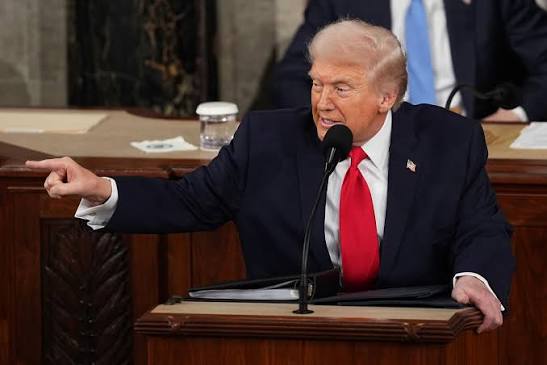
As the President meandered his way through another reality-distorting speech this past Tuesday (State of the Union), many renewed their wonderment as to just how far America’s strayed from its original intention. This July 4th will mark the 250th anniversary of the Declaration of Independence, which sought to remove the nation from the clutches of a monarchy and now more than ever, it feels like this same nation is careening towards a form of authoritarianism that would have its founders shook.
Where George Washington, no. 1, set precedence in choosing to not seek a third term, Trump, no. 45 and 47, has made passing reference on many occasions, including in this speech (“the first year of my second term, should be third term”) to staying on. Where others have shown restraint and considered economic and international co-operation, Trump has gone full Rambo with illegal tariffs (Supreme Court’s opinion, not mine). Where others were humbled by the office, Trump has made it a means to satisfy his cult of personality and for personal enrichment. Some might characterise these as dictator-like behaviours. Some. So how did we get here and (how) can we restore a semblance of order?
Well, the how we got here is fascinating but an odyssey in itself. To keep a long story short, we got here through a mix of complacency in our comfort, reasonable distrust in the traditional politics, economic mishaps, and the corrosion of decency in our culture. Trump has played his cards well with the media by turning the exhaustion of the outrage industry inwards, so that everything becomes washed and askew; just another controversy, par for the course. Truth be told, a lot of Americans sometimes genuinely feel a dictator is a price worth paying, in the face of economic uncertainty, congressional inaction, and a transforming world. (100 years ago this played out in a couple of other countries and while I wouldn’t want to make any dumb equivalencies here, I think it’s fair to say hard times can result in desperate measures and seemingly strong leadership rhetoric.)
Trump’s been emboldened too by the securing of a second term. It’s legitimised his claims, even if the people don’t necessarily agree with or prioritise his policies. From 2017 to 2021, he made great attempts at some of these but was largely blocked due to the novelty of his extremity and divided houses. This time around, he has a majority (albeit slim) and a pandemic/inflation-weary public. January 6th, 2021 and the denial of the previous year’s electoral results were a sign of dictatorial candour to come, of which the first year’s (of his second reign) actions has been complimentary, particularly with regards the tariffs. To quote himself, “[the only thing that can stop me] is my own morality… my own mind.” So that’s the mindset we’re dealing with here.
As aforementioned, the current president and the first differ in some fundamental respects, with regards power and their view of the office. The abuse of power has been questioned in between these periods of time however. Trump’s tenure will eventually end but will order be restored to the position thereafter? Will there be new legislation or re-enforcement of old legislation to define boundaries again? Take the course of American history from the 1930s to the 1960s, which saw this power increase as a result of swift action being necessitated in the context of the Great Depression, World War II, and Cold War. Following the unpopularity of the Vietnam War and the (let’s call them) challenges of the Nixon administration, concerns were addressed via the War Powers Resolution of 1973, Freedom of Information Act, and Congressional Budget Act of 1974. For a time, authority trended towards the House and Senate.
To be fair, it was never a smooth journey arguments can be made against Reagan, Bush, and Clinton for their foreign interventions (something Washington was against). Certainly too, America took a turn in the post 9/11 climate with the declaration of war against Iraq. There was something different in so far as these presidents were acting in accordance with controversial, if still backed ideas however. Trump, quite openly, acts of his own accord. So while foreign action is nothing new (if still something a president shouldn’t technically be in control of), the course he’s taken with disregarding national unity and a stable national government, shows just how far we’ve strayed from the first president’s conception of this role.
In the 1790s, Washington was revered to the point that many would have happily accepted him as a king. The two-term limit wasn’t formally established till after Franklin D. Roosevelt’s tenure but in stepping down before he had to, the first president set an example for the spirit of American democracy. Context changes, of course, but principles should not. Trump’s reach, particularly due to his cult of personality, may extend beyond his administrative role but I foresee a time that follows shortly thereafter when this role could be further checked on, as in the 1970s. It seems, as history is destined to repeat itself (if not echo), that we must be reminded, every now and again, why there is a system of checks and balances. In other words, democracy cannot be taken for granted.
President and King
 The Washington Walrus