With the primaries upon us, it has become clear from the Democratic side of the aisle that there is a wanton desire for a return to liberal principles. Over the last year, America has seen its Right Wing degenerate and fragment causing the GOP to slip into a whirling vortex of misdirected criticism and slanderous obfuscated falderal. Meanwhile, the Left Wing has begun to reassert itself through the battle-hardened Obama administration and the populist no-nonsense principles of Bernie Sanders.
For a society that has entrenched itself so much in the conservative camp, can we really point to these broad instances as a signal for the future however? It’s never been an unpopular notion that America should reconstitute itself as a society in which anything is possible if you dream big and work hard. Indeed, it is almost a century ago that William Tyler Page addressed Congress and presented them with ‘The American Creed’ in which he echoed the steadfast sentiments that the government of the people, by the people, and for the people, should fulfill its duty to be an example of democracy by upholding its core principles. This historic clarion call is perhaps more important now in 2016, than any other time so far in this twenty-first century as the middle-class have been thrust centre stage. For the first time in decades, citizens are beginning to realise just what it takes to satisfy Page’s salvo. Here is a brief overview of how it happened:
1980: The Turning Point
The 1970s were not an easy decade for America. The failed war in Vietnam disenfranchised a great portion of the population, Nixon’s scandals threw the very office of the Presidency into disrepute and then where Ford appeared to be bumbling, Carter appeared uninspiring, telling the American people that they too needed to change their ways – as if. So by 1980, one could have easily argued that America was going through its “crisis of confidence” when even the President couldn’t rely on the support of his base, challenged by Ted Kennedy. On the Right meanwhile, Republicans turned to a man who exuded supreme certitude through mellifluous pros and striking countenance, Ronald Reagan. A former dough-eyed follower of Goldwater, Reagan projected a vision for conservatism that ebbed and flowed with the 1980s.
A New Right
And so a new right was born, not a stoic one of socially progressive values akin to the administration of Eisenhower, but rather one of a hawkish ultra-conservative philosophy. So, what happened to the Democrats? Well, to meet their advisories in the middle, instead of moving in their own direction, they too followed the populist tides of conservatism. The result? The ‘Left Wing’ party by the 1990s, were a very different outfit to the one that had existed in the 70s. America now had a centrist right wing party, and an out and out right wing party.
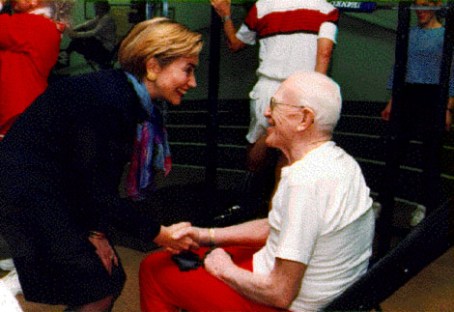
On one contentious issue, this analysis proves incredibly fruitful: health care. Whereas in the 1960s and 1970s, when cooperation between both sides of the aisle was not unusual, that just wouldn’t be the case in successive decades. In 1993 for example, America witnessed the Clinton’s health care plan struck down with fiery vengeance, in a move Hilary herself, and Ira C. Magaziner, a family friend, would view as an indication of lost time, lost opportunities and lost confidence. Bob Dole meanwhile had his own ideas on tackling this issue, attempting to dissuade democrats from going “too far”, yet yielding no positive results. So, with much discourse but little action, by the time the Affordable Health Care Act came through in 2009, there was a bitter taste left in the mouths’ of many Americans – no single payer system, meant the faceless corporations had won again and Wall Street could breathe a collective sigh of gluttonous relief. Though now, it seems as if all of this could change drastically, depending on who wins the presidential race later this year.
The Tipping Point
Obama, by this point, has achieved a great deal, yet for the most part his administration has had to adjust and then readjust focus on a number of occasions as he had battled with an incredibly partisan House and Senate. The Republicans have characterised this as ineptitude on his part rather successfully, leading to a reversal in fortunes with successive mid-term elections. In 2015, however, Obama began an unyielding assertion to reclaim the presidency. With health care presently safe from repeal, he moved on to improving relations with North Korea and Cuba, and spectacularly endorsed the Supreme Court decision to legislate for gay marriage.
The Republicans watched on dumbfounded and awestruck. With ambivalence festering and ideological fissures emerging, Donald Trump, and his hairspray- rife golden mane began to make a complete mockery of the Ring Wing of American politics, traducing anyone who crossed his path on his way to the top of many polls. Meanwhile on the Left, Bernie Sanders also shocked the nation, but in a wholly different, more organic way. He shot from 7% in the Democratic polls in May 2015, up to 28% by the end of August, and onto 37% by January. Armed with a sabre of progressive socialism and an escutcheon of resilient liberalism, the 74-year-old senatorial warrior, proved he was no joke.

Last year cannot simply be pointed to as the one in which all of this change occurred however. Indeed, one could argue that it will take many years to gain perspective on whether or not its events were substantially important. It is nonetheless clear though that the cracks that had been growing on the Left and Right, have become more severe on the campaign trail. Trump and other Republicans still attain a great deal of support, but even to their most calculated minds it is clear that their party will have to change. On the Left meanwhile, people are rallying around the call for greater coverage in health care, lower college fees, more accountability in gun control, and equal pay for women and minorities. Whether Sanders gets the nomination or not, his presence has been felt significantly. The ramifications are such that even Hilary Clinton is calling for free community colleges whilst Obama boldly sets off to do battle with the NRA and tackle global warming.
Conclusions…
Yes, this is a broad theory, and yes, many vociferous pundits could suggest that America is arguably more conservative than ever right now. Even Obama alluded to elements of this claim in his State of Union address this year, as he spoke proudly of the superiority of United States military. Yet, in the pantheon of the election, there is no equivocation that liberal principles are having a profound impact once again.
Could this be the beginning of a domestic shift back to the Left after so many years of rightward positioning? Or is America baring witness to a transient movement that will inevitably crumble under the resolute will of hawkish conservatives? As George H. W. Bush was fond of saying, “time will tell,” but it’s a sorry state of affairs that the bullheaded contingent of the present day GOP are blind to the fact that the tenets of their policies are so right wing that by now, I’m sure President Reagan’s corpse is slowly turning as if on a rotisserie spit.
Andrew Carolan & Matthew O’Brien