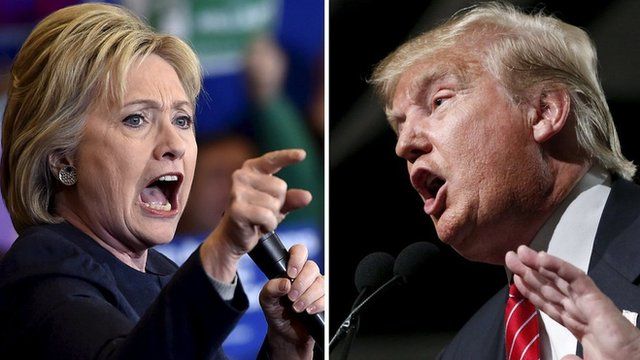
Tonight, while you’re fast asleep in your bed with subconscious rumblings of the dreaded Monday morning work alarm, Hillary Clinton and Donald Trump dual once again, this time at Washington University in St. Louis, Missouri. The general consensus among most lucid pundits in the wake of the first debate was that Clinton managed to sink her teeth into a drowning Trump and came out on top – there is billionaire blood in the water.
Their first war of words coaxed a record audience of 84 million, which surpassed the 81 million that had watched Reagan battle Carter in 1980. While two weeks ago, the candidates faced each other in a traditional format, tonight’s platform offers up something wholly more tantalising and engaging, a town hall styled debate. For those of you not familiar with the Town Hall format, candidates must field questions from not only the moderators but also the audience in what is usually a partisan setting. Que drama, consternation, chaos, and plenty of uncomfortable dry sniffing…
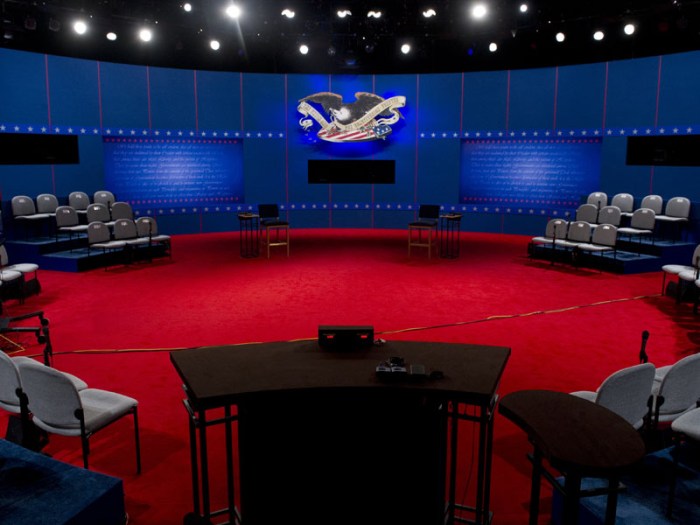
This was the Town Hall set up when Mitt Romney faced off against Barack Obama in 2012 at Hofstra University – the venue of the first debate between Clinton and Trump
This year, however, with thanks to a civic group named the Open Debate Coalition, questions submitted via an online portal have been permitted. These questions have been whittled down to the thirty most popular and will feature in tonight’s debate marking the first time this variation has been used in the history of the Presidential debate. The task of meriting a question’s popularity falls to co-anchors CNN and ABC so expect a very slight left of field filter.
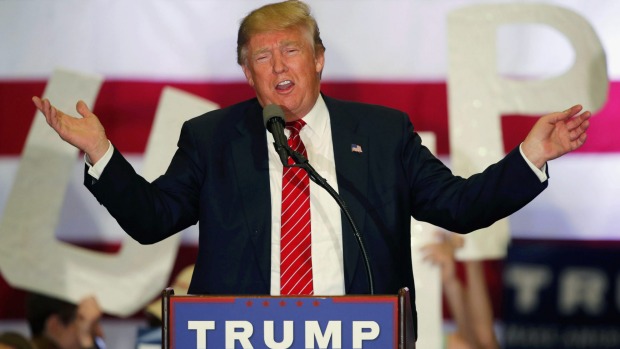
If we look at both candidates’ strengths in terms of how they react and respond to the environments they occupy, it becomes glaringly obvious that Clinton prefers smaller, more intimate settings – much like her husband (not in that way). Trump, on the other hand, thrives on addressing his dirigible, ire bloated, cadre in prodigious arenas and gargantuan sporting centres – reflecting his bumptious gestalt.
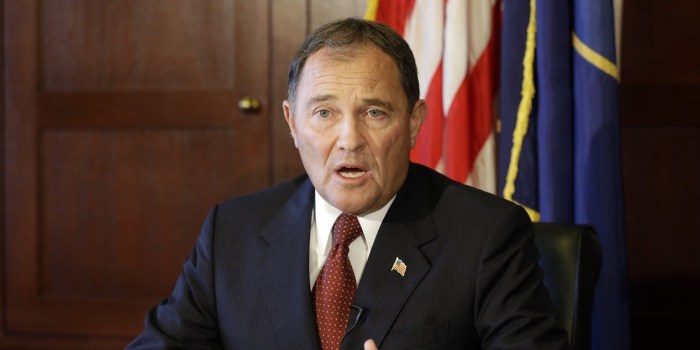
Trump’s gauche behaviour cannot now be un-coupled from his publicly enshrined lewd internal monologues that reaffirm his capricious, deleterious true nature. One can only guess how much practice that he has put into his latest debate strategy – if you can call it that. In light of recent events, the GOP are attempting to collectively pressure Trump. Many Republicans who had previously endorsed Trump have pulled their support. In Utah, for example, Governor Gary Herbert, and Rep. Jason Chaffetz have stated that they can no longer support their nominee, while others such as Sen. Mike Lee and Rep. Chris Stewart have called for Trump to drop out of the race altogether.
Utah Gov. Gary Herbert has pulled his support of Donald Trump this week amidst mounting GOP pressure following the nominee’s perverse audio leak from 2005
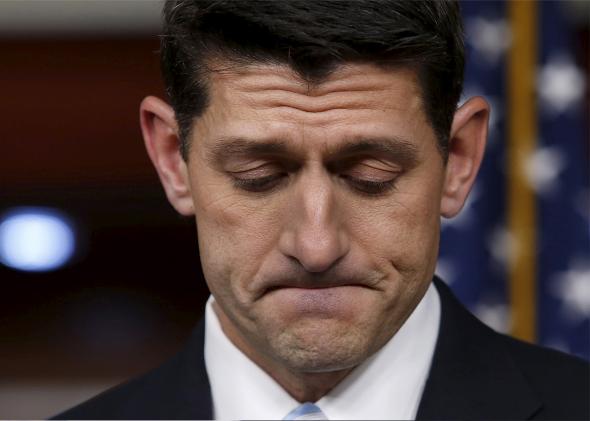
The derision within the GOP is absolutely anticipated. How many more times can Speaker of the House, Paul Ryan, appear before the cameras with the same hollowed out response to the party’s miscreant nominee? It’s a worn out scenario and clearly one that has left many Republicans notably frustrated.
Trump has responded by lambasting the party through his bully-pulpit, Twitter, and at the same time he has been praising his devout supporters who appear to be sticking by him no matter what.
The toxic rhetoric that has propagated the 2016 election thus far will once again come to a head this evening. While the debate may not be as substantive as many would like, one thing will be both incredibly interesting and entertaining: just how will Donald Trump engage with the average American citizen. If we return to the 1992 Presidential debate that featured incumbent George H. W. Bush, Bill Clinton, and Ross Perot, viewers witnessed a masterclass in how to relate to common concerns while appearing professional, intelligible, attentive, and dare I say it, presidential. Bush seemed uninterested and irritable at times, and Perot, well lets face it, he just seemed happy to be there. Check out Bill’s cool performance below.
While Hillary Clinton can appear robotic and cold, she has one quality that Trump doesn’t possess in his political arsenal, empathy (feigned or not, he is a terrible actor). Shane Ross, the current Minister of Transport once referred to Taoiseach Enda Kenny as a political corpse – if Trump doesn’t have a strong showing this evening, he is likely to be atrophied by the Republican Party.
On Monday, the 26th September, Clinton and Trump will engage in the first of three national televised presidential debates. Anyone who caught the back-and-forth between Trump and Jeb or Trump and Cruz or Trump and Rubio during the Republican primaries will understand just how pivotal these forums can be. Simple gaffes can destroy a candidate’s legitimacy. Poor phrasing can undermine a crucial point they want to convey. Even the wrong body language can result in severe repercussions. So what should Clinton and Trump take note of? We here at the Walrus thought it would be worth taking a trip down memory lane.
Kennedy vs. Nixon (1960)
This race heralded the first national televised debate, as the young and charismatic John F. Kennedy squared off against the raging jowls of Richard M. Nixon. Whilst many Americans, listening to the debate on their radios, felt that the Vice-President succeeded in offering a better vision for America, the television viewers felt differently. A wearisome, sick Nixon simply came off as less confident and able on the black-and-white screen. Kennedy, on the other hand, understood this medium in the way FDR understood how the radio could be used to communicate. He spoke clearly and held himself firmly- a man who was comfortable with nothing to hide.
Trump, of course, is no stranger to the televised medium and despite his outlandish hairdo, comes across as quite a unique and exciting figure to beheld. Hillary however, whilst experienced, often appears stiff and calculated, like she’s reading from a prompter.
Ford vs. Carter (1976)
Jerry Ford was one of the most affable presidents America ever had. He didn’t boast the sharpest of wits however, as evident in one of his and Carter’s national televised debates, when he stated that “there is no Soviet domination of Eastern Europe.” Carter wryly smiled whilst the stunned moderator, Max Frankel, responded, “I’m sorry. What?…” This performance only served to reflect and reaffirm the credibility of Chevy Chase’s SNL Ford; a bumbling, awkward man barely getting on by in the job. It may have been a just a little slip, but it cost Ford dearly in the media and public’s perception of him. Trump, in particular, should take note here. He may have gotten away with his random gesticulations in the primaries but Clinton, unlike most the GOP, is hawkish and ready to pounce on any little mis-step.
Carter vs. Reagan/ Mondale vs. Reagan (1980 and 1984)
Ronald Reagan was hardly the smartest of US presidents either but he was a great communicator. He had a way of brushing off criticism and making his opponents feel a bit overbearing. Against Carter, we saw this when he said “there you go again,” in response to a criticism the President made about Reagan’s stance on a past healthcare bill. Against Mondale, we saw this when he quipped “I will not make age an an issue of this campaign. I am not going to exploit, for political purposes, my opponent’s youth and inexperience.” In that brilliant soundbite, he not only pushed aside any genuine concerns about his age, but also posed a good counterpoint and reinforced his likability as a humorous man. So if Hillary could crack a few more lines like “you heard none of this at the Republican convention and Trump went on for 70-odd minutes- and they were odd,” that would be just dandy. This kind of reflex is perfect for the Youtube generation.
Bush I vs. Clinton vs. Perot (1992)
Don’t look at your watch! The Commander-in-Chief George HW Bush made this fatal error in a three-way debate against Slick Willy and a more credulous billionaire than Trump. While Bush may have had pressing matters on his hands, this quick, likely subconscious act, reflected the media’s perception of him as a man both out-of-touch with/ not interested in the common man. Bill, in contrast, not only didn’t get distracted, he stood up and walked out from the center of the stage to make eye contact with the people asking questions. He is of course, in a league of his own, but it’s worth noting nonetheless that you must always respect the time given for these debates, even if they are repetitive and pointless.
Gore vs. Bush II (2000)
To borrow a term from W’s lexicon, Al Gore misunderestimated his opponent. Whilst the second Bush was clearly nowhere near as clever as the Vice-President, he did manage to come across to a great many people as a likable and relatable individual. Gore tried to pounce on his basic understanding of the issues with a multitude of condescending mannerisms. At one point, he walked over to Bush as if to confront him man-to-man on a question he felt he gave the better answer to. At another point, he loudly sighed. It’s not exactly fair but the public do like an underdog and in this case, they gave Bush II enough wriggle room for the contentious count-up that followed. In this year’s case, it may be tempting for Hillary to act this exact same way, but there is a line between humouring your base and offending the other. Reagan understood this; Gore didn’t.
And so Clinton and Trump should now be well prepared for September 26th if they have read this. Naturally we have only scratched the surface but it is clear from these cases that a winning personality and sharp wit does the job best. Hillary has the latter and to some- let’s call them progressively challenged people- Trump boasts the former. We may be given stiff, unintelligible, and ambiguous answers next week but one thing’s for sure, the entertainment factor will be huuuuuge.
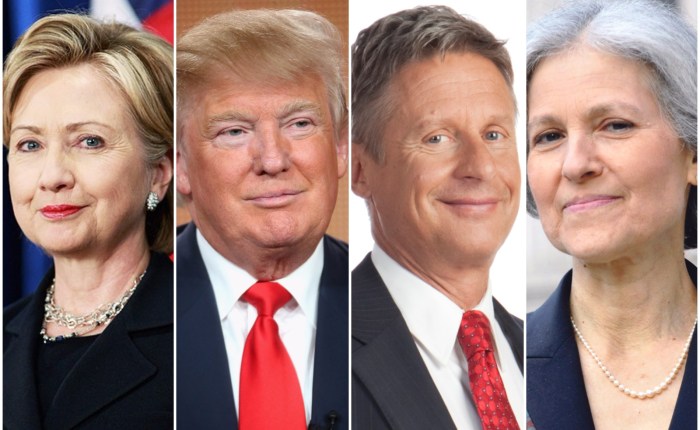
In recent weeks, Green Party candidate Jill Stein and Libertarian, Gary Johnson, have been making the rounds in the media, hoping to draw up the support of the loose stragglers of the Bernie camp, among other disenfranchised souls weary of the Donald and HRC. Chasing that elusive 15% (required to enter the national debates) has so far proved a challenge however, with current polling placing Johnson just under the 10% bracket and Stein at a mere 3%. Is it that these candidates are lackluster? Do they simply lack the magnitude bestowed upon others by the mainstream media? Or is it that old adage at play that affirms a vote cast for an independent is a vote thrown in the garbage? As always, it’s a bit of everything but history, once again, speaks loudest.
Despite the occasional disruption, America, for the most part of its recent history (20th Century), has championed a two-party system. This has developed as a result of natural inclination and artificial structures placed on its political thresholds. With regards to the former point, these two parties have essentially been afforded the right to prosper, owing to conditional and enterprise funding over the years as well as historical gravitas. The party of FDR, for instance, is an institution in itself and tradition, while valued, is often upheld merely for the sake of its own legacy. With the moral decay of the GOP and its hopeful actual decay in the future, one would think a third-party could possibly build itself on the crumbling mounds of another, but a three- or four-way battle is rarely as marketable for the media and public. In America, commercial tendencies encroach on all avenues of life.
See? Even the RNC had its own ridiculous ad!
In relation to these artificial constructs then, we must remind ourselves of the unfortunate nature of America’s election cycle and government. They do not facilitate a parliamentary-like system, the way ourselves or the UK do. With most of their votes, plurality laws eliminate the point of acknowledging where the minority votes lie- even if that is a very slight minority. Basically, winner-takes-all. This, of course, simplifies the already tedious process of the election cycle but it also obfuscates the diverse range of public opinion. Even with many of the latter Republican primaries for example, this applied so that Donald Trump, though opponent-less later on, would be the unrelenting winner. (Surpassing 50% isn’t even mandatory for this reasoning.) This hardly seems necessary for establishing the preferred candidate, when everything is only officially tallied up at the conventions. Math is not the GOP’s forte however. With single-district representation and plurality at play, the scientific study of Duverger’s law has found that such countries will thus be more likely to develop a two-party system.
Theoretically speaking then, a third-party candidate’s ascension to the White House is notimpossible. The climb however is steeper than the one even Bernie had to climb (he was after all, an independent who adopted the Democratic Party to his advantage.) Huge wads of cash won’t do it alone; even with his popular inclusion in the televised debates, Ross Perot wasn’t able to budge a single electoral vote in either the 1992 or 1996 elections. Framing yourself as a genuine alternative may prove appealing to some but as Ralph Nader’s candidacy proved in 2000, without enough steam, you can cause significant damage by taking votes that would have been cast for another candidate. (This humorously led to Bill Maher and Michael Moore begging him not to run in 2004.) In fact, the last actual candidate of a third-party persuasion to make any notable stride was George Wallace in 1968, who took 46/538 electoral votes. And who was the most successful third-party candidate of all time? Well, they fared a great deal better in the 1800s when the two-party system was still in development but the answer is Theodore Roosevelt from 1912, who for obvious reasons, was an exception.
Maher and Moore- liberal mavericks
With Trump and Clinton being the two least popular candidates in decades however, is it not plausible that 2016 could do another flip and present the so-called impossible alternative? Logically speaking, this is a sound theory but as aforementioned, the 15% is still out of reach and the first debate is coming up at the end of this month. After that point, if not already so, most people will have decided if they’re wearing blue or red this November. If a third color is to succeed in breaking this fashion trend (which I do not mean literally, I intend to wear an array of clothes), then it will be because of a strong mass organisation which eschews the notion that a third-party vote is a wasted one. Any other kind of philosophy will continue to hold back the prospect of a third-party president ever existing.
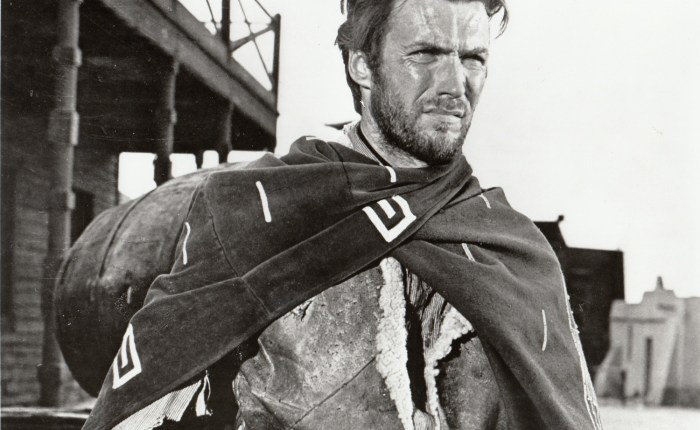
Last week, Hollywood legend and sharp-jowled libertarian, Clint Eastwood sparked outrage for his professed support of Trump over Clinton, amongst other seemingly outdated notions. To keep it brief, he opined that just because Trump’s speeches caused offence, did not mean he was racist; rather that reaction reflected the values of a “pussy” generation, one built on overtly sensitised political correctness. This kind of “talk” (from Trump’s ever flabbergasted face) was not considered “racist” when Eastwood was young. So what has changed? The very discourse and face of civil rights, replied a host of people on Twitter and Facebook. Not a bad point at all, I must admit, but this particular confrontation interested me for the subject matter involved. Let’s face it, Trump could be (could) right on one thing; maybe we do have a big problem with political correctness. Let’s examine this, in light of this controversy.
When the Donald delivered his rousing question mark of a speech announcing his candidacy over a year ago, the internet went abuzz with rage over his remarks regarding Mexicans. Were they stupid? Undoubtedly, Trump displayed (and has since) a poor and dangerous attitude towards immigration; an attitude which, if given credence, could not only sever international relations but also disenfranchise the millions of people who still see America as that beacon upon a hill. Were they racist? There’s a lot of evidence to suggest Trump may be a class-A bigot and indeed his banning policy is a prime Hitlaresque example of discrimination but for the sake of discussion here; not inherently so. It is racist to condemn a race of people because of what they look like and for merely being different. It isn’t necessarily when you criticise their country’s policy or culture, among other facets, given ample reason. Caution, of course, must be advised because no nation of people should ever be identified with a single brush stroke, but when issues such as immigration can’t even be tackled for fear of backlash, a problem arises. For one, you limit the intellectual scope of debate. And for another, you hamper free speech.
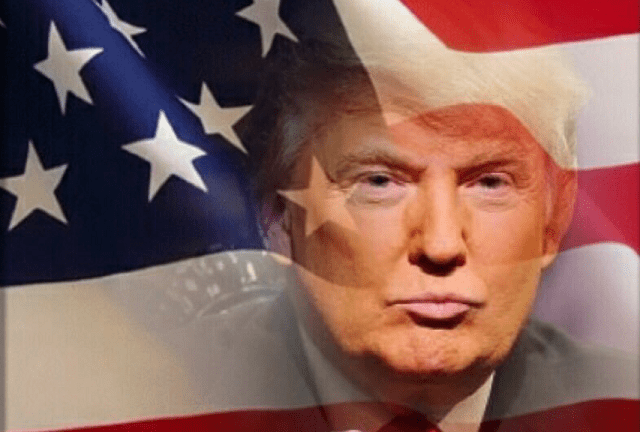
It’s genuinely hard to get a good photo of Donald Trump.
Years ago, many hoped the internet and social media thereafter would break down social barriers and allow people of all creeds, colours, and religion to speak their mind, unburdened by censorship. These barriers have undoubtedly weakened but in their place, liberal constructs have sprung from those so sensitised to controversial opinions. We see this on a moronic level now. Last week, Eastwood wasn’t the only one grabbing headlines. An online petition too, was making the rounds, for the proposed closure of Rotten Tomatoes; a film review aggregate which collected an array of unfavourable opinions on David Ayer’s Suicide Squad. If people can’t even withstand a negative review of a film (and believe me it isn’t great), then what hope have we when it comes to topics which matter and should be discussed in an open forum; rape, religion, and emigration? As Mick Hume stated in his polemic Trigger Warnings, “[words] can hurt but they are not a physical weapon… Free speech is more important than hurt feelings.”
Now back to Trump. Do I agree with anything he’s said? Only perhaps with political correctness being a problem and that America’s infrastructure is crumbling. (The latter I can’t comment on in great detail however.) Overall, I think most people can succinctly point out though, without further reading, that Trump speaks with emotion and not logic, which undermines any gravity his claims may otherwise hold. The controversial subjects he brings to the table should be allowed to remain there however for the sake of free speech. If we disagree and find his comments repulsive, then why not point this out in an intellectually engaging manner? Like a debate, for example. Knee-jerk outrage only serves to energise his uruk-hai like supporters, which brings us neatly back to the generational divide old man Eastwood felt last week.
A Trump supporter at last month’s RNC.
Culturally, America is being pulled in two directions. The liberals, I believe, are beginning to win this tug of war, even if it’s not politically evident. In recent years, social media and television shows such as Glee have been a great platform for the likes of the LGBT community. Where the race issue was once believed to be a shadow of its former pre-eminent self too, it is now at the top of our newsfeed, because of increased pressure from a generation with a growing voice. Most of us would likely agree that this is a good change of direction. On the other hand, many people in America feel betrayed by the direction their country is heading in. They’re tired of not being able to say what they want to and how they want to with regards to the hot issues, mentioned overhead. Is it not reasonable to say in this PC climate, that many feel suffocated? It’s not only with self-identified conservatives either.
Comedians like Jerry Seinfeld and Bill Maher have criticised this aspect of modern culture. The former, amongst others such as Jeff Ross, no longer frequents colleges because students often come across as too uptight. Bill Maher felt the backlash more forthrightly in late 2014, when students of Berkeley protested his address, due to his outspoken criticism of the Islamic religion. In another era, you would have thought Saddam Hussein was coming to flog his best moments’ memoir. Even opposing Katie Hopkins’ visit in this vein is pathetic (though that may simply have been for the quality of guest). Again it is worth repeating, if you have a genuine difference of thought it is worth taking that person head on with questions. If people had done that more calmly with Trump, then maybe he wouldn’t have been able to use increased media frenzy to push his way up the polls. Sensationalism sells, but it’s not always a dignified trade.
From the “Modern Day Seinfeld” Twitter page. A good one to follow.
It is now 67 years since George Orwell’s classic 1984 was released and the Thought Police are becoming an all too eerie reality. In colleges, the very places which should stand as bastions of free speech and open mind, offensive opinions are being rejected without reflection. Whereas we have become a more inclusive society, we have also become one in some respects, that is tolerant of absolutely everything but intolerance. As Mick Hume asks, “[once} you make free speech a privilege and not a right, who are you going to trust to make the decision about where draw that line through free speech?” Eastwood may have the wrong idea about Trump but he’s got a reasonable measure of where American society’s headed, if only having lived so long. Political correctness, for all its good intentions therein, is not always the correct way to tackle the seemingly racist, bigoted, or plain mean.
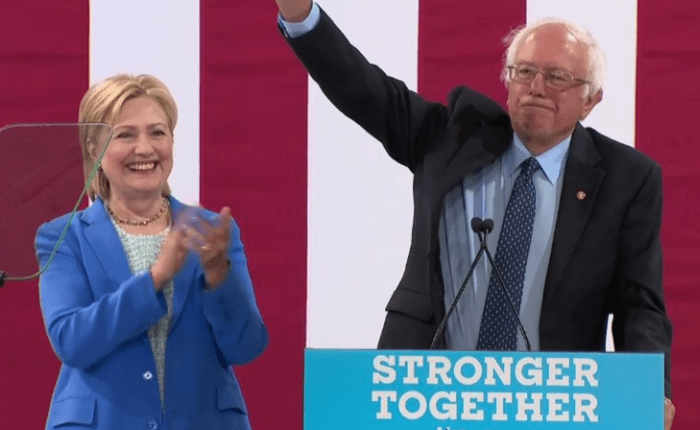
Last week marked the unofficial end of the rivalry between Hillary Rodham Clinton and that ever cantankerous Senator Sanders. In a speech delivered before the people of New Hampshire, who voted in his favour, he addressed the question of his movement’s future and where his loyalty lay. I watched this as it streamed live on Facebook, torn between the body language of the two figures at the podium and the incoming flood of knee-jerk reactions from half-wits and the odd informed. Many complimented this change in tone; it had after all been a long and arduous primary season. Others lamented however Bernie’s decision to stand by the Devil and surrender everything he had ever stood for. And that’s where we stop because (and I’ll put this plainly), Bernie didn’t sell out. Here’s why:
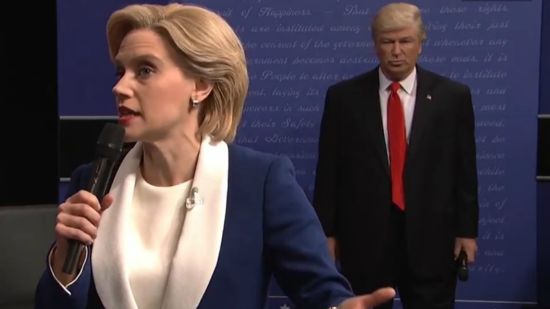
He won on the issues- if you listened to Clinton’s speech, which directly followed Sanders’ endorsement, you will have noticed how clever SNL were with their skit on Clinton becoming more and more Sanders’ like (to the point where Kate McKinnon ended up with a bald cap). At first, I gave her the benefit of the doubt on the assumption that she just isn’t as conservative as the uber-liberals have suggested. When it came to Wall Street however and her bargaining plea to overturn Citizen’s United, it became clear that she was taking note of the issues that prevailed in the debates, brought about because of Sanders’ longstanding rhetoric. She delved into college fees and global warming too, which made for a nice combination, leading me to believe that she has moved far more to the left than even the most hawkish of critics could have guessed.
It’s not just about the Presidency- Sanders’ movement and the rise of the Left cannot solely rely on an office tampered with more than ever. It needs to endure beyond one or two terms into a progressive model by which the future of the Democratic Party can be shaped. Yes, Hillary has, in many senses, won the battle but the future could be Sanders, so long as the issues on which he based his candidacy, continue to resonate. As mentioned above, I think they already have to the point that Hillary can’t afford to ignore them. As well as that however, he can also serve as a highly influential figure outside of the White House. Who, for example, had more of an effect on American culture in the 1960s than Martin Luther King? Has Jimmy Carter not accomplished some of his best work out of office? The presidency is a convenient altar, through which many channels, from foreign aid to educational reform, can be distributed but as Bill Clinton himself has noted, it’s also prey to circumstances beyond a president’s control (e.g. 9/11).
Trump must be defeated- I’ll admit that this is not my favourite argument as I do not believe elections should be contested on the basis of fighting against, rather than for something. It is an important one though and whether it depresses you or not, voting for the lesser of two so-called evils is still worthwhile. Bernie’s candidacy, has gone as far it needs to, in my opinion. With the Democratic National Convention coming up, it has become clear that his issues and supporters will not simply be sidelined but incorporated into the party’s agenda for the coming years. For now, he needs to ensure, if his own visions are to be realised though, that this party does as well as it can come November. Otherwise, the country will head in the exact opposite direction with Trump.
Listen to the speech again- Sanders didn’t have to necessarily endorse Clinton but it was the responsible thing to do; what purpose would their rivalry have served after all? Not enough to sway you? Listen to the speech again then and tell me where exactly he abandons the principles on which he built his campaign? Still not enough? Take a trip through his YouTube interviews and go back to a year ago when he expressed his admiration for Hillary Clinton whilst acknowledging their differences of opinions. Granted, the race heated up and nostrils flared during the primary season but the gulf in rhetoric that existed between their camps, was never as deep as many of Sanders’ less reasonable supporters suggested. He fought a good battle and we can only admire him for what he did but that battle is over now and at some point, you have to concede and look to the positives.
It’s undoubtedly sad to see Bernie leave the race; he shook things up and set the country’s vision towards a better tomorrow, in a manner we just couldn’t have expected over a year ago with the “inevitable” Clinton candidacy. His role however in this race will at least go down in the history books and his role to come will remain that of an inspiring spokesman for a disenfranchised generation.
The United States has something important to learn in the wake of Brexit; protest votes are not only petty, they’re extremely dangerous and stupid too. In this election year, we have been bombarded with multiple pieces on public frustration with establishment politics. As much as we are seeing an intelligent dialogue developing in this context however, we are also witnessing with a great many others, the collapse of a logical framework for debate. Too many people are now voting with knee jerk reactions; against rather than for something. The political game can’t be played like customer service though. Protest votes yield actual results.
On June 23, the British people voted narrowly to leave the EU. Across social media and the web, the reaction was one of shock, even amongst many who voted in this favour. And then came “Bregret”- the pun on a word already being played with, as up to 7% Leave voters began to profess their vote was only cast in the belief that Britain would inevitably remain, or as some form of quasi-protest against some half-formed ideal they didn’t even understand. This became evident immediately in the wake of the votes, as top Google searches ranged from questions concerning what Britain’s role in the EU is to what indeed this “European Union” is. And we thought America was hogging all the stupidity this year…
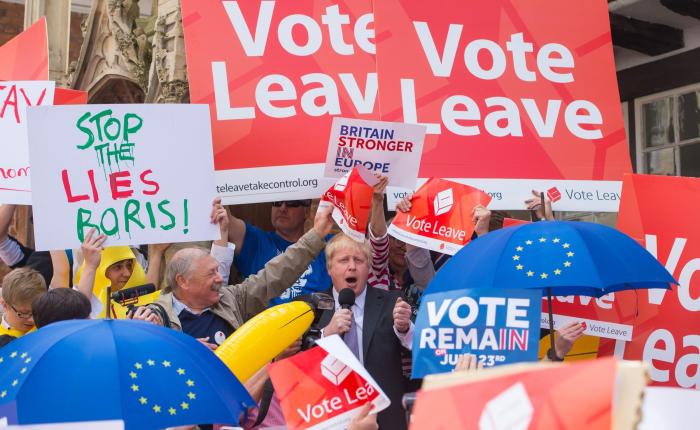
The campaigns in Britain were of course controversial and already we are beginning to see how weak the structures on which Nigel Farage and Boris Johnson built their case were. Interestingly, national identity and immigration were key issues, especially amongst older voters who by large voted to leave the institution that had been irking them since 1973. The question has loomed for many years as to whether Great Britain is losing its Britishness. In America too, this question has come to the forefront with Trump’s campaign. Many of his voters, the so-called “silent majority,” white middle-class feel that they are not being catered for in the way they used to be. After all, look at how much hip hop music is on the radio these days. It’s threatening, quite frankly.
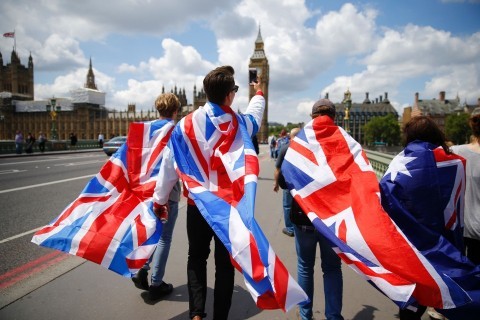
Holding onto their Britishness no matter what…
Political correctness is another factor, in tandem with this, which boils the blood of many. Where actual issues arise with immigration, many liberals disavow the very notion of discussion on this area with labels of bigotry being thrown around at the clinking of a tea-cup. Trump, for all his bullishness and disregard, comes across as genuine and honest, in contrast to the political suits of past times. When he speaks about Mexicans, he’s speaking from the heart. Granted, that’s not a heart I’m sure exists, but he’s speaking from whatever’s there nonetheless. People appreciate this. They want a politician who speaks like your drunken grandfather on a night out. So when people complain about how they’re losing their political identity, it’s not a far stretch to attribute it to many of the left-leaning commentators who put a binding on the language book many years ago.
Whilst I am clearly not a fan of political correctness, I do appreciate where people are coming from. There are problems with the EU and America. There are problems with immigration. National identity and culture should be appreciated. With all these cases however, common sense must then prevail however. For example, you may not have agreed with David Cameron on many domestic or foreign issues, but his Remain stance, was no just cause for joining the anti-establishment. You may feel America is being pushed around with immigration, but does this justify the extremist measures of a man whose policy is based on a Wikipedia entry? Establishment politics can prove frustrating but overhaul and revolutions are only required where all other means are exhausted. Trump may appear to many the underdog saviour who will restore American prestige at rallies, but sit down again and read the transcript of what he says, then think. If the Google searches come November concern the costs of a border wall, then standardised testing should be needed to secure the right to vote.
As Philadelphia prepares to host throngs of Democratic Party delegates for the upcoming Democratic National Convention next month, authorities are gearing up for the inevitable ‘Bernie or Bust’ protestors. This wildly loyal cadre of Sanders’ supporters, most of whom are Independents young and old, are eager to voice their displeasure with the internal processes of the Democratic Party, and their vehement dissatisfaction with the manner in which this primary season has been managed.
Yet, there is always a hope and purpose that through the carnival-esque mechanisms of the convention process, the nominee will emerge and successfully unite the party behind their banner. This incredibly tough challenge falls not only to the presumptive nominee, Hilary Clinton, but also to the yolk of the Democratic Party and those pious super delegates. However, the outcome of disunity and a growing chasm of indifference is often the result. Will it be the same this time?
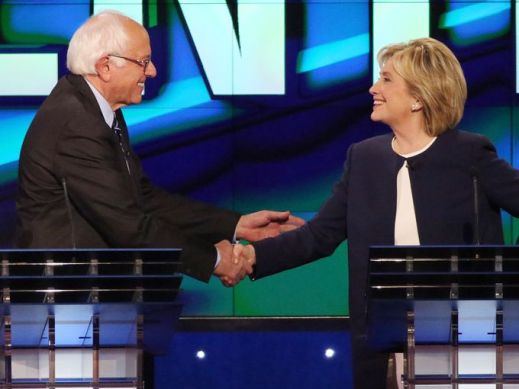
Sanders said that he will vote for Clinton in November to stop Trump
In short, no! Yesterday, Bernie Sanders stated that he will vote for Hilary Clinton in November in order to stop the meretricious master of tautology, Trump. Though Sanders’ concession to Clinton is long overdue, one cannot help but get the feeling that the political revolution at the foundation of his incredibly successful campaign will endure in some form.
For Sanders and his millions of dedicated supporters who continue to feel the ‘Bern,’ a revision (and in some cases overhaul) of Democratic electoral processes and procedures is desideratum. Following a meeting of the two Democratic primary candidates this week in Washington DC, the task fell to Hilary Clinton to placate the Sanders’ campaign in the interest of uniting the party and securing a larger voter base this coming Autumn. Both campaigns issued similar statements in the wake of the meeting saying that the candidates and their aids spoke constructively about beating their opponent and ‘progressive ideas.’
It is no surprise that the Vermont senator has called for the ousting of leadership from the convention committee all the way to the upper echelons of the party. He has been especially critical of DNC Chair, Debbie Wasserman Schultz. The Floridian Representative, Schultz, was this week replaced by Brandon Davies – a Clinton surrogate. This move likely came as a conciliatory tactic by camp Clinton following comments made by Sanders’ campaign manager, Jeff Weaver, on MSNBC. These overtures were clearly an attempt to placate Sanders’ stoic efforts. Caveat Emptor!
Hordes of Sanders’ supporters hungry for political revolution and reform
In a Washington Post article that Sanders composed this past Thursday, the obstinate senator laid out his 95 theses that, should we be living in the 1500s, he would nail to the doors of both the Wells Fargo Center and the Pennsylvania Convention Center. Sanders consistently and emotively repeats the question, ‘what do we want?’ at the beginning of each new point – appealing to the union and solidarity of his support base. Scansion aside, there is nothing new from Bernie here, yet he makes some incredibly salient points about the flawed criminal justice system and climate change.
If Bernie Sanders can auspiciously carry his brand of revolutionary politics to the convention floor and begin a comprehensive dialogue in a public forum the mollification process may continue. Among the alterations that the senator is lobbying for is the abolition of closed primaries, automatic voter registration, and the monitoring of voting machine software.
Sanders needs to show the Democratic Party that he still holds some of the chips, but will have to temper his approach if he is to garner any substantive gains. On the flip side, Clinton and the Democratic establishment know that the Sanders’ promissory note is a valuable asset and have slowly come around to his $15 an hour minimum wage, ban on fracking, and Wall Street reform. Though, according to a Bloomberg poll published on Wednesday, only 55 percent of Sanders’ supporters said that they would vote for Clinton – proving that the ball is now firmly in the establishment’s court.
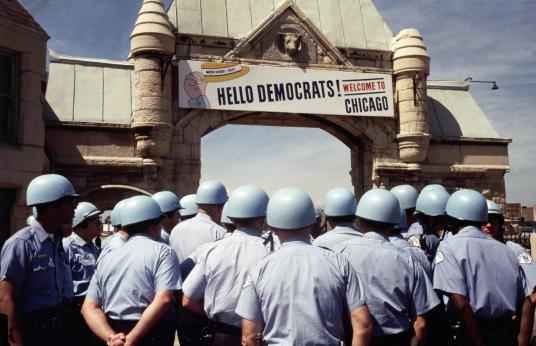
The National Guard were heavily utilised at the DNC in Chicago, 1968
For Democrats, the malaise of the 1968 DNC held in Chicago haunts the party to this very day, as it became a lacerating event that distilled a year of heartbreak, assassinations, riots and a breakdown in law and order. For many American’s, it symbolised the fragility and chaos of the nation. The present environment is equally as delicate and anarchic loaded with pernicious potential. While the issue of unity within the Democratic camp is tenuous, it’s not nearly as tensile as the threads holding the Republican Party together.
The piñata that is the Republican Party has been burst open and every day, new morsels are being discovered by the media. Last Friday, we heard that Mayor Danny Jones of Charleston, West Virginia, had changed his political party status to “unaffiliated” in a growing list of disillusioned conservative officials. That same week, several major companies including Apple pulled their sponsorship from the Republican National Convention. And to cap it all off? The man, the Republican loyalists stood behind (if reluctantly), has lost his momentum.
For a year now, the accepted narrative has been that Trump stands no chance against Clinton. Despite mass coverage and the GOP nomination, many remained undeterred. It seems their faith has been rewarded however as his latest hurdle has resulted in a parting of ways with his campaign manager, Emperor Palpatine… I mean, Corey Lewandowski. The poll numbers are no longer looking so good for the man who once promised “so much winning” for America and in the wake of this great cataclysm of popularity, lies the remains of the fractured right-wing. So what happened? Why? And what’s next?
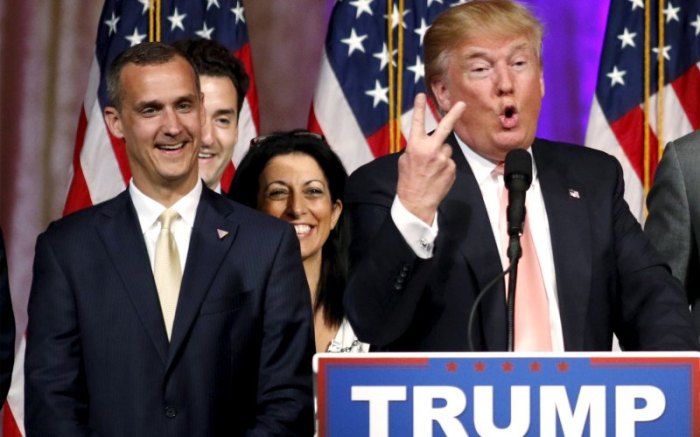
Trump and Lewandowski (left) kicking up a storm.
Since the shining light of Reagan descended upon America, the GOP has adopted an increasingly conservative and radical stance in the political system. This culminated most recently in the refusal to work with the Obama administration on almost every initiative, leading to a Government shutdown on Obamacare. With the culture wars wagging their tails every now and again, the great beliefs of the usually strongly united right became that America was losing its identity. Even the vaguest idea of making it “great” again was so appealing that a man like Trump, strange though he may seem, at least had to be considered. And in their desperation for this fabled era of prosperity, the fractures which set a part fiscal conservatives, social conservatives, tea-party members and cowboys, widened so much so that the GOP abandoned whatever shred of dignity they still held.
Since securing the nomination, a tenuous effort has been made to cobble this mess back together and create something sufficient, lest the Wicked Witch of New York, gain power. The problem is however that it all seems so forced. Even Speaker of the House, Paul Ryan, a man who should really have a pivotal role to play in this, has a hard time vocalising just what he wants. He think Trump is a racist and bigot and should not be encouraged by any means. He also believes Hillary is not the “answer” and therefore Trump must win. His role however, he asserts, is not to tell delegates what to do. It’s the kind of stuff you could imagine seeing on Saturday Night Live but alas, Ryan is presently a tortured soul. It therefore seems the pieces will have to be picked up by Trump himself, who will undoubtedly face the least reserved GOP convention in history next month.
Paul Ryan’s the kind of guy who holds up the drive through with his indecisiveness.
It’s hard to imagine exactly where this party will go next. They could simply reform if Trump loses, pretend as if 2016 never happened and go after Hillary, the way they have done with Obama. After all, remembering things accurately has never been a top priority (remember, Reagan raising taxes, anyone?). They could also have a long look in the mirror, smash it, and treat the likes of Trump as icons of a prevailing radical right, in stark contrast to the rising Left. Lastly, they could not smash the mirror and realise their party can only redeem itself by returning to the principles which once held it in high esteem. Fiscal conservatism, a lower-taxed market, and small government are not necessarily bad ideas if executed with a degree of rationale. They just need to be checked with compromise where compromise is needed and common sense where alternatives yield better results. Richard Nixon understood this when he proposed an ambitious health care plan, alienating himself from many members of his party. George H.W. Bush, too, understood this when he abandoned his pledge and raised taxes to help stimulate the economy. Perhaps, 2016 can mark the beginning of the end for modern conservative practises and a return to form.
Is Hillary still a woman? No, I don’t mean in the old hick “look out, she’s going into the wrong bathroom” kind of way, but rather in the context of this entertaining election. As the primaries draw to a close and Donald Trump begins to scour Facebook for any trace of a scandal linked to the Clinton camp, it can’t helped but be wondered whether the question of gender politics is playing the pivotal role it once did in America. At first, I simply thought “no.” Whereas in 2008, the prospect of a first Black or first Female president was so alluring, today it seems like more of a tangent to a larger debate. Upon inspection and analysis of this race, the political commentary and debate however, the question opened up a great deal. So whilst this main point will be addressed further, it’s certainly worth exploring the recent history of women in politics before the related question of why people dislike this woman/politician so much.
Thatchers in America
It’s still difficult to be anything but stern and tough if you want to be a respected female politician in many countries. In the 1980s, many figured this philosophy with the draconian measures of Ms. Thatcher (depending on your viewpoint) and while there’s been progress since then, the gameplay isn’t exactly equivocal between men and women. This might, in some respects, justify the pompous, disingenuous image Clinton has cultivated over the years – a means to survival. It may also just be a theory. In the debate on gender politics and feminism, there can be a lot of conjecture on hand.
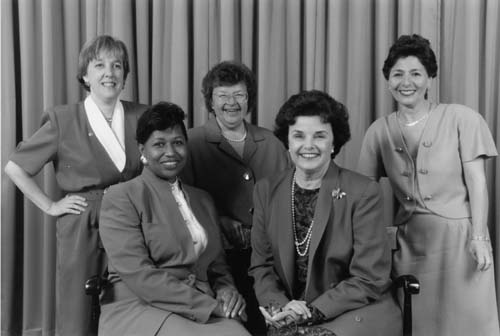
Women, of course, have not been fairly represented in US political history. They were only given the vote in 1920. They only saw their first elected Senate representative in 1932 with Hattie Caraway and since then there have only been a further 45 women anointed to that chamber of Congress (and through staggered junctions). In fact, even as recently as 1992, the ‘year of the woman’ (because a staggering five female senators got the job-and all from one party), that divide was evident.
1992: Year of the Woman- the same year Bill Clinton was elected to office.
In terms of the presidency then, one can imagine there’s been far less representation. As of 2016, seventeen women have managed recognisable attempts for the coveted position (going by popular vote accounts) and two of them are Hillary Clinton for 2008 and this year (the rest would be relatively unknown to most.)
There are now 20 women in the Senate and Hillary is the likely frontrunner for the Democratic Party. In the 1950s, less than half the US population would have voted for a female presidential candidate. Today, over eighty percent would. Whether this politically correct culture has had an affect on how people present their views is also worth considering but for the most part, through all the folds and exceptions, there has been progress.
Haters Gonna Hate, Hate, Hate…
Taylor Swift has a knack for melody but it’s not enough to just say “haters are going to hate.” That’s moronic. People do strongly dislike Hillary though and some of their reasons may be unjustified. For example, in March, the Ms. Magazine blog posted an article on three ways “to tell if your distaste for Hillary Clinton is sexist.” These included a) taking umbrage with the problems of the Clinton years but liking old Slick Willy, b) deciding you hate her first then collecting substantive reasons, and c) holding things against her for which you have forgiven others. Aversive sexism is undoubtedly an issue in modern society and a genuine concern could be that people will preach one thing and act on another (reverting to conservative instincts in the polling booth) by giving Trump the thumbs up. Likewise however, the Guardian also found that many women consider Trump just “creepy.” That said, he has referred to menstruation as being the cause for Megyn Kelly’s “outrageous” questions so it’s hardly balanced.
One of the most useful platforms for finding the unedited, unreasoned thoughts of the public is of course the YouTube comments’ section. I took to this to see if there was some element of truth to the idea of averse hate (even if not sexist). Among misspelled links to bands’ channels and escalating arguments, I found a lot of this, e.g. “I hate that smirk she has every time she finishes a sentence.” Compared to many Fox hosts’ smirks, Clinton’s is far from the worse though I found the majority of discouragement of her to be associated with policy and general dislike, rather than sexism. Granted, most of the commenters appeared to be young men but a lot of anonymous people speak in ways they never would in person.
That smirk from an ABC interview- granted she will have to do something about her laugh.
Many people recognise the fear of being labelled sexist too. Just as these YouTube commenters resolve to knock down Clinton, many of her supporters in return react with unqualified claims of bigotry- the PC police. Articles such as the Huffington Post’s “I Despise Hillary Clinton, And It Has Nothing To Do With Her Gender” convey this level of heightened social awareness. Other articles have attempted in the meantime to contextualise and separate this issue altogether. For example, a New York Magazine opinion piece earlier this year stated; “[there} is no Big Feminism anymore, and no agreed upon figureheads – at least no one to rival Steinem’s fame and iconic status. Today feminism is more about personal identity.” That’s not unreasonable. Many liberals despise Clinton for only her stances, as evidenced by their love of Senator Elizabeth Warren.
So what are these stances? What are her flaws? This hardly needs to be touched upon in detail, considering the feed of commenters out there but for the most part, Clinton’s detractors find her politically motivated and malleable to trends. Her once against-now for stance on Gay Marriage, comes to mind, as one instance of this. Her own compromised marriage too, is drawn upon by many as an exemplification of the calculated moves she has taken this far. Then, there’s the series of scandals that have dogged her career from Whitewater to her Iraq vote, Benghazi, the e-mail scandal and whatever’s next. Against Sanders, these shortcomings have been especially magnified which lends credence to the argument that Clinton’s detractors have just cause for their outrage.
For us, it’s just another manic Monday. For Hillary, another Benghazi.
As It Is – This Election
Leaving aside the historical context of female political leadership and Clinton’s own facets however, how has the gender card been played out in this election specifically? Naturally, Trump has fudged up his alliance with any suffragette movement by acting the classic 80s’ masochist douche, leaving Clinton with a hefty advantage in that vote. While younger women (18 to 29) have generally preferred Sanders, this margin has played out in her favour for the most part with 70% women’s support in the Mississippi primary, 63% in Alabama’s and 42% in Texas’. Sanders too, that beacon of dignity, even came under fire from her camp when in response to asserting that “shouting” wouldn’t do anything about America’s gun problem, Clinton replied that it’s never “shouting” when it’s a man. Ouch. Was there justification for this or could it be argued that Clinton was playing the gender card herself? “If [she] were a man, I don’t think she’d get 5% of the vote” opined Trump in April for the Washington Post. Well, that is Trump but many might yet agree.
As it is, the poll data is showing that there is no state where women don’t make up 54% of Democratic voters. The gender card, in this sense, is a crucial one which can’t be ignored, even if its utility is immoral. When it comes to the general election then, assuming Clinton’s candidacy (based on today’s results), it is likely that Trump will need a different strategy (given the percentage of population he’s alienating). That said, one of Clinton’s greatest flaws (regardless of any gender politics) has been in her underestimation of the electorate. Sanders already proved her victory was not secure when one year ago her success was inevitable. Female voters too, though faced with the alternative of Trump, will not vote for Hillary just because she is a woman. Years ago, many would have assailed against the notion of a female president. Today though, they also assail against Hillary Clinton.
Since he announced his candidacy one year ago, Donald Trump has been drawing consistent headlines for his outlandish remarks, wildfire debate performances, and of course, the odd lapse in logic. It seems by this point that there is no way he can truly surprise us but just like Game of Thrones, he manages to reel you in every week to see if that threat beyond the wall is indeed serious or just a way to waste some time. And guess what? We are only a month and a half off from the Republican National Convention in Cleveland, Ohio where he’ll presumably hold his hand up with another’s and bark sentiments of making America great again. So who’s hand will it be? Will it be a hook?
First, let’s consider the factors that go into choosing a running mate. In 1960, JFK chose LBJ to compensate for his lack of support in the South. Obama got Biden on board so that he could add experience to his cabinet’s credentials. Similar concerns will no doubt be dogging the otherwise muddled minds of Trump’s camp. As it is, he’s doing well across the country with many speculative polls tying him with Clinton but women and Hispanics aren’t flocking to his side. Having some insiders would also be a good measure as his business acumen will not compensate for political naivety. So without further ado, let’s take a look at a cluster of depressing possibilities.
Chris Christie
The New Jersey governor was one of the first Republican candidates to sell his soul to the Devil. We all remember that moment in March when he stood behind the Donald at a rally, conveying all the confidence of a Cosby apologist. Despite this, his loyalty has been noted by the Republican candidate in several interviews.
Newt Gingrich
You may remember him as the crazed Speaker of the House from the mid 1990s but did you know Newt attempted a Presidential bid in 2012? He has ambitions still. As a stalwart of the GOP, Gingrich could help Trump solidify the party’s base, although that may not prove an issue considering how easy it’s been for him already in building that momentum.
Ben Carson
The former neurosurgeon and bat-shit crazy candidate was at one point last year, the gravest threat to Donald’s victory. He’s another person Trump has said he “respects” and his help could sway those easily fooled by the race card. And in terms of image too, he projects a level of calmness lacking from the frothing jowls of Trump.
Sarah Palin
It was the death nail for McCain eight years ago but it says a lot about America that the wacky Sarah Palin still has a part to play in the party that pretty much disowned her a couple years ago. Some folk have speculated that Trump has just given up courting the female vote but if he has a woman as his running mate, he can’t be sexist, right? Sneaky stuff, Don but this would definitely be the worst bet.
Joni Ernst
Another female Republican but one who has been critical of Trump’s sexist comments, many feel Ernst could be the perfect counterweight to Trump. She’s an able communicator and can help Trump with the Midwestern vote. She’s a bit less colourful of course than the others though which may not go down well with the man who paints himself orange.
Ted Cruz
Cruz’ exit surprised me somewhat considering the fact that he himself had chosen a running mate in Carly Fiorina just before. Trump has repeatedly called Cruz a slime-ball and launched personal attacks, even against his wife. The senator’s exit may have been a calculated move for a greater cause however. This would seem a hypocritical move but many pundits are nonetheless intrigued as Cruz has a large following. After all, they don’t have to like each other (JFK and LBJ certainly didn’t).
A Member of his Family
This seems like a ridiculous prospect but not an unpopular one. Ivanka, in particular, seems to be drawing a lot of attention. They’ve had gainful employment in his business ventures so clearly he has no qualms with nepotism.
A Mountain Bear?
Why not? It’s not as if making sense is high on Trump’s agenda. The mountain bear, or any bear in fact, would sure up the support of those who enjoyed either this year’s The Revenant or The Jungle Book. They also convey a level of toughness that even Putin would flinch at.
Nothing is of course yet finalised though we expect to hear an announcement in the coming weeks as Donald continues to rail assaults against Hillary and that wild husband of hers. Whoever he picks, it can be assured that there will be a lot of “winning.”