Ten Years On: An Inconvenient Truth Remains

Ten Years On: An Inconvenient Truth Remains

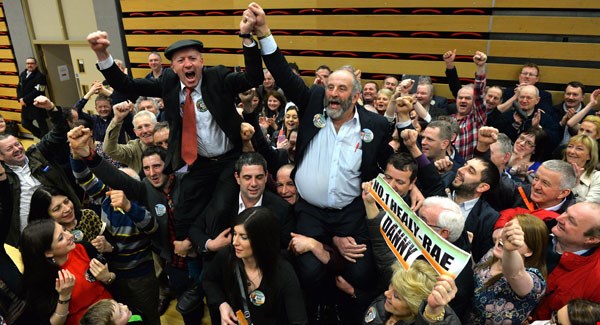
It seems America is not the only nation that can boast its share of Climate Change denying morons. Last week, most of you will have heard Independent TD Danny Healy-Rae’s bamboozling testimony on the case of Global Warming. You will be glad to hear that there’s nothing we have to do anymore to save this world because God, of course, controls the weather. How could we have been so foolish? As much as the voters of Kerry should feel ashamed of themselves for having enabled this crackpot’s rise to power, we should remind ourselves first that these ludicrous distinctions hold a great weight and advantage in the arena of politics. Let our focus now turn back to America; where the stakes are considerably higher.

HealyRaebrothersGE_large
Healy-Rae’s election should also prove the point that just because they’re not in a party does not mean they’re smart.


It is now ten years since Al Gore’s groundbreaking documentary, An Incovenient Truth, was released and as Bill Maher put it recently, we are perhaps in need of that sequel, An Inconvenient Truth 2: What The Fuck Is The Matter With You People? Out of the three candidates remaining in the 2016 election, one of them firmly believes that Global Warming is a hoax. Can you guess who? The trouble is that such views create a dialogue, in tangent to the more crucial debates we should be having, in which areas to build turbines and on what level our investment for renewable energy should be, i.e. the specifics. The question still remains as to whether we can really trust the 99% of scientists who believe in the accelerated rise of global temperatures or to what degree  human influence has been felt. And the Republicans who begrudgingly accept this theory (that is essentially consensus) have simply adopted the defeatist viewpoint that ‘well… it’s too late, innit?’ For many it seems this reality is too daunting. They’d rather bury their heads in the sand.  Well that reality is upon us already; California is drying up, the Great Lakes of the US-Canadian border have reached record lows, and worst of all, the melting of Arctic ice has caused our beloved walruses to seek salvation off the coast of Alaska- where Sarah Palin lives!

walrus-sea-ice_jpg_650x0_q70_crop-smart
We here at the Washington Walrus are fond of these guys. For those of you who aren’t, polar bears and fish will also be gravely affected.


To be fair there’s been some progress. President Mic-Drop, for example  stood against the Keystone Pipeline and last year’s Clean Power Plan called for 30% more energy renewal generation by 2030 with a 32% reduction in carbon dioxide emissions from 2005 levels. Economically, this makes sense too in that renewable energy will be the future. Obama’s plan is still not good enough though, considering scientific projections. A lot can happen in 14 years too: we may yet see President Yeezus and the great Kardashian Deficit of 2022; we will certainly hear about more politicians putting big money ahead of the environment; and naturally (with a pinch of irony) a barge load more of pollutants and fossil fuels will be ejected into the atmosphere. So just as President Kennedy ambitiously called for man to walk on the moon before his decade was out, why shouldn’t Obama or the next president switch that 30% to 50% and begin to prioritise the foremost issue of our day; the one which should dominate this election cycle because it the one which cannot wait.

Al Gore said ten years ago: “Each one of us is a cause of global warming, but each one of us can make choices to change that with the things we buy, the electricity we use, the cars we drive; we can make choices to bring our individual carbon emissions to zero. The solutions are in our hands, we just have to have the determination to make it happen. We have everything that we need to reduce carbon emissions, everything but political will. But in America, the will to act is a renewable resource.” Since that great renegade Carter before him was thrown out of office for tearing up the flag with his “Energy Programme,” America has fallen back on its worst habits of greed and self-consumption. Sacrifice is not a word anyone likes to hear but the eleventh hour has by this point surely been reached. So whilst we must never pay respect the likes of Healy-Rae, we must accept that their assertions are crucial in the greater scheme of things.

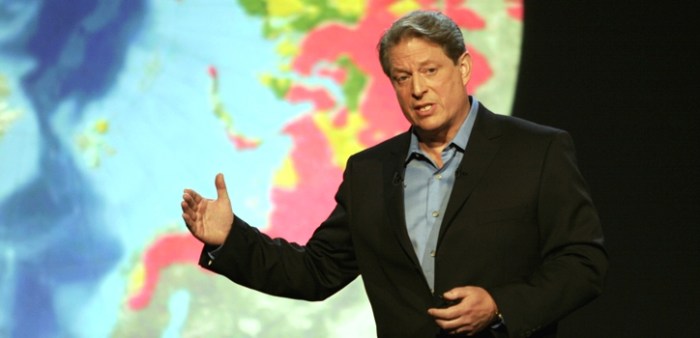
inconvenient-truth-abc-of-solar-mbqfda8oym2nfdi9k0j74v70rxq4sxc5an94kr4dyk
Al Gore in 2006- forever standing by his slide shows.


Andrew Carolan

Superdelegates: Another Obstacle Towards Democracy?

Superdelegates: Another Obstacle Towards Democracy?

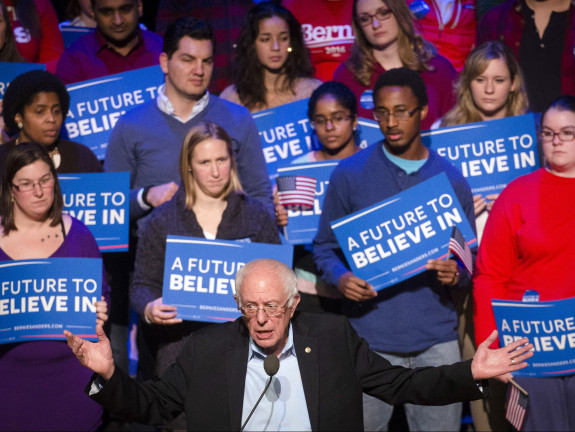
If there’s a central theme to the 2016 election, it is outrage against Washington. Whether it’s with the Panama Papers or Campaign Financing, the majority of Americans feel great frustration with an establishment that seems bent on obstructing any meaningful change. The superdelegate system, in this regard, may be seen as just another obstacle in the path of democracy; with its concern rising higher on the agenda as the clash between Sanders and Clinton sparks towards New York. Others however, would argue its significance remains as crucial today as did back in the 1980s when it was conceived for the consolidation of the Democratic Party.

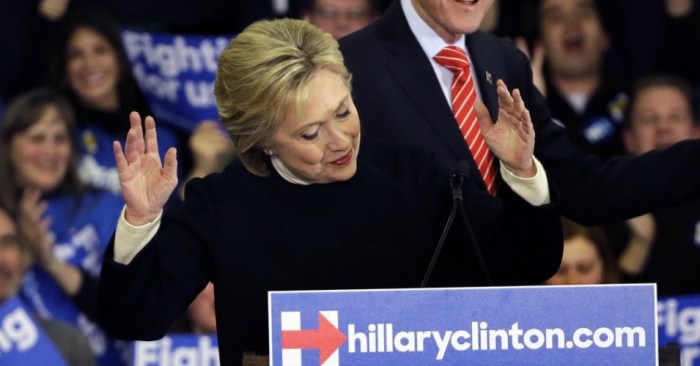
clinton_hands_nh
Hillary has the backing of the party’s elites. She even has a former President at her side.

There are 718 superdelegates involved in this year’s DNC. They are essentially unelected delegates, comprised of party leaders, governors, congressmen, and DNC members, who are free to cast their vote of their own volition this July in Philadelphia at the convention. Presently, their pledges therefore don’t count for anything but political pundits and avid supporters are nevertheless paying attention to the 472 pledged to Clinton, 32 to Sanders, and 207 uncommitted. It’s important in that these so-called pledges hold influence over some voters (who may be unwilling to support a ruffian like Sanders) and in that they have been toted up irresponsibly by many as assumed votes already, thus giving the impression that Sanders’ campaign is beyond hope.


The system came about as a result of disappointing election results for the Democrats. As Jim Hunt, the 1982 Chairman of the Democratic Party Commission explained eight years ago in a Washington Post piece, 1972 saw a Democratic Party ‘out of step with mainstream Democratic leaders.’ George McGovern, the nominee that year, lost a devastating defeat to Richard Nixon. Four years later, Carter prevailed but his Presidency and defeat in 1980 proved that it wasn’t even ‘enough just to win;’ clarity and cooperation between all branches of the party was needed. It was a means by which the party’s greater interests could be accounted for with 1984 seeing its first contenders rise to the fore. They exist ‘really to make sure that party leaders and elected officials don’t have to be in a position where they are running against grass roots activists,’ according to today’s Democratic Chairwoman, Debbie Schultz. Today, of course, superdelegates account for 15% of overall votes in the party’s nominating process; a troubling portion to many.

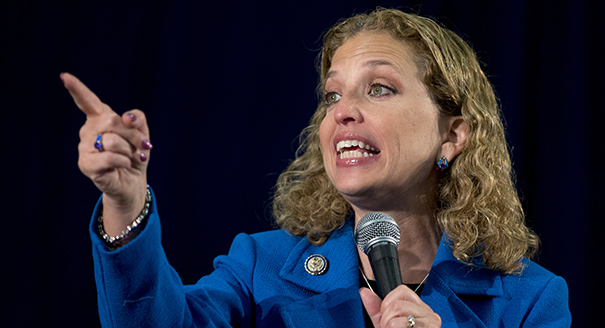
Debbie Wasserman Schultz
Debbie Schultz, Chairwoman DNC

To address its defenders first, it must be acknowledged that in  1980 the Democratic Party was bitterly divided with Carter’s own nomination being called into question by the challenger, Ted Kennedy. To defeat the Republicans, some kind of system was likely needed and this system, whilst democratically questionable, seemed reasonable to many at the time . Indeed their presence could be taken with a grain of salt as the Democratic Party’s rules dictate that these delegates should ‘in all good conscience reflect the sentiments of those who elected them.’ Are they doing that, though?

The Sanders’ campaign is playing a much tougher game today than it was a couple of months ago when the New Hampshire primary resulted in a virtual tie on an account of these premature pledges, despite Sander’s 60% public vote. Since then, reports have circulated that superdelegates are relentlessly being messaged with calls for support on his side. For some superdelegates vowed to Clinton’s side, this is causing great agitation amongst those who believe these delegates aren’t representing the people of their states. As aforementioned though, they are not voted for and their allegiances mainly derive from statehood and past representations; some are merely old stalwarts of the party. Others, like Peggy Schaffer of Maine for example, are less certain on their final decision. Having been a longtime Clinton supporter but witnessed Sanders win her state, she has decided to opt for whichever candidate winds up with the most pledged delegates. And those who have outright ‘offended’ Sanders’ most valiant supporters, like Akilah R. Ensley of the Young Democrats of America, have been bombarded with messages bordering on abuse via Social Media for her support of Clinton.

sanders supporters
Young folk are especially annoyed with the superdelegate system


In many instances, this doesn’t paint a wholly positive picture of the Sanders’ campaign but as many have argued, this system may justify such responses. Sally Kohn of CNN, for example has reiterated the DNC’s account of  the superdelegates’ role as one which exists ‘to preserve the power and influence of the Democratic Party’s elite.’ Naturally in this day and age, online petitions have therefore  begun to gather momentum, with some calling for the removal of superdelegates altogether whilst others simply ask for them to align their vote with the choice of the regular voters. Then, there is Spencer Thayer’s ‘Superdelegate Hit List,’ a sinister sounding but simple website list of superdelegate contact information, which has served to only add fuel to this fire. It will of course remain to be seen whether some of them end up feeling the blame but as it is now,  he will need to muster landslide defeats in the next few contests to secure the 2,383 votes needed for nomination.

The superdelegate system may not be a complete barrier to winning the Presidency but like Citizen’s United, it is hard to argue that it doesn’t make things much more difficult for candidates like Sanders. Many argue that it’s still possible that those pledged to Clinton would change their mind (as they did in 2008) but many more seem to fear, even given success in states like New York and California, the superdelegates would screw Sanders over. The memory of those defeated liberals between 1968 and 1988 remains a sore note for the Democratic Party and Clinton, in the end, may just be the safer bet.

Andrew Carolan

A Comedy of Errors: Voting Hurdles in the Race for the White House

A Comedy of Errors: Voting Hurdles in the Race for the White House

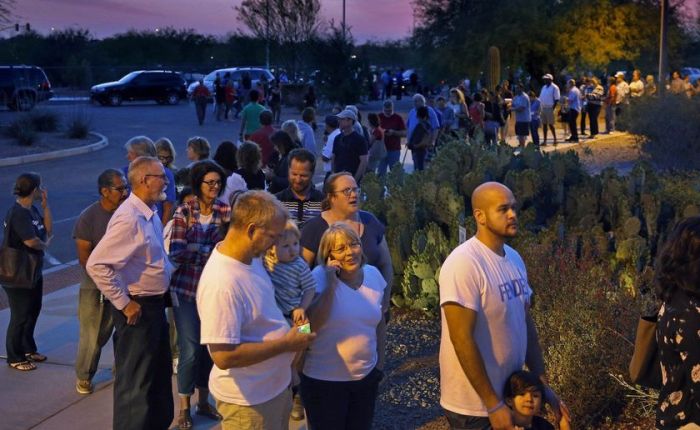
On the evening of March 22, the residents of Maricopa County, Arizona, left their homes to vote in the Grand Canyon States’ primaries. Little were they aware that excruciatingly long voter lines would obstruct their path as residents scattered the pavements that wended from the bloated polling stations. The evenings polling swiftly descended into farce, leaving many locals without a vote, and seething at the poorly handled event. But, what went wrong, and who was to blame?

Maricopa County Recorder, Helen Purcell, fell on her sword, proclaiming that she “screwed up”. Purcell was responsible for planning polling locations ahead of elections, which were reduced by a whopping 70 percent this year in contrast to the 2012 primaries, from 200 locations to a paltry 60. This was a ludicrous decision – the agency of hindsight is not required. Maricopa County is the most populous statewide, and includes its largest city, Phoenix, which just happens to have a non-white majority and is predominantly a Democratic Elysium situated within a Republican Nirvana.

To put things in perspective, four years ago 300,000 citizens voted compared to the 800,000 that were trying to cast their ballots last month. Looking at it from another angle: there was one polling facility for every 21,000 voters, compared with one facility for every 2,500 voters throughout the rest of the state. This is a serious oversight particularly with the knowledge that this years primaries have been acerbically divisive, resulting in huge voter turnout nationwide, it is simply deplorable that this was allowed to happen.

Purcell nonchalantly claimed afterward that the number of polling stations reflected the early voting lists and that one third of the people registered in the county could not officially mark a ballot, as they were Independents. The latter is an unfortunate, obstructive by-product of Arizona’s closed primary system in which one must be registered to vote for a designated party.

Arizona_voting_AP_img
Maricopa County residents faced lengthy queues while trying to vote in Arizona’s primaries last month. (AP Photo/Matt York)

Much to the chagrin of many Independent voters (who have the option to change, or choose a party at the time of voting), many were left disillusioned as they were turned away upon reaching the top of the lengthy queues. Some were given provisional ballots, or simply told that their votes would not be counted, fueling the frustration.

In the aftermath of the fiasco and bearing in mind that many Independents would have voted for Bernie Sanders if they had been given the opportunity, a whitehouse.gov petition emerged that charged voter fraud and voter suppression in Arizona. As of April 8, there have been 213,306 signatures meaning that the White House is required to provide an official response (the threshold being 100,000 signatures).

What transpired at the polling stations across Maricopa County is hardly a new phenomenon, yet it serves as a useful, and worrying precedent. The Mayor of Phoenix, Greg Stanton, illuminated the saliency of the issue and disparaged the lack of organisation. He expounded that the allocation of stations was more favourable in predominately Anglo communities and that there were fewer voting locations in parts of the county with greater minority populations.

Furthermore, Stanton highlighted the plight of poorer voters, “if you’re a single mother with two kids, you’re not going to wait for hours, you’re going to leave that line,” he added that “tens of thousands of people were deprived of the right to vote.” This iniquity is nestled in the bosom of voting bulwarks that have been mainly constructed by the GOP across the United States in recent years.

Leading the way with such studies is the Brennan Center for Justice at the New York University School of Law. Michael Waldman, president of the center, argues that Republicans have been positioning to pass laws around the U.S. with the end goal of making it more difficult and convoluted for people to cast their vote. According to the Brennan Centre, in 2016 17 states will have new voting restrictions in place for the first time in a presidential election. These new laws vary, from strict photo ID requirements, to early voting cutbacks, to registration restrictions.

Some of the more punitive and heterogeneous cases feature an amendment in Texas that stipulates residents must show a state or federal issued form of ID to vote, or that the only ID issuing office in Sauk City, Wisconsin, is open 8:15am to 4:00pm on the fifth Wednesday of each month (there are only 4 fifth Wednesdays this year).

20141108_usp502
Voter ID is an increasingly pressing issue facing the Presidential election (AP Photo/Matt York)

The presentation of relevant identification at polling stations was the cause of puzzlement during the Wisconsin primaries last Tuesday evening. Wisconsin has been thrust centre stage over the last few weeks as it became apparent that Governor Scott Walker (formerly of the presidential hopeful parish) signed a bill into law that would make it harder for the poor and minorities to register to vote in the upcoming presidential election. The new legislation will allow Wisconsinites to register to vote online.

While this sounds like a positive step in the right direction, many community organisers, such as the the League of Women Voters, et al, have argued that it will disenfranchise the poor or marginalised as these groups are more likely to register through voter registration drives. There are other obstacles that face these groups too, such as the lack of a driver’s license.

Historically, a larger voter turnout for presidential elections has favoured the Democratic nominee, a philosophy that the Sanders’ campaign has firmly grasped. That being said, high turnouts this primary season for Donald Trump have helped catapult him to the top of the withering GOP tree. Yet, it is apparent that the GOP establishment is holding out hope for a contested RNC. The abjectly handled primaries in Arizona, and Wisconsin on Tuesday evening are telltale signs of an ominous portend for the general election in November. Voter suppression is a cog in a larger machine that asphyxiates the very fabric of American ideals, a moralistic tapestry that continues to fray with much contrition.

Matthew O’Brien 

Hillary or Bernie? The Audacity of Change

Hillary or Bernie? The Audacity of Change

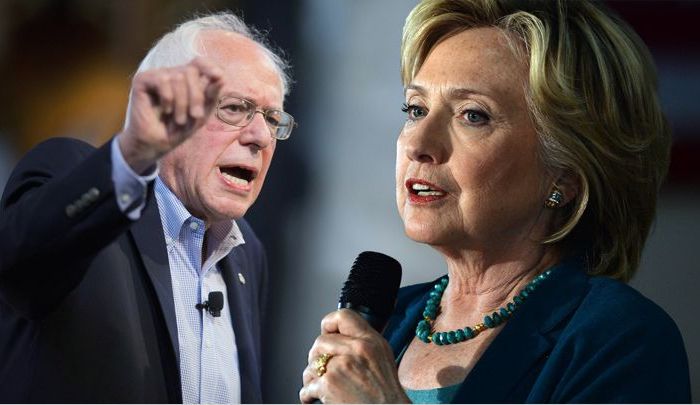
Earlier this year, the popular liberal commentators The Young Turks discussed Obama’s ill defined but probable endorsement of Hilary Clinton, suggesting that he perhaps felt stung by the notion that Bernie’s campaign reflected his own one in 2008; for change. While his Presidency has been gratifying in many areas for liberals,  few would argue that it exactly reflected the rhetoric of that glorious, “hope-mongering” (as he once put it) campaign. Simply put, he did not break the political establishment of old. Bi-partisanship has entrenched the country into its greatest division in years. Wall Street still looms malevolently; its regulations tightened but its lesson unlearned or accounted for. Campaign finance, as Sanders would put it, is a “mess” and despite economic recovery, millions are still struggling with poverty. While these issues aren’t wholly the President’s fault, it is interesting to consider The Young Turks’ assertion, especially in light of the struggle between progressive and revolutionary rhetoric being exhibited between Hillary and Bernie.

120123_barack_obama_change_605_ap

In a sense, Hillary truly does stand for progressivism; having championed women’s rights for years and led the effort for an ambitious if unsuccessful health care bill in 1993. There have been hiccups along the way (with her support for same-sex marriage sliding in at a convenient time) but evolution in thought and policy should naturally coincide with progressivism. Many of Clinton’s detractors have argued that she is part of the political elite; a chameleon who adapts to her environment as it changes. That’s true but is it necessarily a bad thing? For all her flaws and that hyena cackle, Clinton’s hardly rebounded and flopped her way to the top the way Mitt Romney has. Rather, she has allowed herself some leg room so that she may face the mercurial world she acknowledges Washington to be. As she said herself, she’s a progressive but one “who likes to get things done.” It worked for good old Bill when the GOP regained the Congress in 1994, could it not work again?

tl6195

On the other side of this struggle for the soul of the Democratic party is Sanders; a rogue independent, who wants to drive the party back to the Left it so long ago abandoned. At this point, his nomination seems highly unlikely but the people are nevertheless paying attention because his cause remains relevant. Can America continue to accept a rigged economy? Can America afford to see so many of its citizens unable to afford third level education in a competitive global market? Can America continue on this rightward path that began in 1980? Earlier this year, we here at the Walrus wrote a piece on the “return of the left.” This is very much the revolution Sanders and his supporters want. It’s certainly not politically viable on Capitol Hill, especially with the likes of today’s Republicans but it is a bold step, many would argue, is essential for a modern United States.

sandersbernie_070215

Every now and again, the US will witness an election which changes everything; from the way its politics is conducted to the way it is perceived abroad. In 1860, it was with Lincoln. A hundred years later, it was with the election of John F. Kennedy. In 2008, it was with the first Black President (albeit for a small bit). Other elections are not so dramatic however. Eisenhower, for example, may have resolved the Korean War which dampened Truman’s appeal in the early 1950s but the course America took, economically and in terms of Cold War policy, remained very similar. In the late 1980s, George Bush Sr. faced a rapidly changing world with the fall of the Berlin Wall, but moved into it with care for the populist Reagan vision, whilst acting off of his own more reserved diplomacy. So with Bernie and Hillary, we see two different trajectories for the US; a revolution in rhetoric and a will for progressivism with respect for the past. As Bernie’s appeal continues to soar, we will likely see Hillary’s campaign continue to pay more credence to liberal principles but the revolutionary zeal for which the people beckoned in 2008 will remain in waiting.

Andrew Carolan


A Contested Republican National Convention in 2016?

A Contested Republican National Convention in 2016?

It is often said that history repeats itself, and like so many platitudes, this is true most of the time. Yet, while fundamental historical tenets and axioms that govern the discipline rarely change, the context and players certainly do. Let’s apply this to the present situation that is currently facing the Republican Party in the United States and the distinct possibility of a contested Republican National Convention this summer.

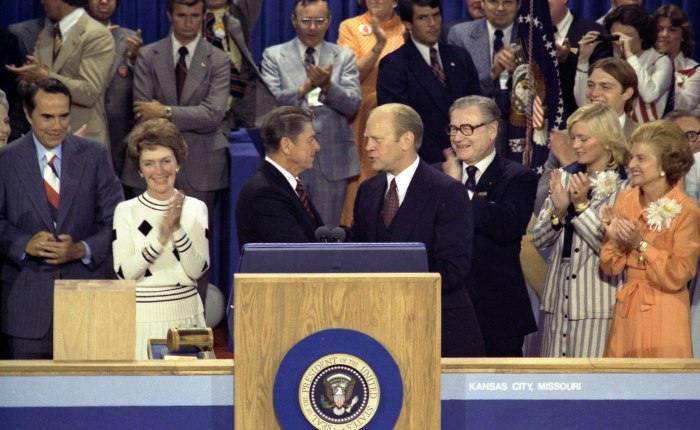
The last contested convention took place in August of 1976 and pitted B-star Hollywood actor Ronald Reagan against the establishment curry favourer and incumbent, Gerald Ford. This was the first contested convention since the brokered Democratic National Convention of 1952 in which there were 6 hopefuls vying for the nominations. The 1976 card however had just two Republican runners.

As the convention got under way at Kemper Arena in Kansas City, Missouri, Ford had amassed a greater number of primary delegates than Reagan, coupled with a plurality in popular vote. This was not enough however to get him to the magic number of pledged delegates needed to secure the nomination. As the convention kicked off in the Show-Me State, Ford and Reagan went on the charm offensive.

The President was able to use his executive prerogative to lure straggling delegates to his side by offering luxuries such as: exclusive flights aboard Air Force One, gourmet dinners in the White House (that were accompanied by wanton firework displays), or executive “favours,” the cornerstone of political leverage, longevity, and legacy.

Among the many bulwarks that Reagan’s managers tried to construct in an attempt to stymie Ford’s lead, was the pursuit of Rule 16-C, which stipulated that convention rules would be changed to require any presidential candidate to name his vice-presidential choice prior to mass ballot. This backfired though when Reagan shocked the nation with liberal Senator, Richard Schweiker of Pennsylvania.

Schweiker was rated 89 percent by the liberal Americans for Democratic Action, and 47 percent by the American Conservative Union, making him an unattractive choice. The risk taken by Reagan’s staff was injurious to his ambition and the vote on Rule 16-C wasn’t passed. President Ford managed to garner the necessary momentum to rubber-stamp his name on the ballot securing 1187 votes to Reagan’s 1070.

Interestingly, Reagan was viewed as an outsider to the Republican establishment, and was disparaged by many within the party elite – akin to Trump, though lacking the profound animus that Trump garners. Reagan left an indelible mark on the 1976 convention with his humble, extemporaneous closing stump speech that was a clarion call for unity within the party in preparation for the general election. It was at this moment when the charged Republican congregation witnessed the content of the former Californian Governor’s character – there was no equivocation, he would return.

GTY_rnc_2012_jtm_140402_16x9_608
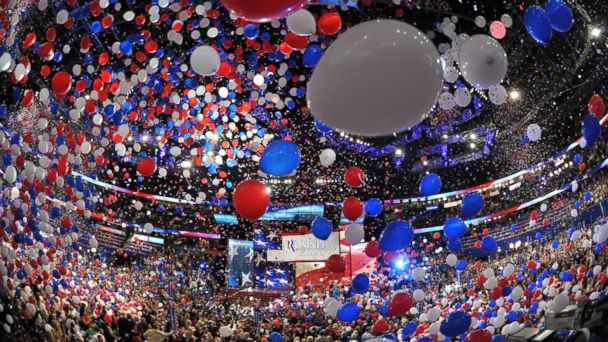
The Republican National Convention showcasing it’s pageantry in 2012

Many commentators have, in recent weeks, teased out the potential for a contested Republican convention this summer. In fact, it has become a highly popularised suggestion as a method of stopping the rogue Trump machine that seems to be getting more vitriolic and abhorrent by the day.

The last two weeks have been telling with Trump’s loyal troops marching on, propagating his language of hate and raw xenophobia. It is the results over the next few weeks which will contribute towards a degree of certitude on whether the convention will be a formality, or a tilt-a-whirl of political jockeying. This process can be obfuscating and frustrating to unravel and navigate. The confusion that perforates the aura of the process is muddied further by the semantics of the RNC Rulebook. Indeed, some of the rules referenced through the document are contradictory.

To parse the current situation: Trump has 741 delegates, Cruz has 461, and Kasich trails with 145. If Trump can sustain the momentum throughout the duration of the primaries, he may very well hit the desired 1237 delegate count. Traditionally, if this were the case, Trump would secure the Republican presidential nomination following the first count at this year’s RNC much to the party’s chagrin. Though, it is still unclear whether he can do this. The 2016 election cycle has been unprecedented for many reasons, and it seems set to continue in a carnival style of discourse.

While Donald Trump says that he is confident of securing the nomination after the first count, he has suggested that if this doesn’t happen and a contested convention takes place, there will be rioting in Cleveland – an ominous, but predictable portend from the demagogue. It appears that the establishment wing of the Republican Party, through a series of machinations, are doing all they can to downplay the electability of the billionaire bigot.

Curly Haugland, a member of the RNC Rules Committee, stated this past week in an interview with CNBC that the power is in the hands of the delegates, not the voters. He added, “The political parties choose their nominees, not the general public, contrary to popular belief.” Is this a clumsy warning shot of animosity across Trump’s golden bow? It looks that way. This bumbling anti-democratic statement is corroborated by the RNC rulebook, which whimsically states that:

“BE IT FURTHER RESOLVED, That the following be and hereby are adopted as The Rules of the Republican Party, composed of the rules for the election and government of the Republican National Committee until the next national convention…”

As these rules were adopted before the 2016 election cycle, technically like-minded Republican’s could possibly interpret the phrase, “until the next convention,” to suit their agenda by altering the rules to block Trump’s path to the nomination.

Looking at this from the other candidates’ perspectives, Ted Cruz remains confident that he will showcase a strong performance in the remaining primaries reiterating on Monday to CNN’s Wolf Blitzer that his was the only campaign to have bested Trump on a number of occasions. Meanwhile, John Kasich remains steadfast in the face of adversity. He reinforced this stance on CNN’s State of Union exclaiming that he is confident in his electability and that he expects the delegates to act seriously and select the right man for the job when the time comes.

Reince Priebus
Reince Priebus could be facing a very divided RNC this coming summer

Chairman of the RNC, Reince Priebus, commented that the Republicans are “preparing for the possibility” of a convention in Cleveland. Meanwhile Paul Ryan, Speaker of the House of Representatives, has downplayed the possibility of a 2016 run for the White House if a contested convention is called. That being said, he has not openly denied this media speculated, Twitter trending, notion. Ryan’s predecessor, John Boehner endorsed the current speaker for GOP nominee this past week, though he added further that his comments were off the cuff – good save!

One thing is for sure, the phantasmagoria that is this 2016 Republican primary race is set to get even more nebulous as the convention approaches. It has become apparent that the protectorate of the GOP kernel has realised that Ted Cruz, a man who is not entirely representative of their values, is the lesser of two evils when stacked against Trump. Frankly, the marshaling of ‘establishment’ politicians, Mitt Romney, and now Jeb Bush, may have come too late.

Just like Ford in 1976, the importance of a united front is desiderata in order to mount a successful campaign against either Hilary Clinton or Bernie Sanders in the autumn. Should Trump be denied the glory in Cleveland, expect rapture. The Republican loyalists have only themselves to blame.

Matthew O’Brien

Why Won’t Obama Do Bill Maher…

Why Won’t Obama Do Bill Maher…

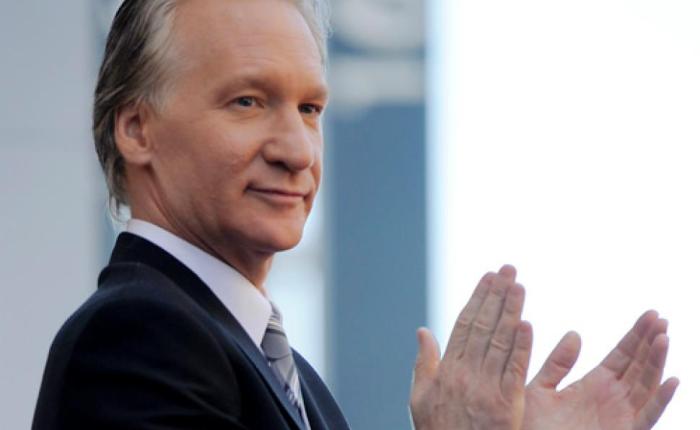
For many connoisseurs of US political commentary, Real Time With Bill Maher has remained a constant source of liberal principles. While its host has not always agreed with the President and his base, he has been a loyal disciple of sorts, lambasting the opposition whilst upholding the general rhetoric of the Obama administration. So why won’t Obama acknowledge this and make a guest appearance?

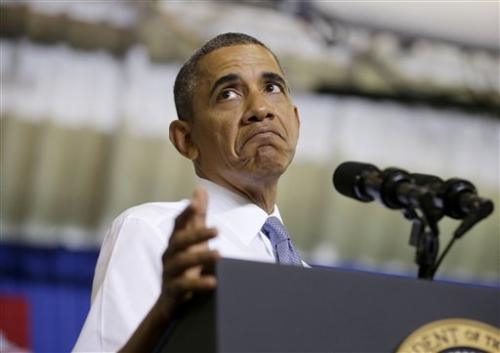
Barack Obama
“Eh… I don’t feel like it.”

To elucidate, I will first give a brief context: for Bill’s 60th birthday in January, he requested Obama appear on the show while in office, on the basis that he and his audience support the President and that he has appeared on virtually every other show (from the Colbert Report right through to Between Two Ferns). Bill Maher, during his tenure with Politically Incorrect and Real Time, has interviewed former President Carter and dabbled with stand up in the White House for Bill Clinton, but he has never bagged a sit-down chat with an in-term Commander-in-Chief.

Of course, as is the case with what seems to be every minute plea these days, a petition was set up online and over 100,000 quickly signed their names down for Obama to give a response, which arrived a week ago in the form of a vague gesture of consideration whilst expressing open admiration for the show. Although disappointed, Bill largely shrugged it off but the question nevertheless lingers as to why Obama won’t do this one show, when he’s put his name to so many others. Here are just a few, quick interlinking theories:

  • The Controversial Element: Jon Stewart and Stephen Colbert were known for making critiques on their own platforms but they always kept it light hearted. Bill Maher doesn’t feel the need to do so. For example, he unreservedly warns about the threat of radical Islam and what he perceives as the innate flaws of that religion, often without pause for a snappy closer. In short, he’s not afraid to put his opinion on the line, even if it upsets some of his politically correct audience or the general public. Obama, as President, naturally has to avoid potential hazards with such divisiveness. Bad press is created for him on an hourly basis before he’s even brushed his teeth. Would it really serve him to make an appearance on a show where witty jabs at large chunks of American society are commonplace?
  • The Partisanship Element: Bill Maher has absolutely no problem with criticising the Democratic base but it’s clear nonetheless that he sides with them over the GOP. While Obama is a Democrat, presidents should overcome partisanship. Like it or not, Obama has to work for all Americans and not just the ones who support him. By appearing on this show and grating Donald Trump’s hyenas, he would, in many people’s opinions, not be acting presidential-like.
  • He’s Not Well Equipped Enough: On Jimmy Fallon, if you forget what your child’s name is, you could probably get away with it by playing a quick game of Box of Lies. This same flippancy applies elsewhere but on Real Time, you have to know what you’re talking about. That’s why so few celebrities join the panel discussion; it’s just a different ball game altogether. Now, I am by no means insinuating Obama is not clever enough to join Salmon Rushdie or Sam Harris. The problem is that he just wouldn’t be able to express his opinions fully for fear of political backlash on topics such as Marijuana legalisation (something Maher is devotedly in favour of). As with the partisanship element, he has to be sensitive to security issues, the opposition, his own party, international relations, and the people. On Bill Maher, of course, you expect the unfiltered, real guest who appears. Sidestepping issues and avoiding controversial subjects just wouldn’t work (which begs to question why certain politicians even bother). Perhaps, once he leaves office he can speak freely but for now, Obama’s own true opinions have to be kept, tucked away in a corner.
  • He’s Afraid?: I think this is unlikely but it is plausible that Obama doesn’t have satisfactory answers to some burning questions, which again could be brushed off on other shows, but would be pursued on this one: Why’d it take so long to act on Guantanomo? Hillary or Bernie?, etc. There’s an element of vulnerability on this show, lacking from the press junkets, which would make for a stressful day; not that Bill would even go after Obama.

In these regards and in my own opinion, it seems the better question to ask would be: why would Obama think to appear on this show? Personally, as a fan, I would love to see it but for now, we’re going to have make due with the odd senators and representatives Bill does get. Hillary certainly won’t be appearing.

Andrew Carolan

The Last Days of Jeb (!)

The Last Days of Jeb (!)

Towards the end of his speech in South Carolina on Thursday, Jeb Bush exclaimed, “I hope you don’t think the end is near.” Unfortunately for Jeb(!), and with that almost unimpressively prophetic defeatist statement humming, the end has come for his nightmarish presidential campaign.

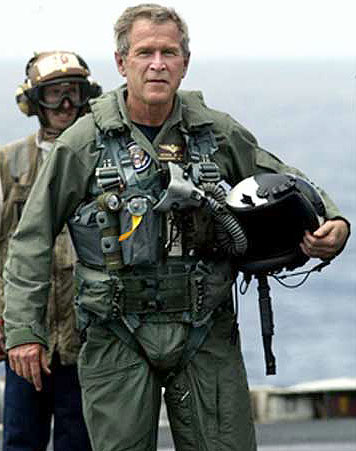
Up until South Carolina’s Governor, Nikki Haley surprised many Bush supporters by endorsing the heir to Bush’s throne, and perpetual brat, Marco Rubio, Jeb Bush’s campaign had experienced somewhat of a welcomed flux. Fresh from his solid performance on the debate stage last weekend, morale was on the rise in the Jeb camp. There was frenzied anticipation of a Monday evening gathering with guest of honour, former President, George W. Bush, who did what he was supposed to do, appeal to the South Carolinians with his trademark charm and outward affection of his baby brother. According to Jeb, the “right time” has finally come  to utilise the former Commander in Chief.

Bush_codpiece_debbc
Return of the King

South Carolina, however, has been a happy hunting ground for the Bush family in the past with primary victories for George H. W. Bush, and ‘Dubya’ in their respective successful bids for the White House.

To experience the clichéd “rise and fall,” there must of course be a rise, and with Jeb Bush’s campaign to date, it is genuinely difficult to identify anything that resembles such (unless you consider that brief 15% spike in the national polls last July a feat). Rather, there has been a steady and consistent decline and it appears that from the outset Jeb has, to borrow a Bush-ism, “misunderestimated” the field of play.

One would be naïve to disregard the former Governor’s political history when it comes to an analysis of how his presidential campaign has failed him thus far. The appendages that are so frequently attributed to Jeb are that he appears weak and awkward when facing the public. These charges can be traced back to his failed 1994 gubernatorial challenge to the established Democratic incumbent, Lawton Chiles.

350143_15356295_8col
Slightly less depressing days for Jeb

When asked what he would do to help African Americans, the inexperienced Bush replied nonchalantly, “probably nothing.” Gaffes aside, and there were quite a few; Bush was hammered in the election and was one of only two to miss out on being elected nationwide amid Newt Gingrich’s GOP revolution. There was hope anew for Jeb as the GOP establishment cleared the field for him to stake a 1998 bid – seeing promise in his electability. As he courted the electorate with his popular brand of centrism, akin to his waning 2016 rhetoric, he was carried to the Governor’s office with the assistance of his mighty war chest, which all but stampeded his opponent, Buddy McKay, by 10 points.

Journalists, political commentators, and indeed, prospective Presidential candidates argue that as Governor of Florida, Jeb has never really had to make a hard decision. While this is probably an unfair assertion, after all he eliminated affirmative action, overhauled public education and presided over a presidential election that ended in a recount placing his brother as president, it does offer a psychological window into the manner in which he deals with his detractors and aggressors. Throughout the 2016 campaign, he has appeared weak (despite those rousing claps), and almost reluctant to fight back with gusto. For a man, who by all measures is the more intelligent of the two political brothers, choosing to exercise academic scrutiny towards policy rather than oiling up his robotic joints and interacting meaningfully with the public, Jeb has failed to establish exactly what it is he stands for. In doing so, he has appeared indecisive, wooden, and old-fashioned; a candidate of yesteryear.

Comparisons to George Herbert Walker Bush evoke another interesting perspective on his failing campaign, particularly when it comes to assessing his character. In the current milieu of GOP campaigning, Jeb’s character has been traduced time and time again. The Bush family mantra is work hard, be humble, and always do your best, and it seems that these traditional values no longer appeal to the GOP electorate, perniciously infringing on Jeb’s efforts. Let’s not forget that George H. W. Bush was portrayed as a ‘wimp,’ an indictment that was injurious to his bid for the White House. But, Sr. managed to turn the tables with thanks to the negative campaign spinning of one Lee Atwater. These days however, there is a new king of the diss and Jeb… well, he’s certainly no “tough guy.”

trump-bush-getty
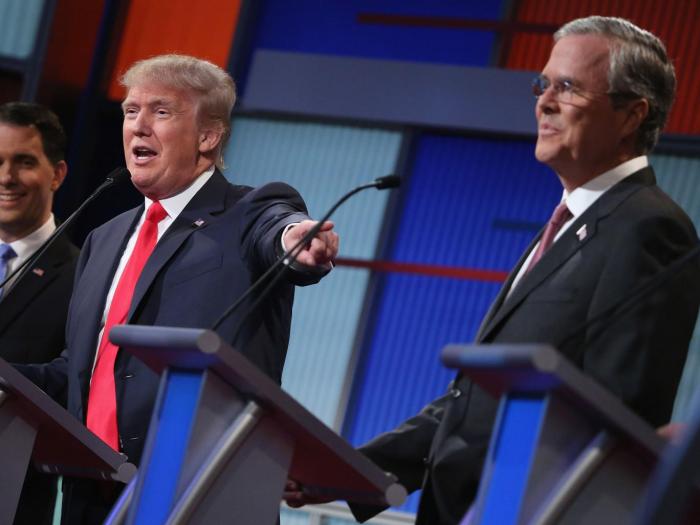
Jeb ponders whether or not to order take out…

While George H. W. Bush lamented his decision to go negative in retirement, his son’s team needs a new perspective. On this score, town hall goers in South Carolina this past week have been offering Jeb some hard-nosed campaigning advice, one of whom asked if he could be, “excuse me for saying in the vernacular – a son of a bitch?” Bush offered a pre-packaged response by saying that he will be tough, resolute and firm. Following on from his vow to be indomitable, he then tweeted a photograph of a gun, with the single worded caption – “America.” To compound matters, a poll released on Wednesday showed Jeb drawing just 1 percent of likely Nevada caucus-goers – bad, meet worse.

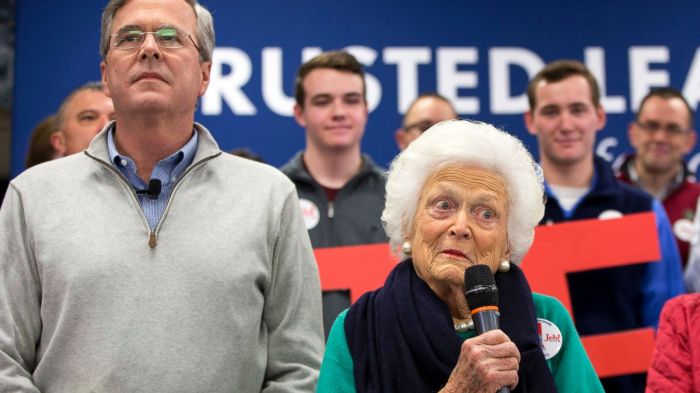
Despite the introduction of Dubya to his weary bid, there is an air of finality to Jeb’s presidential campaign – evidenced by his “Super PAC”, Right to Rise cancelling up to one third of its advertisement reservations in the run up to Super Tuesday. Let’s address the elephant in the room, not the triumphant GOP beasts, straddled by Trump, Cruz, et al. but rather the pang of reality, that Jeb Bush will more than likely drop out of the Presidential race following this weekend’s events. As his mother, Babs, perhaps best surmised, he’s “almost too polite” for this race and moms do know best. After all, she was the one who said in 2013 he shouldn’t run(!)

WireAP_2645f63b943c415291e76c63b8c9fedd_16x9_1600
Babs Still At It!


Matthew O’Brien & Andrew Carolan 

Will 2016 Usher in a Return of the Left?

Will 2016 Usher in a Return of the Left?

With the primaries upon us, it has become clear from the Democratic side of the aisle that there is a wanton desire for a return to liberal principles. Over the last year, America has seen its Right Wing degenerate and fragment causing the GOP to slip into a whirling vortex of misdirected criticism and slanderous obfuscated falderal. Meanwhile, the Left Wing has begun to reassert itself through the battle-hardened Obama administration and the populist no-nonsense principles of Bernie Sanders.

For a society that has entrenched itself so much in the conservative camp, can we really point to these broad instances as a signal for the future however? It’s never been an unpopular notion that America should reconstitute itself as a society in which anything is possible if you dream big and work hard. Indeed, it is almost a century ago that William Tyler Page addressed Congress and presented them with ‘The American Creed’ in which he echoed the steadfast sentiments that the government of the people, by the people, and for the people, should fulfill its duty to be an example of democracy by upholding its core principles. This historic clarion call is perhaps more important now in 2016, than any other time so far in this twenty-first century as the middle-class have been thrust centre stage. For the first time in decades, citizens are beginning to realise just what it takes to satisfy Page’s salvo. Here is a brief overview of how it happened:

1980: The Turning Point

The 1970s were not an easy decade for America. The failed war in Vietnam disenfranchised a great portion of the population, Nixon’s scandals threw the very office of the Presidency into disrepute and then where Ford appeared to be bumbling, Carter appeared uninspiring, telling the American people that they too needed to change their ways – as if. So by 1980, one could have easily argued that America was going through its “crisis of confidence” when even the President couldn’t rely on the support of his base, challenged by Ted Kennedy. On the Right meanwhile, Republicans turned to a man who exuded supreme certitude through mellifluous pros and striking countenance, Ronald Reagan. A former dough-eyed follower of Goldwater, Reagan projected a vision for conservatism that ebbed and flowed with the 1980s.

A New Right

And so a new right was born, not a stoic one of socially progressive values akin to the administration of Eisenhower, but rather one of a hawkish ultra-conservative philosophy. So, what happened to the Democrats? Well, to meet their advisories in the middle, instead of moving in their own direction, they too followed the populist tides of conservatism. The result? The ‘Left Wing’ party by the 1990s, were a very different outfit to the one that had existed in the 70s. America now had a centrist right wing party, and an out and out right wing party.

Clinton_health_care_elderly.jpg

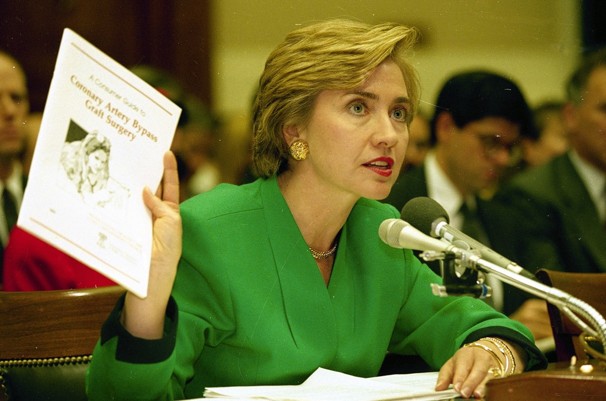
On one contentious issue, this analysis proves incredibly fruitful: health care. Whereas in the 1960s and 1970s, when cooperation between both sides of the aisle was not unusual, that just wouldn’t be the case in successive decades. In 1993 for example, America witnessed the Clinton’s health care plan struck down with fiery vengeance, in a move Hilary herself, and Ira C. Magaziner, a family friend, would view as an indication of lost time, lost opportunities and lost confidence. Bob Dole meanwhile had his own ideas on tackling this issue, attempting to dissuade democrats from going “too far”, yet yielding no positive results. So, with much discourse but little action, by the time the Affordable Health Care Act came through in 2009, there was a bitter taste left in the mouths’ of many Americans – no single payer system, meant the faceless corporations had won again and Wall Street could breathe a collective sigh of gluttonous relief. Though now, it seems as if all of this could change drastically, depending on who wins the presidential race later this year.

The Tipping Point

Obama, by this point, has achieved a great deal, yet for the most part his administration has had to adjust and then readjust focus on a number of occasions as he had battled with an incredibly partisan House and Senate. The Republicans have characterised this as ineptitude on his part rather successfully, leading to a reversal in fortunes with successive mid-term elections. In 2015, however, Obama began an unyielding assertion to reclaim the presidency. With health care presently safe from repeal, he moved on to improving relations with North Korea and Cuba, and spectacularly endorsed the Supreme Court decision to legislate for gay marriage.

The Republicans watched on dumbfounded and awestruck. With ambivalence festering and ideological fissures emerging, Donald Trump, and his hairspray- rife golden mane began to make a complete mockery of the Ring Wing of American politics, traducing anyone who crossed his path on his way to the top of many polls. Meanwhile on the Left, Bernie Sanders also shocked the nation, but in a wholly different, more organic way. He shot from 7% in the Democratic polls in May 2015, up to 28% by the end of August, and onto 37% by January. Armed with a sabre of progressive socialism and an escutcheon of resilient liberalism, the 74-year-old senatorial warrior, proved he was no joke.

AP_bernie_sanders_jef_150707_12x5_1600.jpg

Last year cannot simply be pointed to as the one in which all of this change occurred however. Indeed, one could argue that it will take many years to gain perspective on whether or not its events were substantially important. It is nonetheless clear though that the cracks that had been growing on the Left and Right, have become more severe on the campaign trail. Trump and other Republicans still attain a great deal of support, but even to their most calculated minds it is clear that their party will have to change. On the Left meanwhile, people are rallying around the call for greater coverage in health care, lower college fees, more accountability in gun control, and equal pay for women and minorities. Whether Sanders gets the nomination or not, his presence has been felt significantly. The ramifications are such that even Hilary Clinton is calling for free community colleges whilst Obama boldly sets off to do battle with the NRA and tackle global warming.


Conclusions…

Yes, this is a broad theory, and yes, many vociferous pundits could suggest that America is arguably more conservative than ever right now. Even Obama alluded to elements of this claim in his State of Union address this year, as he spoke proudly of the superiority of United States military. Yet, in the pantheon of the election, there is no equivocation that liberal principles are having a profound impact once again.

Could this be the beginning of a domestic shift back to the Left after so many years of rightward positioning? Or is America baring witness to a transient movement that will inevitably crumble under the resolute will of hawkish conservatives? As George H. W. Bush was fond of saying, “time will tell,” but it’s a sorry state of affairs that the bullheaded contingent of the present day GOP are blind to the fact that the tenets of their policies are so right wing that by now, I’m sure President Reagan’s corpse is slowly turning as if on a rotisserie spit.

Andrew Carolan & Matthew O’Brien


Should You Vote?

Should You Vote?

In Ireland, 2008, when the infamous Bertie Aherne stood down, only a year after re-election, we were given our proverbial white knight, Brian Cowen. A man of superior intellect, yet lacking experience and know how, his fate was already sealed as he assumed the highest office in this land. While dealing in hypothetcials is often trite, it’s fascinating to cogitate on the following: what if the Fianna Gael/Labour coalition had won that day in 2007? Let’s face it, that election was a poisoned chalice that could just as easily have had Enda’s lips pressed against the rim. If that was the case, what would have happened in 2011? Would the Irish people have re-elected the current government in a back to the future style election? We honestly don’t think so. There was something rotten in the state of Ireland and this was met with a prevailing current of mistrust towards government officials. But let’s not get bogged down in hypothetical situations because they can be as unrealistic as the person who posits them wants them to be such as, what if Donald Trump became POTUS? Shudder!

Still, all around the world, the question remains: Does voting make a difference? Are we actually participating in a democratic system? They all look the same! Indeed, one might nod along just to give the impression of comprehension but with the US election in full swing and an Irish one right around the corner, it’s important to actually take some time to consider this question. Done? The answer is yes – it makes a difference. You might not change the colour of the sky, you may have to wait a little while for a bill to pass but that doesn’t mean you should just give up, shake your head and turn on The Big Bang Theory. Allow us to explain…

Without voting, democracy would crumble and fail. Without it, the margin between public interest and political rhetoric simply widens; oligarchies develop, corruption thrives, and the people lose. Yes, we may feel this if often the case when taxes are raised and any worthwhile bills get frozen in deadlock. What we need to understand and ultimately appreciate however is that any worthwhile change requires this time and care. It’s frustrating but necessary if we mean to be part of a reasoned society and believe me, every last vote can count.

Take for example the U.S. Presidential Election of 1960, the closest race for the White House in history. Kennedy eeked out a .1% victory over Ticky Dicky, and became the youngest ever American president. Fueling the embers of the much anticipated election were the inaugural televised presidential debates, which presented a new platform that the American population embraced, well, those who owned a television set. So, it simply doesn’t matter if the margin of victory is .1% or 60%. What does matter, however, is that the vessel of democracy is kept afloat through its virtuous axiom, and that as members of the electorate we recognise the importance of the responsibility and indeed power that we wield.

BE024615-Debates-hero-631.jpg__800x600_q85_crop

Our responsibility extends further than merely casting a vote for the sake of a vote, however. By that we mean that people should know what they’re talking about. In his seminal body of work, Democracy in America, the French scholar Alexis de Tocqueville commented that any true democracy requires the ‘enlightenment’ of its people. In short, people who vote need to be smart about it. On the radio a couple of weeks an average Joe called in to rant against the ‘waffling’ of People Before Profit, whilst claiming he would support Michael Martin because he seems like a ‘nice’ guy. Well, that’s all very good if you’re choosing someone to go drinking with but is that what elections are really about? This should be obvious, but elections should be treated more like job interviews. So don’t be an idiot and vote for someone only because you like them. Don’t vote for someone you know, your friends recommend or who has an amiable poster face. Vote for the person who actually knows what they’re talking about and has the nation’s interest at heart.

This brings us to a crucial point; personal bias. So you might know someone who seems fairly tuned in to the whole political process but who also puts their own interests forward as the most important. We all have a point to make about how our own class or family or club has been affected by government cuts, e.g. a middle class earner may gripe about having to pay higher taxes, while lower earners may feel just as hard done by paying what they pay. Yet sometimes, you need to put the country before yourself; vote for what you think is right rather than what is beneficial for you.

When the campaign trails start, make an effort to absorb all the information you can. Ask the important questions. Challenge your own pre-conceived notions and make a smart decision because when smart decisions are made, the game is raised. When you test these politicians, it follows that they naturally have to become a bit smarter, themselves; a bit more accountable even. Then you get the changes you want. When you sit at home and don’t make the effort but spout out vague nonsense about revolutions, well, you might get a few Facebook likes but you won’t be taken seriously. Remember, a government is only as good as its people. Don’t be so naïve as to think all politicians are naturally bad.

Andrew Carolan & Matthew O’Brien