Collusion & Shit Storms: Trump’s 2018 In Summary

Collusion & Shit Storms: Trump’s 2018 In Summary

At the Washington Walrus, we recognize that it can sometimes be difficult to keep up with the latest in baffling tweets, nonsensical decisions, and eh… “reverse psychology” employed by the Trump Administration. One story may change from one end of the day to the next. So, we thought, it’d be handy to save you the hassle of sorting through this all and give you the main talking points that dominated this presidency in 2018 (year 2) with some colorful commentary.

January

  • Fire and Fury is released. Although Michael Wolff’s first-hand account is un-sourced and speculative, it manages to grind Trump’s gears immediately. Mike Pence, who believes gays can be cured with shock therapy, decries it as a “work of fiction.” Later on this year, his family will release a book about his rabbit, Marlon Bundo.

    marlon bundo
    The Pence’s book was met with John Oliver’s rival companion, A Day in The Life of Marlon Bundo, which told the story of a gay rabbit.
  • Trump presents the “Fake News Awards” via Twitter. The New York Times and CNN dominate the evening.
  • Government Shutdown 1/3- this time over government funding.

February

  • Government Shutdown 2/3- over funding again. Eventually, things clear and a budget proposal is launched with major tax cuts for the rich.
  • Former Trump lawyer, Michael Cohen, starts facing a tough year when he acknowledges payment (on his own behalf) to Stormy Daniels in 2016.

March

  • Trump fires Rex Tillerson and hires former CIA director, Mike Pompeo, as new Secretary of State. Gina Haspel takes over his role meanwhile.
  • Trump, against advice, calls Putin to congratulate him on his re-election.
  • White House issues memorandum on Mattis’ military policies to the effect that they support disqualifying transgender people from military service.

April

  • Increased scrutiny on Stormy Daniels’ affair. She files a lawsuit on claims Trump’s made.

May

  • Ends temporary protected status for Hondurans.

June

  • Department of Homeland Security reveals that between April 19 and May 31, nearly 2,000 children were separated from adults at the Mexican border. Trump tries to blame others, including Democrats for what easily ranks in his top 3 evil policies to date.
  • Describes Canadian Prime Minister, Justin Trudeau, as “very dishonest and meek” after G7 summit.

July

  • Scott Pruitt resigns as EPA head.
  • Robert Mueller indicts 12 Russian intelligence officers over hacking Democratic emails.
  • Trump advises Theresa May to sue the EU over Brexit negotiations. It’s quite a month for him.
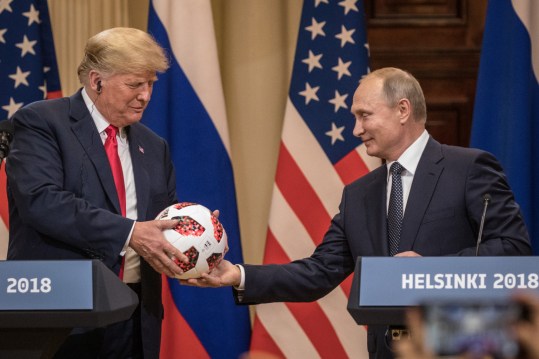
  • Trump and Putin meet at a summit in Helsinki. Trump states he knows no reason why Russia would’ve interfered in the 2016 election. Putin gives Trump a football as a present. Trump throws it to Melania, saying it’ll be a present for Barron. The world watches stunned.

    President Trump And President Putin Hold A Joint Press Conference After Summit
    Perhaps the most shocking moment witnessed on live TV since Janet Jackson’s nip-slip at the 2004 Superbowl.
  • Iran’s President, having said a war between the US and Iran would be the “mother of all wars” is hit with Trump’s latest constipation tweet: “To Iranian President Rouhani: NEVER, EVER THREATEN THE UNITED STATES AGAIN OR YOU WILL SUFFER CONSEQUENCES THE LIKES OF WHICH FEW THROUGHOUT HISTORY HAVE EVER SUFFERED BEFORE. WE ARE NO LONGER A COUNTRY THAT WILL STAND FOR YOUR DEMENTED WORDS OF VIOLENCE & DEATH. BE CAUTIOUS!” It was all caps, so you know he means business.
  • Cohen claims Trump knew of June 2016 meeting in Trump Tower between campaign officials and Russian lobbyists promising “dirt” on Clinton.

August

  • Press Secretary, Sarah H. Sanders calls the press the “enemy of the people”.
  • Manafort and Cohen are both found guilty of 5 counts of tax evasion.
  • Trump says in an interview with Fox that if he was to be impeached, the market would most surely crash. He’s taken a lot of credit for the economy this year.

September

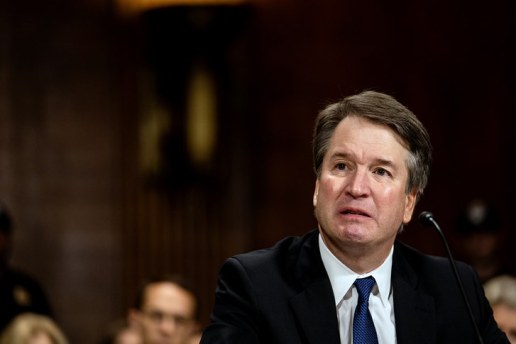
  • The Senate Confirmation hearings begin for Trump’s Supreme Court nominee, Brett Kavanaugh. This lasts through to October. We learn he likes beer and studiously marks his calendars.

    Lista-The-Tears-of-Brett-Kavanaugh
    “I like beer!” The impassioned plea of a former frat boy and Supreme Court Justice. He also has the Ronald Reagan hair-do going on.
  • Trump claims before the UN General Assembly that his administration has, in less than 2 years, accomplished more than “almost any other” in history. They laugh at him. Trump says he wasn’t expecting that reaction but that it’s okay. It’s not really though, is it?

October

  • Kavanaugh’s confirmation by a hefty 51-49 affirms for many that the #metoo movement still faces limits.
  • Trump campaigns in anticipation of the mid-term elections.

    maxresdefault (5)
    A campaign rally for Trump supporters.

November

  • Jeff Sessions resigns and is replaced by Matthew Whitaker.
  • Trump fails to attend a WW1 memorial ceremony in Paris with other world leaders due to weather.
  • Despite expressing concerns over the disappearance of journalist Khashoggi, Trump declares loyalty to Saudi Arabia.
  • Defends Ivanka’s use of private email.
  • Cohen pleads guilty to lying to Congress over Mueller/Russia investigation.

December

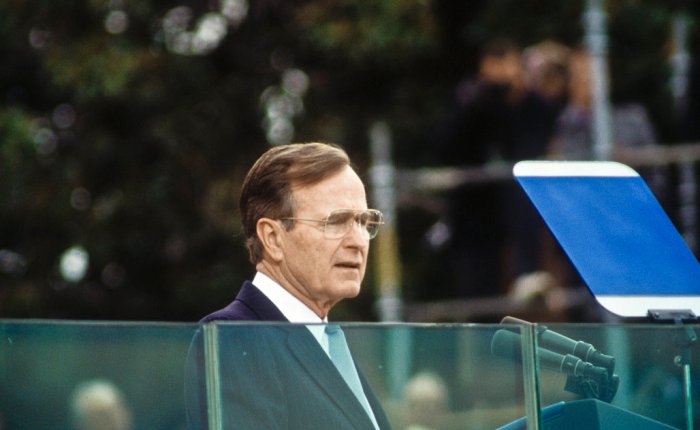
  • George H.W. Bush’s funeral reminds us that the president doesn’t have to be a villain. Not by virtue of Trump however. He looks strikingly out of place.
  • Cohen sentenced to 3 years for tax evasion, violation of campaign finance laws, and deceiving banks and Congress.
  • Secretary of Defense, Jim Mattis, resigns, after Trump tweets that troops will return home from Syria with victory over ISIS being assured.
  • Government Shutdown 3/3 over funding for the Border Wall.

    pelositrumpap_hdv
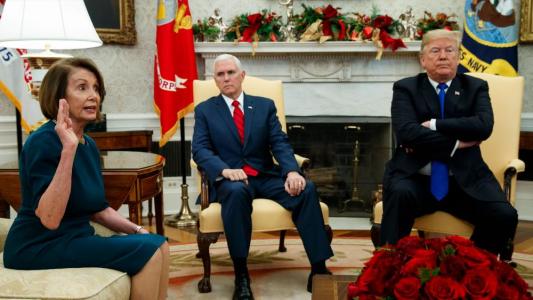
    Pelosi and Schumer (not pictured) has a meeting before the press with Trump. It went supremely well. Meanwhile, Pence contemplates the possibilities of a Marlon Bundo movie.


And there you have it! Quite a year, huh? Of course, this only scratches the surface. There was also the beginning of a trade war with China and many other resignations/firings. Or how about that meeting with Kim Jong Un? Yes, even though it was one year, a lot happened but what seemed to dominate thematically and quite literally were:

  1. Trump and his team’s lies unfurling under the weight of the exhaustive Mueller investigation.
  2. Trump’s sense of indignation and hostility growing exponentially with any who disagreed with him.
  3. Trump’s needs for appraisal at any cost- be it by others lying to him or by him lying to others about things he has (but hasn’t actually) accomplished.

These themes will probably course over into 2019, a year in which the stakes will undoubtedly be amplified considering the momentum of Mueller’s investigation and the fact that the Democrats will take lead in the House of Representatives. But will it be an easy road for liberals then? Or will Trump’s base fight back, feeling the victims of persecution in both a political and cultural war? And what can Trump do/say to shock us at this point. Well, here’s a few things for 2019 we predict:

  • The “Fake News Awards” become an actual 3-hour long televised event on Fox with in-memoriam slides for celebrities Trump feels were wrongly accused of sexual misconduct.
  • Trump tweets spoilers for the Game of Thrones’ finale having gotten Eric to secure a copy. Eric, meanwhile, feels he has done his father proud and gets a gold star.
  • Attacks nations that don’t pay their dues on the international stage, like Wakanda, which he mistakes for a real country. Marvel play ball.
  • Promotes Barron to an advisory role. Eric looks on with jealousy.
  • Delays the 2020 election on account of “important things” needing taken care of first. Democrats, gridlocked on the issue of whether Harry Potter promoted a diverse-enough school experience, fail to challenge him on this.
  • Claims the wall has been built but is invisible. It’s best not tested though because while it will not prevent you crossing as such, it will inflict a terrible curse on you and your family.


George H.W. Bush: A Legacy

George H.W. Bush: A Legacy

George H.W. Bush one said in an interview that the “L” word was banned from his household in regards to defining his legacy and part played in history. His humility, today, seems all the more gratifying and admirable for the Sasquatch who now occupies the White House and the incessant stranglehold of political tribalism gripping America. Bush was, in many respects, a classic conservative but like McCain (who passed earlier this year), he tempered the extremists of his party. (He could also take a joke- inviting Dana Carvey, who impersonated him on SNL, to perform at the White House upon re-election defeat in 1992.) He raised taxes at great political cost. He formed a lasting friendship with the man who beat him in his re-election bid. He even voted for Hillary Clinton in 2016. This man, to many, seems like the last of a dying kind.

In 1989, the world transformed with the fall of the Berlin Wall. What seemed an unlikely reality mere years ago quickly materialized and a steady hand was needed to oversee the end of the Cold War. Bush was the perfect man for this. His mother had instilled in him from an early age the idea to never brag and take any successes as a team’s, not his own. To be fair, Bush wasn’t responsible for what transpired across Eastern Europe or in Russia, credit or fault (depending on who you ask) belongs to a great many but for a US president to not drag this out as a triumphal moment took remarkable tact and restraint. “I’m just not an emotional kind of guy” he remarked, almost disinterested, when pressured by the press. Gorbachev certainly appreciated this. Relations between the US and Russia had never before (or since) been so cordial. This respectful line of diplomacy would prove instrumental in German reunification in the succeeding couple of years.

bubiwc

While he may have averted the world’s gaze from his own mantle however, he wasn’t ready to let America slip by the wayside in its foreign policy. The New World Order, as defined by the end of the Cold War, would see America stand up for sovereign nations being aggrieved across the world. To the World War 2 Generation, this may have seemed admirable, especially with despots like Noriega (in Panama) and Saddam Hussein pushing their luck. To many others however, this marked the beginning of a sinister role for their nation; world police.

The Gulf War of 1991 however was no Vietnam. It was a quick and altogether successful operation, as set out by the Bush administration, which resulted in the liberation of Kuwait. Critics on the left may have questioned the legitimacy of this war (albeit to a lesser extent than his son’s) and pointed to instances of civilian casualties as war crimes. Critics on the right may have argued that the US should have gone into Iraq and overthrown Saddam. Both voices of dissent were largely drowned though by the majority when Bush’s approval ratings shot to an unprecedented 91%.

So how, just over a year later, did such a popular president lose re-election? There were a wide variety of reasons, chief among them; a recession caused by Reaganomics, the entry of a third-party candidate into the race- Ross Perot, and the perceived image of Bush as a man out of touch. Particularly in the case of the latter factor, the Bush Administration’s take on the AIDS crisis and the War on Drugs are remembered unfavorably but he was also seen as a president far more interested in foreign policy than domestic. This is understandable given the Gulf War, Panama, and Somalian interventions, as well as all the changes occurring across Eastern Europe but Bush deserves a little more credit here, in my opinion. There was for one instance, a Clean Air Act, which seems out of place in a Republican’s administration. There was the tax compromise, aforementioned, which eschewed politics in favor of national interest (earning him years later, a Profile in Courage award from the Kennedy Center.) Then there was also the American with Disabilities Act of 1990 which gave legal protections to people with disabilities, previously unaccounted for. This doesn’t often get mentioned but is a key piece of Civil Rights legislation.

Despite all this,  Slick Willy Clinton really was able to capture the spirit of the country at the time with his “I feel your pain” moments, saxophone solos, and direct intern management. The 1992 election got fierce and Bush felt the blow personally for years after but he always refrained from criticizing his successor, wishing him the best of luck from day one with a now viral letter (below).  He spent the rest of his life, mostly out of the spotlight, save a couple humanitarian relief efforts with Bill and parachute jumps on his birthdays (the last one on his 90th in 2014).

george-h-bush-letter-to-bill-clinton-on-in

Historians, he once noted, “will point out what we did wrong” and “perhaps, some of the things we got right.” Has a former president ever put it so simply yet brilliantly? One can certainly argue the proportions of these wrongs and rights and yes, one certainly should not do it, merely by comparison to Trump (a benchmark set so low it goes without bothering with) or his son (their approach to Iraq was fundamentally different). It’s definitely a mixed bag, as is the case with most presidents. The impression, I always got of this man however, was that he truly wasn’t obsessed with his legacy or bragging rights. He served 58 air missions in World War 2 (when with his rich connections, he probably could’ve avoided service), took some thankless tasks (chairing the RNC under Nixon, fathering “weak-sauce” Jeb), and acted as a public servant, rather than a typical calculative politician. Even putting aside today’s dark climate, this is the kind of leader we’re unlikely to ever see again.


Democratic Voter Mentality & The Midterms

Democratic Voter Mentality & The Midterms

On Tuesday, American voters have the chance to re-frame much of their governmental structure and the issues at play over the next two years. Not only are all House seats and 1/3 Senate seats up for grabs, so are a number of Governorships and Attorney General positions. Historically, voter turnout for midterms have been lower than years when the presidency is up. This year however, early voting seems to indicate a promising shift for the otherwise complacent Democratic party, who’ve seen devastating losses since 2010. Is this purely reactionary to the Trump agenda or have liberals finally learned what it takes to set the tone for a nation so entrenched in right-wing dogma? It’s seemingly both (as you’d imagine) but the issues aren’t all that’s at play.

Let’s take a trip back down memory lane to two years ago when Trump defied the odds and became the 45th US President. Liberals were so beside themselves in trying to explain just what had happened. Was their progressive vision now irrelevant? Had bigotry eclipsed their hopes for further equality and subsumed any focus of their issues? Was all lost? Well, it’s not that simple but they had lost bad. After all, Republicans had taken both houses of Congress as well as the Oval Office. So, as Crooked Hillary’s book asked, what happened?  Here’s a few thoughts, not expressed in that book:

  • The Democrats lost focus on the important issues: Really, most Americans need proper health care, are for sensible gun control, and could do with a decent minimum wage hike. As Bernie Sanders would say though (arms flopping about), these are the issues that are never covered by the mainstream media. But also by some liberals. They take the bait too often and lose themselves in the maelstrom of Trump’s tweets and the latest non-controversies, defined by-
  • Political Correctness. Sigh. We’ve covered this topic, maybe exhaustively, but let’s be clear about this; it’s not that political correctness is in itself bad but it alienates liberals from many potential voters by painting a picture of piety and self-righteousness wildly at odds with most Americans’ mindsets. Most people don’t want to associate themselves with the buzz-killingtons of the world and the liberals SJWs are just that.
  • Identity politics too, for all its value in assessing demographics, should not be religiously standardized to the point that blacks, women’s, gays, and white males get defined by atypical subsets of values. When statements like Hillary’s about Trump’s inaugural address being a “cry from the white nationalist gut” are made, it does very little for reaching out to Trump voters. And liberals should be reaching out. There’s no real reason you have to separate these groups of voters when so many of their concerns are shared in actual issues; job protection, health care, social security, etc.
  • The Democrats have lost vision for their party too. To be fair, it’s gotten more progressive recently but in 2016, there seemed to be two threads being pulled between that side (on behalf of the likes of Sanders and Elizabeth Warren) and the more centrist wave that’s dominated since the 90s. The party needs to consolidate its core principles and its base because for all the terrible ideas the GOP espouse, they do so together. Unlike the Democrats, they’re confident, strong, and on-point.

In many ways, this is a call for the Democratic Party to react to previous losses by moving further to the left, so long as they do so on the issues. It’s no use criticizing and labeling all of Trump’s supporters when in reality, their concerns aren’t so different from liberals’. Trump is a unique phenomenon and his presence is undoubtedly felt in these midterm elections but he’s also best understood as a symptom of a sickness that’s taken hold in American politics; extreme bipartisanship.

As above, I’ve argued that identity politics is limiting to our understanding of how Democrats will vote on Tuesday but that doesn’t mean key issues, primarily affecting womens or blacks won’t play a role. For instance, I think it’s fair to say there’ll be some backlash to the nomination of Brett Kavanaugh. In the era of #metoo as well, there’ll likely be a thirst for progressives and indeed, it is a record year for women running for office (but again, complacency is a great weakness- just ask the last year of women, 1992.) In this respect, individual issues are taking a backseat to greater visions for a new liberal base. If the Democrats lose badly, the party may very well resume its default centrist position but it feels like it’s beginning to get the fire in its gut again.

Identity Politics: Resentments & Realities

In the last few years, American politics have become increasingly preoccupied with style over substance, in the avenue of political correctness, the culture wars, and identity politics. The latter issue hasn’t been discussed much yet on this website because hey! who needs to hear from another white male about race and gender issues? This may seem like a cheap joke or key point, depending on your point of view, but it cuts right down to why this has become incontrovertibly linked with political discourse today.

Identity politics (and how it’s stirred in conversation) breeds off a culture of resentment among alienated groups (privileged and disenfranchised, generally) while at the same time remaining all the more relevant, in times when a US president can’t even be bothered to condemn the KKK. Its genesis lies in the history of oppression of minority groups (Blacks, LGBT+, etc.) and the effective silencing of their voices resulting in what many believe to be a necessary template for defense. Its faults, as some would argue, lie in the abuse of where it’s applied and the mentality of “victimhood” it encourages; giving a victim the leverage of identity over an opponent in debate. Naturally, it’s a sensitive topic to discuss because discrimination isn’t some abstract idea for many people but to make some steady progress, let’s examine the criticisms and defense channeling this conversation.

Criticism of Identity Politics

Let’s divide the critics into two types: a) rhetorical and b) practical.

The former have problems with the rhetoric identity politics inspires. They charge that it inspires groupthink, which in turn compromises individual thought on complex issues and furthers the gulf between left and right. In common discourse, we expect minorities to side with liberals all the time, even though many of the matters dividing the Republican and Democratic parties have little to do with identity, e.g. gun control, climate change. We assume race and sexuality plays a major role in a Black or Gay person’s life which may be statistically sound but at times, possibly comes across as condescending and untrue. As the popular political commentator Dave Rubin has noted, “you as an individual are much more than your immutable characteristics.”

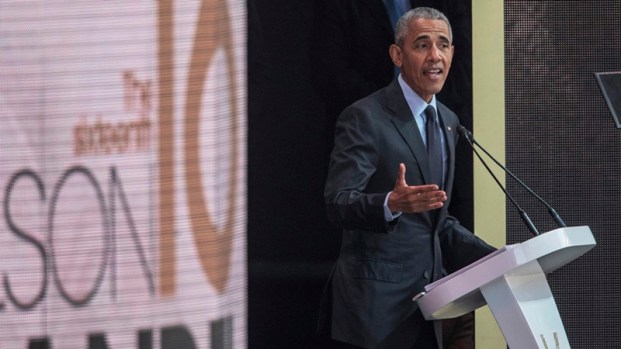
Plus, experience does not necessarily establish authority in an argument. We may not be able to fully appreciate another person’s struggles and yes, it may at times appear insensitive to even engage but debates should be run on good ideas, regardless of one’s “immutable characteristics”. This notion blossomed considerably when echoed by Obama in a speech commemorating the 100th anniversary of Mandela’s birth in July (when he said opinions should not be dismissed just because they are white or male).

SAFRICA-US-POLITICS-PEOPLE-OBAMA-MANDELA

Practical critics think along these lines too but with goals in mind- i.e. beating Trump in 2020. As Sheri Berman opined in a Guardian piece (“Why Identity Politics Benefits The Right More Than The Left”): “Is our ultimate goal ensuring the compatibility of diversity and democracy? Then promoting the overlapping interests and identification that enable citizens to become more comfortable with differences and thus more tolerant and trusting, is absolutely necessary.” Left and right have been painted as stark opponents in the culture wars. A tough point, some liberals seem unwilling to accept, is that not all Trump’s supporters are racist white males. Okay, there are definitely some racists. And yes, a lot of his support was from white males. Their support did not rest solely on identity politics however. It derived from other places; chiefly, economic misfortune- a shared characteristic for people of all identities in many situations. In short, as Bernie Sanders would hound, the media needs to pay more attention to the issues!

In Defense of Identity Politics

Okay, so that’s all very good but racism, homophobia, and sexism are everyday issues affecting millions of lives. There are oppressive methods in place preventing Blacks from voting (by conservatives gerrymanders and legislators). There is a double standard for women and inequality of opportunities in many job sectors. LGBT groups are routinely subjected to the nastiest treatment and commentary for merely being who they are. So, in many respects, identity politics is something that has been thrust upon these groups rather than something they’ve sought out and just as the right are known to parry off cries of offense with deflections like “oh you’re just being PC”, is it not possible that identity politics helps their cause a little when it comes to such enduring prejudice?

In his article, “In Defense of Identity Politics”, Paul Von Blume writes that American society has been mechanized to the umpteenth degree to reinforce the status quo of white male privilege. When expressions like “just plain American” or “melting pot” are bandied about, he argues that while they may be “well meaning,” they really just brush over the historical “exclusion” of millions of its people. Direct, aggressive racism or prejudice in general does not necessarily tie this altogether. White privilege is maintained out of fear that the promotion of less enfranchised persons may lead to a decline in their quality of life (a concern that pervaded the “turbulence” of the 1960s). Michael Eric Dyson, a professor of Sociology at Georgetown University and Peterson opponent), has noted this much, writing for the New York Times in December 2016 that “the interests of the white working class have often been used by white political elites to stave off challenges to inequality and discrimination by black folk and other minority groups”. (It should be noted however that he’s been criticized for pushing identity politics to the extreme, referring to Jordan Peterson as a “mean mad white man” during a debate on political correctness).

To Conclude

White men like me will never fully appreciate the Black, Women, or Muslim experience, as diversified or as shared as it can be. In many respects, our culture and systemic prejudice has necessitated such labels as identity be used in the mainstream. It catches people’s attention when a meme or hashtag or article goes viral, encapsulating all the frustrations of “mansplaining”, whitewashed history, or privilege. It’s all very understandable but at times, overtly sensitive to the point debate gets shut down; e.g. with the above case between Peterson and Dyson, the former debater was immediately cast under suspicion (or an attempt was made) just because he was a white male arguing against political correctness. At times, this isn’t fair but there will always be exceptions in every case that define how we must study it. For example, a panel of all male commentators discussing abortion would seem ridiculous to most but of all females, rather reasonable. Also, “All Lives Matter”?

It’s a trying discussion which transmogrifies the collective into the personal experience. For all practicalities’ sake though, in light of recent political developments, it has become a “serious nuisance” underlying almost every political debate. In order for the Democrats to make some ground on those stubborn Trump supporters, there needs to be some attempt at reconciling the majority with the minority, whose interests don’t necessarily deviate from one another’s. The 2018 midterms and the 2020 election should return to the boring stuff that makes up most sane countries’ elections; economic opportunity- and that means to help all citizens advance, be it on an individual or group level.


Jordan Peterson & Open Dialogue

Jordan Peterson & Open Dialogue

Much has been made of Jordan Peterson, the Clinical Psychologist, and his foray into the world of public intellectualism and politics. At times, his rhetoric seems deigned for ingratiating proponents of free speech and those sickened by the debasement of open dialogue into base proclivities and at others, for widening the gulf between liberals and conservatives. Does Peterson’s loyalties lie with the latter? I think that’s reductive but certainly there’s a case to be made that his words could do a whole lot more for that camp than any other figure stealing headlines.

Peterson became something of a fixture following his challenge of the Canadian government’s Bill C-16, which proposed to add “gender identity or expression” as a prohibited ground of discrimination under the Canadian Human Rights Act. His objection lay on the grounds, not of transphobia, but this being an assault on free speech (by inference of “compelled speech”). Naturally, some saw this as transgressive and petty. Peterson managed to ride a wave of popularity thereafter though, with a series of videos riling against political correctness. This led eventually on to a bestseller 12 Rules for Life, a self-help guide, whose insistence on personal responsibility (and not victimhood) became inextricably linked with the numerous issues he was being questioned on. These included feminism, a crisis in masculinity, and support from some members of the alt-right.

The thing is a lot of Peterson’s support is comprised of anti-PC white males. In the arena of identity politics, he’s been attacked by many because he doesn’t seem to disavow the more extremist parts of his base. Is this necessarily his responsibility? Maybe not but it becomes a worrying clause because conservatives really could do with an intellectual figure or at least his ideas. It gives them something the likes of Trump can’t- legitimacy. Dorian Lynskey illustrated this cohesively in a February piece for the Guardian on the “dangerous” side of this professor and his perceived image as “the cooly rational man of science facing down the hysteria of P.C”. He writes, “[His] YouTube gospel resonates with young white men who feel alienated by the jargon of social justice discourse and crave an empowering theory of the world in which they are not the designated oppressors.” A little ambitious on their part, yes.

Many have brought Peterson up on his defense of patriarchies as natural outcomes of history by asserting that that doesn’t necessarily make them desirable.  I wonder if perhaps both sides are being too hasty in this increasingly complicated dialogue. Yes, one could muster that the many elements constituting the history of mankind have resulted in the kind of society we now have but even with this viewpoint, that doesn’t mean all Peterson’s views are calculated to an anti-leftist agenda. In many respects, he’s a breath of fresh air because he dares to question the background behind things like the gender pay gap and the ideology surrounding humanities in universities. It’s also kind of nice to just hear an articulate figure coming from somewhere outside the left.

Even if he’s a troll benefiting from all this controversy, the liberals will take the bait however. In one notable instance, he clashed with Cathy Newman in a Channel 4 interview and came out all the more triumphant and heroic to his base by holding his own against an onslaught of accusations as to what his intentions are (e.g. is he against equal pay for equal work?!?) In others, he’s been protested with blaring horns during speaking engagements on campuses (to the effect that his free speech is quite literally being drowned out). His appeal has magnified significantly as a result of these instances and given the impression to many that liberals really are as hysterical and outraged as conservatives believe.

On the other hand, we can then return to his base of support/fans. They’re aggressive and the message that open, calm debate is the best strategy for discourse seems lost on them. Just look at the YouTube searches related to him. The titles are unabashedly biased and intended to only promote what these people already believe; e.g. “Those 7 Times Jordan Peterson Went Beast Mode” and “Jordan Peterson  Destroys Transgender Professor”. These are not the kind of fans you want. As Lynskey has noted, their “intense adoration  can turn nasty. His more extreme supporters have abused, harrassed, and doxxed several of his critics”. (That is to publish their personal details online.)  Again, he’s not wholly responsible but we can’t ignore the fact that his platform lends him major influence. Some have even referred to him as the most popular Western intellectual in the world today.

Academics are credible sources of wisdom. At least, they’re perceived to be. The problem is that Peterson may have become too big for his shoes. Maybe he does have a lot to offer in clinical psychology and helping young men take responsibility for their lives but now, his inferences have shaped new, highly impressionable ideologies that people are grappling with in quite a messy manner. I admit I find it difficult to distinguish between admiration and skepticism in his case. He’s an engaging and forthright speaker but for every seemingly sensible theory/notion he brings up (I always enjoy a bit of PC bashing), there’s a rocky generalization or embarrassing climate skeptic posturing.

Initially, I wanted to write purely on the dangerous aspects and repercussion of his espousing but a) Lynskey’s article does that both eloquently and in great depth and b) I don’t want to contribute to the idea that he’s just good or bad. He’s a complicated figure and his ideas have opened and added to our dialogue on a number of key issues governing the divide between left and right.

Impeachment May Not Be The Wisest Way To Go

Impeachment May Not Be The Wisest Way To Go

Firstly, let’s qualify this title before it’s misinterpreted the way so many others are. This is meant, by no means, as a defense of Trump, his policies, or his legitimacy as president. Rather, it is a simple, nagging thought bubble that submerges every now and then, prodding as to whether impeachment is necessarily the path we should take. Lately, I’ve been thinking no. 

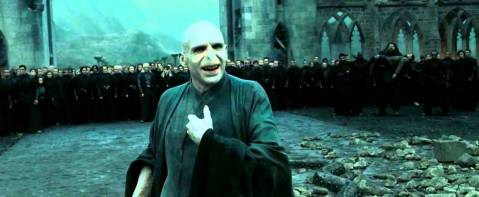
Trump deserves impeachment. He never deserved to be president. He probably doesn’t deserve human form; perhaps a Horcrux but okay, sorry, not even that. To put aside the platitudes surrounding his level of deftness for a moment though, let’s consider impeachment: what it means, what its effect on America and the cultural hegemony would be, and why beating Trump in the 2020 election may unfortunately be the option best waited on.

maxresdefault (3)
Like many other political figures, Lord Voldemort’s popularity has risen since the election of Trump.

Impeachment, as established by the U.S. Constitution, can come about as result of treason, bribery, or other “high crimes and misdemeanors”.  Trump’s probably guilty of these three in some form or another. The problem is these clauses are open to a wide spectrum of interpretation, particularly in the case of the latter. Realistically, as President Ford put it, it comes down to “whatever a majority of the House of Representatives considers it to be at a given moment in history”. The House is of course controlled by the Republicans and so is the Senate. So straight off the bat, we have a problem there. But here’s a few other hard truths:

  1. Recently, Trump’s approval ratings have lingered in the mid-40s. This is not unusual for a president at this point in their first term. His support may have dropped but don’t fool yourself into thinking it’s gone.
  2. His support eludes morality and reason. Remember back in 2015 when everyone thought his bid was a joke? Remember when no-one thought he could beat Hillary? We need to stop thinking the ludicrous can’t happen.
  3. His endurance rests on: a) the flotsam of a post-truth world in which facts get lumped in with “Fake News”; b) the populist frustration that still exists with old Washington; and c) the inflammation of the Culture Wars and polarity between Left and Right

I’m not arguing that Trump’s levels of support cannot dwindle to the point of endangerment but for practicality’s sake, we need to accept that perception and emotion precludes reason, doubt, and logic at present. With regards to point 3.c. above especially, we must recognize that there’s a base of conservatives and even non-political individuals who’ve come to disavow much of what the far-Left are associated with; political correctness, identity politics, and liberal activist leanings in all areas of society (e.g. universities and the arts). Trump has fed off this polarity and taken things farther. Although there were some right-wingers who truly wanted “THE WALL” and a Muslim ban, there were also many people in 2016 who just wanted to stick it to the Left. They may be wrong- I won’t weigh in- but the image was drawn. That picture hasn’t changed.

Of course, you might wonder as to when impeachment should occur if not now. It is still possible, I suppose. Headlines continue to shock, even in recent days with that pantomime display in Helsinki. But impeachment, given the context above, will leave a  lot of people unhappy and they won’t rest easy. They will see it as a means of encroachment on their civil liberties, freedom of speech, etc. and bullshit. It may even result in further mobilization of the Alt-Right, who would then seek to take down the next Democratic president without hesitation. (Clinton and Obama experienced increased pettiness on this scale and it’ll only get worse). Of course, that problem doesn’t go away even if Trump’s defeated in election. The Republicans will likely stew as they always have but- it will be that much harder to justify supporting a president who lost by electoral means than one who was “done in”.

As aforementioned, none of this may even matter as the Republicans are in control and they, collectively, have no spine. A few figures have criticized Trump’s rhetoric on occasion (like in Helsinki) but for the most part, it has become normalized among their ranks. Democrats may make major in-roads this November but given the seats up for contention in Senate, are unlikely to take a majority there. Plus, the impeachment process would be long, as anything in politics, ever is. 2020 may seem far away now but it may prove easier to just wait out as was the case with Lincoln’s successor, Andrew Johnson.

Andres-Johnson-17th-U-S-president
Andrew Johnson was impeached but acquitted when it became apparent no-one would vote for his election (having taken over from Lincoln). Often regarded as one of the worst US presidents, he too seemed to scowl a lot.

So where should the Democrats’ efforts go? Undoubtedly, a strong and media-savvy candidate will be needed for 2020 but even if 2018 proves a success, the Democrats must not give up on the House and Senate as they continually seem to do just when their president needs them. They must also try harder across the whole country, given the disastrous electoral college system that’s screwed them over twice in recent years. They should also not consider themselves “above” attacking Trump. After all, his wacky branding helped him knock off candidate after candidate in the Republican primaries. At the same time, focus on the issues the likes of Bernie Sanders and Elizabeth Warren hark on about; be the party of welfare and increased minimum wage but not the party that gets bogged down by identity politics and PC agendas. Those Trump supporters may very well be for the taking given enough room in that area.

It all essentially comes down to restoring order and sense in a chaotic time. Impeachment’s appealing and Trump deserves retribution but eliminating the Horcrux itself won’t eliminate the whole  (all America’s problems). What he represents (or doesn’t) is far stronger than who he actually is.

Some Thoughts On Political Correctness

Recently, I watched a Munk debate on the motion, “Be it resolved, what you call political correctness, I call progress…”. On the pro-side, Michael Dyson and Michelle Goldberg argued for the necessary protection of targeted groups, who have been mistreated on the basis of identity, particularly in the case of African Americans. On the con-side, Stephen Fry and Jordan Peterson pointed out the indemnifying effects this cultural swing has had on free speech, thought, and the Enlightenment. The con-side won by 70% but the issue, which I had once seen as frustratingly stupid and obvious, was actually complicated for me.

As it stands, I still think PC culture is annoying and potentially dangerous in certain cases. Beforehand however, I had never really considered the pro-based arguments one might employ. I would like to discuss some thoughts on that part first. For while it may seem the “PC Police” conglomerate are out to make sure we never speak our mind, there is an inherent need in society to check those who would vilify certain groups with hate speech or false propaganda. Terrible things can occur as a result of blatant bigotry, like the Holocaust. Plus, on a subconscious level, images can be drawn of racial, religious, and cultural groups that become highly influential.

Certain conservative commentators spring to mind in this thread, like Alex Jones and Rush Limbaugh. It’s fair to have an opinion; even one that diametrically opposes yours. Is it fair to exert that however, when you sprinkle misinformation throughout your diatribes and have a expansive market for your voice? Here’s where things become foggy. Hate speech should be discouraged, challenged, and forcefully opposed, yes. To oppress and shut it down however only ever serves to create a greater furor. It emboldens the ridiculous too.

For example, Katie Hopkins. You ever heard of this banshee? She believes you can judge kids’s characters on their given names, and other such things. She came to prominence in some season of The Apprentice and has somehow managed to leach off public outrage in the UK since for her wild assertions. When she spoke at Brunel University in 2015, students organised a “silent protest” by walking out. Theirs was a view based on the idea of opposing controversial views and terrible guest speakers. Why even give these people a platform to speak? While I can wholeheartedly agree that was a dumb miscalculation on the university’s part, it only served to highlight the weakness of what some might call the “Regressive Left.” There’s a great deal more satisfaction to be gained in taking one’s controversial views down on the debate platform than there is in ignoring them. So when Hopkins later asserted that the students were “close minded”, she actually had some ground on which to stand. As Professor Richard Dawkins has argued, if you can’t have honest debate and face new ideas in a university setting, where can you? If those ideas are awful, take them down.

Of course, this kind of treatment hasn’t just been reserved for D-list celebrities. Walkouts and protests have been arranged for scholars, politicians, authors, and comedians as well. One of the most depressing examples was in 2014, when former Secretary of Condoleeza Rice pulled out of giving a speech at Rutgers University, over protests surrounding the Bush Administration’s involvement in Iraq. I’m not going to argue it was a worthy war or that she was an excellent Secretary of State but she is an important political and historical figure and such figures, should be heard, regardless of your opinion. Again, it’s much more satisfying to challenge these people in person. It also demonstrates that you can articulate in an intellectual manner just why these people are wrong.

To return to the pro-side of the aforementioned debate, I’d like to refer to Michael Dyson’s argument, which he based on the idea of White Privilege. I believe it is a harsh reality and it is fair, in a sense, to assert that White people have more to lose in a politically correct society than others do, who lack that societal advantage. Perhaps, it is agonizing for some groups to hear their very real concerns and fears being brushed of with assertions of overt-sensitivity. After all, White people, like me, have not had to deal with everyday racism or bigotry. Ours is an entirely different experience. It’s beyond our sphere of comprehension, for the most part.

Political correctness and racism/bigotry may correlate but that does not necessarily mean it is an adequate or sensible means of curing society’s ills. It’s actually a rather lazy means by which to tackle those doing the damage because a) again, when you try to silence them you only really embolden them and their base and b) it pushes us on the path to a different kind of oppression- an Orwellian kind in which group think (and to a degree, thoughtspeak) replace the freedom of individual expression and wide margin needed for intellectual debate. The reality is people say the wrong thing sometimes or express opinions indelicately. That is no means for justifying racism or sexism or homophobia (pay heed Trump supporters) but rather, a reminder that we learn best when we expose ourselves to all sorts of ideas and debate them openly. In the end, good ideas are good and bad ideas are bad, irrespective of identity.


Paul Ryan Fades Into The Mist…

Paul Ryan Fades Into The Mist…

It’s no secret that we here at the Washington Walrus hold Speaker Paul Ryan in low regard. It’s not that he’s as knuckle drawn and villainous as his contemporary right wingers, but rather that he’s so spineless and tepid in his approaches within this political sphere that he appears lame and useless as a result. In fact, we even covered this last year in a piece on just how pathetic he is, in case you want to read that.

Still, that word feels almost a little too cruel for this boy among beasts. Despite the level of authority and respect his position should merit, he has never really shined the way he should have- that is within the confines of a Republican snowglobe. No, he’s just been there somehow, haunting the halls of Congress like a a specter of mediocrity or Wormtongue-like essence- waiting for justification to leave; a legacy on which he can stand.

Grima_and_King_Theoden_-_Two_Towers.png
Paul Ryan during his service years to King Theoden

Has he achieved any sort of legacy therein? Not really. He may posit that his conservative agenda, with the likes of tax reform, has seen great strides in recent months but this has only haphazardly come to proposal under the tumultuous reigns of a man who pays porn stars to keep their mouths shut. He may argue that he never really wanted the position of Speaker and merely stood in to keep the reigns on the severing factions of the GOP. Even within that framework, he has largely failed- as evidenced by the election of a man he refused to even support one month out from voting. In fact, he has largely traipsed a line of abandoning any so called principles we thought he had in favor of appeasing a president who’s put him down more flagrantly than most political commentators. He may say he’s leaving to be more than a “weekend dad”, but does his family really want him at home?

25-paul-ryan-donald-trump.w710.h473
Ryan wonders where it all went wrong.

Okay, so admittedly these musings are a little slanted. Let’s take a shot at assessing a more objective truth:

  1. He may very well miss some quality family time. Republicans are all about the family unit and Ryan, compared to many of his cohorts, does seem like more of a traditional Republican.
  2. Perhaps he needs some time to lay low and relax. The Trump Presidency has been an exhausting experience and Ryan hardly needs the stress of the job.
  3. Strategically, this doesn’t seem to be a promising year for Republican candidates. They’ll all be held, to some extent, accountable for all the chaos that’s ensued the last two years. By taking the LBJ route and removing himself from the game altogether, Ryan need not get entangled in what will surely be a contentious and hard-fought race. (Even if his team were confident he would win, it seems likely that the Democrats are due a comeback of some kind this year).
  4. Ryan doesn’t like ‘identity’ politics and that’s something you better get used to in 2018. Maybe the environment’s just become too toxic for a man like him. Maybe this party has just gotten too crazy for him.
  5. Maybe he’ll return in some years for a Presidential run or some sort of other role. Hypothetically, if he was going for the top job, a bit of a break might do him some good. To follow up on point 3, it’d allow him to escape the embarrassment of a potential loss and to remove himself from the tendrils of the Trump campaign; give him some time to become his own man again. He could even write a book and earn a few bucks.
maxresdefault (2)
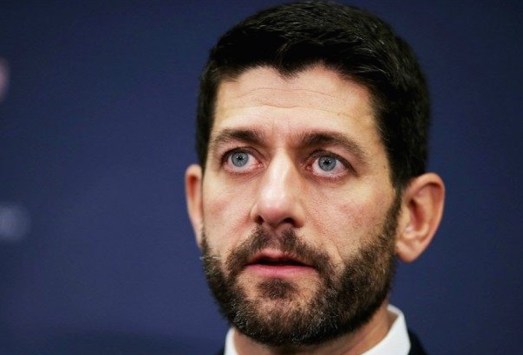
He also had a beard at one point…

When one considers these five points, Ryan’s decision becomes all the more logical but truth be told, we can’t determine exactly why it’s time for him to step down. His overturning, like Boehner’s some years back, seems unlikely, given his stature and position within the GOP. Indeed, even his frothy relationship with Trump has stilled, probably owing to his decision to deal with the President increasingly in person, instead of in a public forum. One would hope, he finally came to the realization that ‘enough was enough’, but that seems a rather hapless and gullible approach to understanding this.

It may not matter- at least for now, our attention will turn to who will contest his seat on both sides come November and who, thereafter, will take the mantle of Speaker in January 2019. With many pundits already speculating about a Democratic takeover in the House, liberals will undoubtedly read this as a significant blow to their adversaries but if history has taught us anything, it’s that the GOP always have something up their sleeves (even if unintentionally).

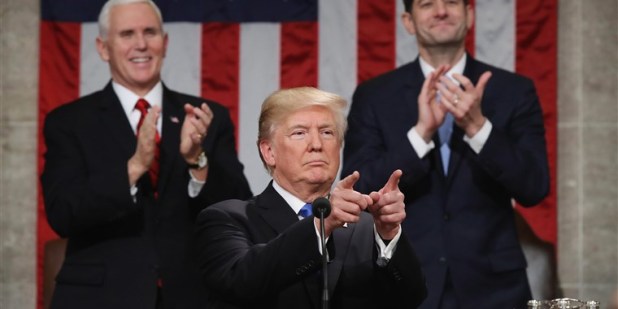
180130-sotu-trump-address-njs-1031p_392638c073d35409bd5a21e6b34dd6df.focal-760x380


Lessons From The Lewinsky Scandal: 20 Years On

Lessons From The Lewinsky Scandal: 20 Years On

20 years ago, the scandal that would define the latter part of the Clinton presidency broke on The Drudge Report. With the advent of the Internet Age, this story would take on a life of its own, exposing a changing media and political landscape traceable right through to today. Although the focus of the scandal would consume the next year’s news, resulting in the impeachment of the president, its elements and themes remain ever prevalent. In retrospect, we can now understand just how significant this cultural moment was for a) partisan politics, b) media sensationalism, and c) the online community / cyber bullying. Just how, you ask?

a) Partisan Politics

To be fair, 1998 can hardly be pointed to as the year in which partisan politics turned ugly. It’s not even when tensions began to spark between the Clinton Administration and the Republican majority. It is, however, reasonable to identify it as the year in which these tensions took a hold of the national consciousness and shifted the focus away from the issues to the ideological fronts on play. In establishing the impeachment process against Clinton in December 1998, the Republicans ushered in a new breed of malice that would become commonplace over the course of the next 20 years.

Of course, Clinton survived impeachment and his approval ratings even soared as the public saw past the petty under goings of the Ken Starr investigation but the bar for civility in politics was undoubtedly lowered. From thereon, the creed of the Republican Party became largely associated with winning on any level, as opposed to winning on the issues. Thus, support for Trump.

b) Media Sensationalism

7bcub

Again, 1998 wasn’t the year sensationalism in the media was born but it easily got vamped up a notch as every sordid detail was covered in this case- from the blue dress to the definition of what sex is (“it depends on what the meaning of the word is is”- smooth Bill, really smooth).

Now, I’m not saying it’s in any way appropriate for the president to have an affair on the job but to be fair, a president’s always on the job and it’s a private matter. The media loves a scandal, of course, so in many ways Clinton can be blamed for digging his own grave. (It is conjectured by many that he’s a self-saboteur.) What many pundits, anchors, and journalists failed to recognize (or rather, chose to ignore) at the time however was a) how distracting their constant coverage was to the political and legislative process, b) how distracting it was from serious issues that could have been addressed- e.g. the growing threat of terrorist activity or the rise of Smash Mouth, and c) how damaging it was to a young woman (which we’ll cover in a moment.)

It’s one thing to make a case out of a proper injustice in the system (e.g. Watergate) but unlike any scandal beforehand, save that, this was covered with more gall and obsession than could ever be justified. And whilst being frank about it, let’s put to rest the claim that Clinton’s evasiveness and lies damaged the moral fabric of America. Yes, he was wrong but also politically motivated like any of the Republicans going after him, to save his own ass so that important things could be accomplished. Of course, many of his greatest opponents, like Newt Gingrinch, would later come under fire for their own affairs. Somehow, that just didn’t leave the same mark on the mass media’s blueprints however.

c) Cyber Bullying

7adb146402a457282081af7f165e3912e6bab151_2880x1620
Lewinsky at her 2015 TED talk

Today, you only have to load the comments’ section on any Youtube video to encounter the ugliest, most vile, and seemingly illiterate people around. In some ways, Monica Lewinsky was patient zero for this new wave of bullying (at least on a national level) and it took a long time for her to come to grips with what had happened, especially because the focus turned to her so immediately. As she remarked in her 2015 TED talk; “overnight I went from being a completely private person to being completely publicly humiliated.”

It could be argued that she hardly helped the situation. She, of course, had an affair with a married man and later admitted to having done this before, all whilst under the delusion that this could result in an actual partnership, swayed by the charm of old Slick Willy. (She even kept the dress…) Her mistakes were her own but the backlash was insatiable, as she struggled for years to find work and at every corner, was reminded of the shame she had brought upon herself and her family.

Years later, she became an activist against cyber bullying, relating her own experiences to those targeted on social media and other platforms: “I couldn’t count how many horrible things people online had said about me, but I could count when somebody said something face to face on one hand.”

This is symptomatic of what’s going on today and ties in with the points above, in illustrating the inner portrait of America that was being painted a la Dorian Gray style. I’m not saying things were perfect before this happened but in these three respects, they were a little nicer and political relations were a little more civil. When you lower your standards, it only gets harder to reach for a higher platform. Trump, the modern GOP, social media, and mass media have largely followed this line to to its natural next breach and where it goes next is beyond daunting.