The idea of historical accuracy, when it comes to film, has always struck me as a highly subjective contest of bias and personal preference. After all, how can one ever truly achieve this goal when one accounts for shifting language, cadence, beauty standards, politics, inaccurate retellings, and scarce sourcing? It’s basically impossible. And yet, that is not to say we shouldn’t at least strive for some target, depending on the genre and artistic direction of the project. The question is where we draw compromise in a changing cultural landscape.
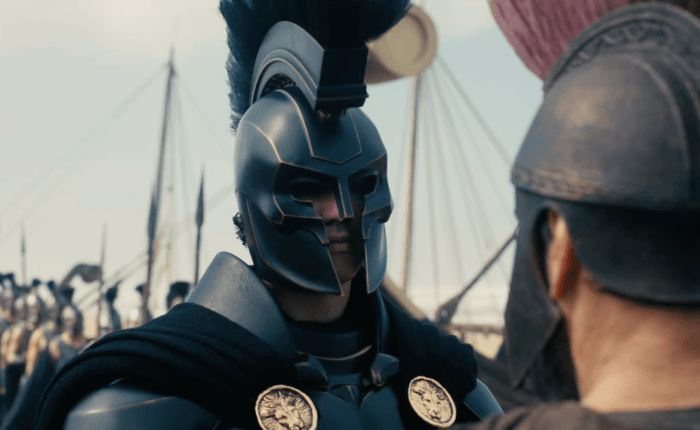
A new trailer for Christopher Nolan’s The Odyssey was released recently, which unsurprisingly set the internet ablaze. How could Tom Holland be saying “dad” in this Bronze Age epic? Would Odysseus really say “let’s go”? What’s with the armour? And the… diversity. Now, part of me would like things to be as true to the period as possible. However, there are two notes worth considering here. Firstly, part of our collective imagination is drawn from the biblical epics of the 1950s, when these movies were more fashionable. They were likely seen as inaccurate then too but have stood the test of time, cementing their legacy atop the minute flaws. Secondly, outside of details like the armour, the time is largely unknowable and inaccessible, if aside from a few general strokes. Suffice to say, they weren’t speaking English. They didn’t have our mannerisms, rhetorics, or way of looking at life, necessarily. They didn’t look like us, even without accounting for races. (Heck, we seem to even look different now from the 1990s). Plus, you know… it’s mythology.
The outrage is quite obviously premised on the debate surrounding DEI in film and television today (i.e. the onslaught of “woke” in our modern culture). I’m not going to delve into a subject that requires a book’s worth of address but in considering the question of compromise, let’s be fair: is it fair to exclude people of colour from one of the rare, prestige Hollywood productions just because you feel it’s not historically accurate? (Especially when it’s one based on mythology that involves a Cyclops.) Perhaps there are subjects and periods where this is best avoided too for other reasons of sensitivity, but given the changing make-up of our population in juxtaposition with the historical great works (frequently revisited, e.g. Shakespeare), historical accuracy can be something of an albatross.
To take “make-up” on another level however, let’s address cosmetic procedures and “iPhone face”. Given they’re such a recent phenomenon, it does seem embarrassing to have someone dolled up with modern aesthetics appear in a 19th-century piece (cough… Enola Holmes 3). Everyone has their own squabbles of course but for me, this is an easy one to avoid. In fact, if anything, people need to look worse if it’s a period piece (cough… Wuthering Heights ’26) or at least as true as possible to the style of that era.
Inevitably, we always seem to fall short despite our efforts. Sometimes, it’s laziness; e.g. with American Hustle, everything feels like a stereotype of 1970s’ styling. Sometimes, it’s a compromise to appeal to a modern audience, most typically with employing modern humour, phrases, and sensibilities (we’re a lot more insincere and referential nowadays). Oftentimes, it’s because the entertainment comes first; after all you have to sell Braveheart to a mass audience to make money. To be historically accurate in telling a story, particularly if it’s biographical, would mean the inconvenience of toning down sensationalism and re-arranging the flow of events. Making a movie is tough work and as they say, you can’t let the truth get in the way of a good story.
When people say they want historical accuracy in their films therefore, I don’t think they entirely mean it. They want a degree of it, for sure, but where that line is drawn simply differentiates by person and by project. It’s crucial to appreciate too that history is always being revised and today’s understanding of, say, the 1920s will differ from the 1960s’. Perhaps, we can only truly capture the times we are living in and to “repeat the past”, as reference to the 2013 adaptation of The Great Gatsby (which says more about its time than the 20s) is a fruitless endeavour.
Tag: diversity
The Politicisation Of Entertainment
In recent years, celebrities have adapted to an increasingly politicised world by themselves becoming more outspoken and vigilant on the issues. On various chat shows and through social media outlets, they’ll let their opinion ring out, regardless of research, originality, or grammar to attain that seal of approval needed to go on working in the industry without being seen as problematic.
So what’s the problem then?
On the surface, it’s not that evident. Celebrities should be entitled to their opinions. They don’t necessarily have to play ball with any mandate. You can simply scroll by if you don’t like what Whoopi Goldberg or Matt Damon has to say. Big whoop!
Well, the problem is that this politicisation has begun to affect the art itself and the culture surrounding it. For example, the other day I decided to punish myself by watching 10 minutes of the Video Music Awards (VMAs) to see what was what with the youths of today. They had a category for “Best Video With A Message” which was delivered to Billie Eilish for her (unusually) unremarkable song “Your Power”. She proceeded to offer vague insistences of people using their power responsibly or recognising privilege. I wasn’t able to pay attention, really. I was transfixed on the fact that this was an actual category at the VMAs- the dumbest awards’ ceremony ever created. After she had finished her speech, several performances then followed featuring twerking and lyrics about haters being haters and speaking one’s truth or something equally embarrassing. But back to the category. When did this vapid, moronic ceremony feel the need to pay tribute to ambiguous social issues? When did these issues, furthermore, become so commercialised?
If one has something genuine to say about race, mental health, addiction, or inequality, you shouldn’t bemoan or ridicule them necessarily. Sometimes, even celebrities can offer nuggets of wisdom with first-hand experience or a good depth of knowledge. Nowadays however, it’s enough to just hitch your ride to this wagon for the sake of trending on Twitter or getting a few, click bait likes. (It’s Prince Harry and Meghan Markle’s career plan.) What was once seen as pandering and distasteful is now seen as courageous and important. (One has to wonder, on a side note, how courageous it is to say something you know will go down well?)
It happens in the music industry with many of the top-charting songs today addressing empowerment on a fundamentally basic level, in literature (with an increasing number of novels tackling issues and story/plot trailing behind as a casualty), and in TV/movies. With regards the latter, this problem is most evident. On press junkets, actors will often be asked to elaborate on an issue or theme in their work (better suited to a director or doctorate student) that their PR has clearly tapped them on. When they don’t answer quite convincingly, it can elicit a Twitter storm. For example, Margot Robbie’s lack of dialogue in Once Upon A Time In Hollywood garnered negative reactions from those who sought to make a sexist out of Quentin Tarantino (ignoring Jackie Brown and Kill Bill) when he refused to pander and answer the question. (Poor Margot wasn’t quite sure what to say but felt she’d been given a good opportunity.)
Hollywood has always been a predominantly liberal market. This is nothing new. Politics have aggressively come to the fore in recent years however, as evident with the movies put up for major awards that lack general popularity or remote commercial appeal (Nomadland) and an increased emphasis on ideology over art. Too often now, I see reviews focusing on the importance of the subject rather than the quality of the project itself, e.g. Black Panther. Similarly, many of the reviews for the Star Wars sequel trilogy were built around subverting expectations and the promotion of a female lead rather than the nonsense stories roughly hewn together without a plan (not even my analysis; J.J. Abrams confirmed it would’ve been better with a plan).
This trail of thought can go a little awry though so it should be stated that diversity is, in fact, a good thing in cinema and TV. It gives an increased number of actors, writers, and directors an opportunity. It promotes a wealth of stories, not seen before. And it attracts a wider net of audiences.
It can’t be the be-all and end-all of creating art however. Problems arise when producers think it’s enough and don’t do the proper work involved in actualising the reality of the stories represented by various cultures. For example, the female-reboot of Ghostbusters was widely ridiculed because it felt, from the offset, like a cheap cash-grab. By ridiculed, it is worth noting, I mean by audiences. Critics are a different matter.
As aforementioned with the Star Wars sequels, reviews can be skewed. Social media dictates a lot of what we’re willing to say today which is why any Marvel criticism can cause a stir online or why super popular figures are beyond criticism in their camps (Beyoncé, Obama, Oprah, etc.) With the politicisation of entertainment, it’s only become a tougher job to give an honest critique of a musical performance (lest you undermine how women are perceived by criticising Little Mix) or a movie like Nomadland (which said a lot about America without the distraction of remote entertainment or story). It takes tact to be a successful critic, these days.
We live in a time when politicians try to grab the public’s attention with the flair or a celebrity and when celebrities speak with the calculations of a politician. For all the good that’s come of these last years, opening the floodgates for diversity and tackling subjects previously not remarked on, we’ve somehow permitted political correctness to infect the arts. If history has taught us anything, it’s that many of the great pieces of literature (Huckleberry Finn), film (Citizen Kane), and TV (The Sopranos) were not created in a space of orthodoxy and permissiveness. Simply stated, the problem lies in thinking we can mandate artistic relevance and excellence.