The piñata that is the Republican Party has been burst open and every day, new morsels are being discovered by the media. Last Friday, we heard that Mayor Danny Jones of Charleston, West Virginia, had changed his political party status to “unaffiliated” in a growing list of disillusioned conservative officials. That same week, several major companies including Apple pulled their sponsorship from the Republican National Convention. And to cap it all off? The man, the Republican loyalists stood behind (if reluctantly), has lost his momentum.
For a year now, the accepted narrative has been that Trump stands no chance against Clinton. Despite mass coverage and the GOP nomination, many remained undeterred. It seems their faith has been rewarded however as his latest hurdle has resulted in a parting of ways with his campaign manager, Emperor Palpatine… I mean, Corey Lewandowski. The poll numbers are no longer looking so good for the man who once promised “so much winning” for America and in the wake of this great cataclysm of popularity, lies the remains of the fractured right-wing. So what happened? Why? And what’s next?
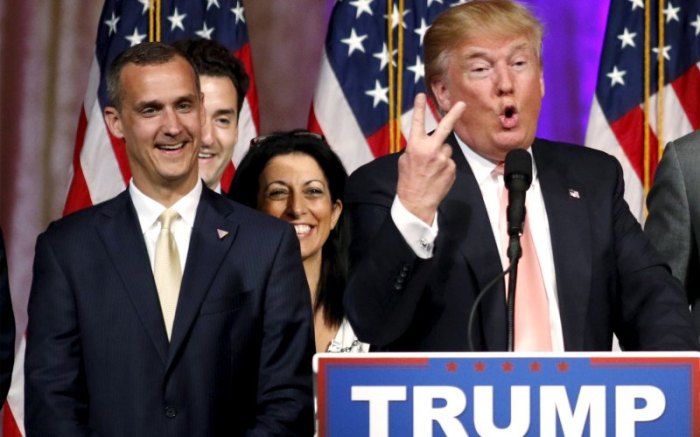
Trump and Lewandowski (left) kicking up a storm.
Since the shining light of Reagan descended upon America, the GOP has adopted an increasingly conservative and radical stance in the political system. This culminated most recently in the refusal to work with the Obama administration on almost every initiative, leading to a Government shutdown on Obamacare. With the culture wars wagging their tails every now and again, the great beliefs of the usually strongly united right became that America was losing its identity. Even the vaguest idea of making it “great” again was so appealing that a man like Trump, strange though he may seem, at least had to be considered. And in their desperation for this fabled era of prosperity, the fractures which set a part fiscal conservatives, social conservatives, tea-party members and cowboys, widened so much so that the GOP abandoned whatever shred of dignity they still held.
Since securing the nomination, a tenuous effort has been made to cobble this mess back together and create something sufficient, lest the Wicked Witch of New York, gain power. The problem is however that it all seems so forced. Even Speaker of the House, Paul Ryan, a man who should really have a pivotal role to play in this, has a hard time vocalising just what he wants. He think Trump is a racist and bigot and should not be encouraged by any means. He also believes Hillary is not the “answer” and therefore Trump must win. His role however, he asserts, is not to tell delegates what to do. It’s the kind of stuff you could imagine seeing on Saturday Night Live but alas, Ryan is presently a tortured soul. It therefore seems the pieces will have to be picked up by Trump himself, who will undoubtedly face the least reserved GOP convention in history next month.
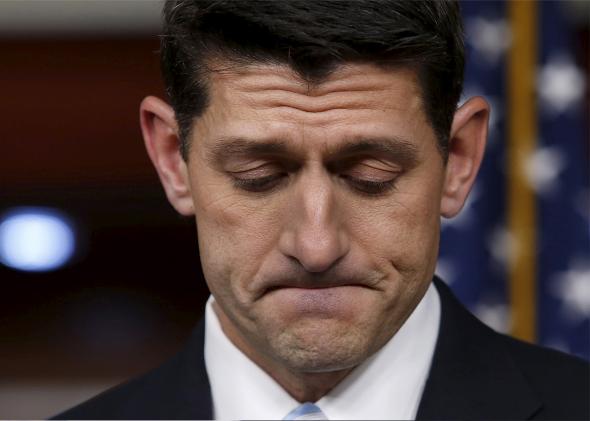
Paul Ryan’s the kind of guy who holds up the drive through with his indecisiveness.
It’s hard to imagine exactly where this party will go next. They could simply reform if Trump loses, pretend as if 2016 never happened and go after Hillary, the way they have done with Obama. After all, remembering things accurately has never been a top priority (remember, Reagan raising taxes, anyone?). They could also have a long look in the mirror, smash it, and treat the likes of Trump as icons of a prevailing radical right, in stark contrast to the rising Left. Lastly, they could not smash the mirror and realise their party can only redeem itself by returning to the principles which once held it in high esteem. Fiscal conservatism, a lower-taxed market, and small government are not necessarily bad ideas if executed with a degree of rationale. They just need to be checked with compromise where compromise is needed and common sense where alternatives yield better results. Richard Nixon understood this when he proposed an ambitious health care plan, alienating himself from many members of his party. George H.W. Bush, too, understood this when he abandoned his pledge and raised taxes to help stimulate the economy. Perhaps, 2016 can mark the beginning of the end for modern conservative practises and a return to form.
Is Hillary still a woman? No, I don’t mean in the old hick “look out, she’s going into the wrong bathroom” kind of way, but rather in the context of this entertaining election. As the primaries draw to a close and Donald Trump begins to scour Facebook for any trace of a scandal linked to the Clinton camp, it can’t helped but be wondered whether the question of gender politics is playing the pivotal role it once did in America. At first, I simply thought “no.” Whereas in 2008, the prospect of a first Black or first Female president was so alluring, today it seems like more of a tangent to a larger debate. Upon inspection and analysis of this race, the political commentary and debate however, the question opened up a great deal. So whilst this main point will be addressed further, it’s certainly worth exploring the recent history of women in politics before the related question of why people dislike this woman/politician so much.
Thatchers in America
It’s still difficult to be anything but stern and tough if you want to be a respected female politician in many countries. In the 1980s, many figured this philosophy with the draconian measures of Ms. Thatcher (depending on your viewpoint) and while there’s been progress since then, the gameplay isn’t exactly equivocal between men and women. This might, in some respects, justify the pompous, disingenuous image Clinton has cultivated over the years – a means to survival. It may also just be a theory. In the debate on gender politics and feminism, there can be a lot of conjecture on hand.
Women, of course, have not been fairly represented in US political history. They were only given the vote in 1920. They only saw their first elected Senate representative in 1932 with Hattie Caraway and since then there have only been a further 45 women anointed to that chamber of Congress (and through staggered junctions). In fact, even as recently as 1992, the ‘year of the woman’ (because a staggering five female senators got the job-and all from one party), that divide was evident.
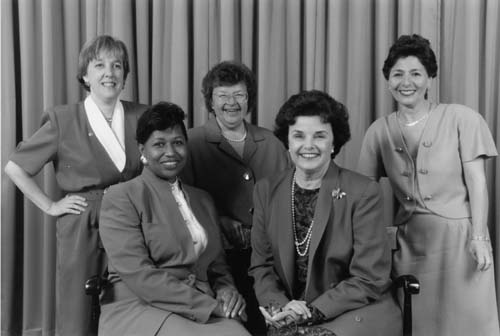
1992: Year of the Woman- the same year Bill Clinton was elected to office.
In terms of the presidency then, one can imagine there’s been far less representation. As of 2016, seventeen women have managed recognisable attempts for the coveted position (going by popular vote accounts) and two of them are Hillary Clinton for 2008 and this year (the rest would be relatively unknown to most.)
There are now 20 women in the Senate and Hillary is the likely frontrunner for the Democratic Party. In the 1950s, less than half the US population would have voted for a female presidential candidate. Today, over eighty percent would. Whether this politically correct culture has had an affect on how people present their views is also worth considering but for the most part, through all the folds and exceptions, there has been progress.
Haters Gonna Hate, Hate, Hate…
Taylor Swift has a knack for melody but it’s not enough to just say “haters are going to hate.” That’s moronic. People do strongly dislike Hillary though and some of their reasons may be unjustified. For example, in March, the Ms. Magazine blog posted an article on three ways “to tell if your distaste for Hillary Clinton is sexist.” These included a) taking umbrage with the problems of the Clinton years but liking old Slick Willy, b) deciding you hate her first then collecting substantive reasons, and c) holding things against her for which you have forgiven others. Aversive sexism is undoubtedly an issue in modern society and a genuine concern could be that people will preach one thing and act on another (reverting to conservative instincts in the polling booth) by giving Trump the thumbs up. Likewise however, the Guardian also found that many women consider Trump just “creepy.” That said, he has referred to menstruation as being the cause for Megyn Kelly’s “outrageous” questions so it’s hardly balanced.
One of the most useful platforms for finding the unedited, unreasoned thoughts of the public is of course the YouTube comments’ section. I took to this to see if there was some element of truth to the idea of averse hate (even if not sexist). Among misspelled links to bands’ channels and escalating arguments, I found a lot of this, e.g. “I hate that smirk she has every time she finishes a sentence.” Compared to many Fox hosts’ smirks, Clinton’s is far from the worse though I found the majority of discouragement of her to be associated with policy and general dislike, rather than sexism. Granted, most of the commenters appeared to be young men but a lot of anonymous people speak in ways they never would in person.
That smirk from an ABC interview- granted she will have to do something about her laugh.
Many people recognise the fear of being labelled sexist too. Just as these YouTube commenters resolve to knock down Clinton, many of her supporters in return react with unqualified claims of bigotry- the PC police. Articles such as the Huffington Post’s “I Despise Hillary Clinton, And It Has Nothing To Do With Her Gender” convey this level of heightened social awareness. Other articles have attempted in the meantime to contextualise and separate this issue altogether. For example, a New York Magazine opinion piece earlier this year stated; “[there} is no Big Feminism anymore, and no agreed upon figureheads – at least no one to rival Steinem’s fame and iconic status. Today feminism is more about personal identity.” That’s not unreasonable. Many liberals despise Clinton for only her stances, as evidenced by their love of Senator Elizabeth Warren.
So what are these stances? What are her flaws? This hardly needs to be touched upon in detail, considering the feed of commenters out there but for the most part, Clinton’s detractors find her politically motivated and malleable to trends. Her once against-now for stance on Gay Marriage, comes to mind, as one instance of this. Her own compromised marriage too, is drawn upon by many as an exemplification of the calculated moves she has taken this far. Then, there’s the series of scandals that have dogged her career from Whitewater to her Iraq vote, Benghazi, the e-mail scandal and whatever’s next. Against Sanders, these shortcomings have been especially magnified which lends credence to the argument that Clinton’s detractors have just cause for their outrage.
For us, it’s just another manic Monday. For Hillary, another Benghazi.
As It Is – This Election
Leaving aside the historical context of female political leadership and Clinton’s own facets however, how has the gender card been played out in this election specifically? Naturally, Trump has fudged up his alliance with any suffragette movement by acting the classic 80s’ masochist douche, leaving Clinton with a hefty advantage in that vote. While younger women (18 to 29) have generally preferred Sanders, this margin has played out in her favour for the most part with 70% women’s support in the Mississippi primary, 63% in Alabama’s and 42% in Texas’. Sanders too, that beacon of dignity, even came under fire from her camp when in response to asserting that “shouting” wouldn’t do anything about America’s gun problem, Clinton replied that it’s never “shouting” when it’s a man. Ouch. Was there justification for this or could it be argued that Clinton was playing the gender card herself? “If [she] were a man, I don’t think she’d get 5% of the vote” opined Trump in April for the Washington Post. Well, that is Trump but many might yet agree.
As it is, the poll data is showing that there is no state where women don’t make up 54% of Democratic voters. The gender card, in this sense, is a crucial one which can’t be ignored, even if its utility is immoral. When it comes to the general election then, assuming Clinton’s candidacy (based on today’s results), it is likely that Trump will need a different strategy (given the percentage of population he’s alienating). That said, one of Clinton’s greatest flaws (regardless of any gender politics) has been in her underestimation of the electorate. Sanders already proved her victory was not secure when one year ago her success was inevitable. Female voters too, though faced with the alternative of Trump, will not vote for Hillary just because she is a woman. Years ago, many would have assailed against the notion of a female president. Today though, they also assail against Hillary Clinton.
If there’s a central theme to the 2016 election, it is outrage against Washington. Whether it’s with the Panama Papers or Campaign Financing, the majority of Americans feel great frustration with an establishment that seems bent on obstructing any meaningful change. The superdelegate system, in this regard, may be seen as just another obstacle in the path of democracy; with its concern rising higher on the agenda as the clash between Sanders and Clinton sparks towards New York. Others however, would argue its significance remains as crucial today as did back in the 1980s when it was conceived for the consolidation of the Democratic Party.
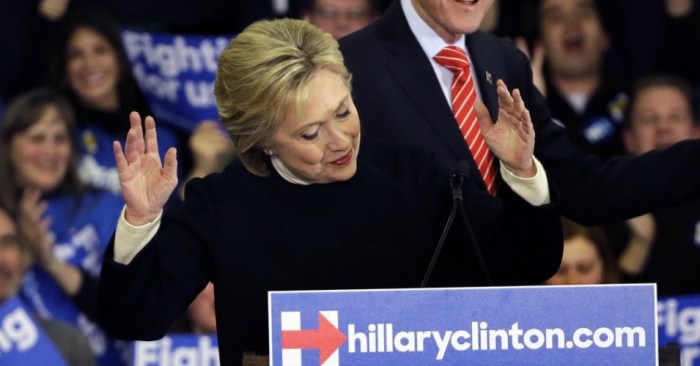
Hillary has the backing of the party’s elites. She even has a former President at her side.
There are 718 superdelegates involved in this year’s DNC. They are essentially unelected delegates, comprised of party leaders, governors, congressmen, and DNC members, who are free to cast their vote of their own volition this July in Philadelphia at the convention. Presently, their pledges therefore don’t count for anything but political pundits and avid supporters are nevertheless paying attention to the 472 pledged to Clinton, 32 to Sanders, and 207 uncommitted. It’s important in that these so-called pledges hold influence over some voters (who may be unwilling to support a ruffian like Sanders) and in that they have been toted up irresponsibly by many as assumed votes already, thus giving the impression that Sanders’ campaign is beyond hope.
The system came about as a result of disappointing election results for the Democrats. As Jim Hunt, the 1982 Chairman of the Democratic Party Commission explained eight years ago in a Washington Post piece, 1972 saw a Democratic Party ‘out of step with mainstream Democratic leaders.’ George McGovern, the nominee that year, lost a devastating defeat to Richard Nixon. Four years later, Carter prevailed but his Presidency and defeat in 1980 proved that it wasn’t even ‘enough just to win;’ clarity and cooperation between all branches of the party was needed. It was a means by which the party’s greater interests could be accounted for with 1984 seeing its first contenders rise to the fore. They exist ‘really to make sure that party leaders and elected officials don’t have to be in a position where they are running against grass roots activists,’ according to today’s Democratic Chairwoman, Debbie Schultz. Today, of course, superdelegates account for 15% of overall votes in the party’s nominating process; a troubling portion to many.
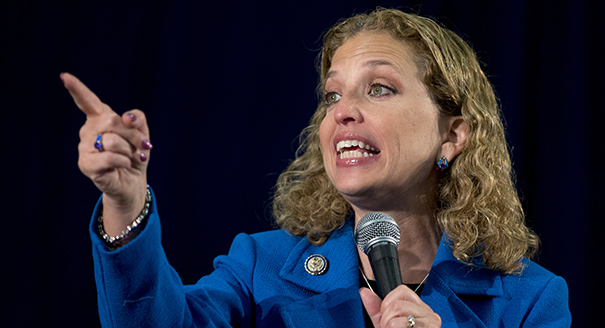
Debbie Schultz, Chairwoman DNC
To address its defenders first, it must be acknowledged that in 1980 the Democratic Party was bitterly divided with Carter’s own nomination being called into question by the challenger, Ted Kennedy. To defeat the Republicans, some kind of system was likely needed and this system, whilst democratically questionable, seemed reasonable to many at the time . Indeed their presence could be taken with a grain of salt as the Democratic Party’s rules dictate that these delegates should ‘in all good conscience reflect the sentiments of those who elected them.’ Are they doing that, though?
The Sanders’ campaign is playing a much tougher game today than it was a couple of months ago when the New Hampshire primary resulted in a virtual tie on an account of these premature pledges, despite Sander’s 60% public vote. Since then, reports have circulated that superdelegates are relentlessly being messaged with calls for support on his side. For some superdelegates vowed to Clinton’s side, this is causing great agitation amongst those who believe these delegates aren’t representing the people of their states. As aforementioned though, they are not voted for and their allegiances mainly derive from statehood and past representations; some are merely old stalwarts of the party. Others, like Peggy Schaffer of Maine for example, are less certain on their final decision. Having been a longtime Clinton supporter but witnessed Sanders win her state, she has decided to opt for whichever candidate winds up with the most pledged delegates. And those who have outright ‘offended’ Sanders’ most valiant supporters, like Akilah R. Ensley of the Young Democrats of America, have been bombarded with messages bordering on abuse via Social Media for her support of Clinton.
Young folk are especially annoyed with the superdelegate system
In many instances, this doesn’t paint a wholly positive picture of the Sanders’ campaign but as many have argued, this system may justify such responses. Sally Kohn of CNN, for example has reiterated the DNC’s account of the superdelegates’ role as one which exists ‘to preserve the power and influence of the Democratic Party’s elite.’ Naturally in this day and age, online petitions have therefore begun to gather momentum, with some calling for the removal of superdelegates altogether whilst others simply ask for them to align their vote with the choice of the regular voters. Then, there is Spencer Thayer’s ‘Superdelegate Hit List,’ a sinister sounding but simple website list of superdelegate contact information, which has served to only add fuel to this fire. It will of course remain to be seen whether some of them end up feeling the blame but as it is now, he will need to muster landslide defeats in the next few contests to secure the 2,383 votes needed for nomination.
The superdelegate system may not be a complete barrier to winning the Presidency but like Citizen’s United, it is hard to argue that it doesn’t make things much more difficult for candidates like Sanders. Many argue that it’s still possible that those pledged to Clinton would change their mind (as they did in 2008) but many more seem to fear, even given success in states like New York and California, the superdelegates would screw Sanders over. The memory of those defeated liberals between 1968 and 1988 remains a sore note for the Democratic Party and Clinton, in the end, may just be the safer bet.




 The Washington Walrus