A Bridge Collapsed: The Biden Presidency

A Bridge Collapsed: The Biden Presidency

Had President Biden made the decision to withdraw from the 2024 race earlier, we might’ve been writing a much different story. Alas, his refusal to do so (in conjunction with his initial proposal that his presidency would mark a “bridge”- like transition to a new generation) will likely be the first thing people recount when asked about his legacy. As it stands, this legacy looks on the grim side of things; at least, according to a Gallup poll which showed 54% of Americans viewed him as a “below average” or “poor” leader. But… history has a way of changing perspectives and so in complete folly, we’re going to (already) try and take the longview in assessing this administration.

Well, it’s a bridge of some kind, albeit between two terms of Donald Trump. So assuming the historians hold true on their negative assessment of Trump’s tenure, they’re not going to be too pleased with Biden for enabling his comeback. Granted, a lot of that blame can be placed at the feet of top Democrat party heads too but the story of a fractured party, torn by generational and cultural values, doesn’t exactly help Biden’s case. Had a more effective coalition been built, there might’ve been proper competition for the MAGA crowd. Instead, this party floundered and yielded way for the return of a stronger Trump backing. 

Granted, some of this was beyond Biden or Trump’s control. The chaos of the pandemic, for instance, was always going to have severe economic repercussions and this came in the shape of a massive 9% inflation rate in 2022. Like Jimmy Carter or any other unfortunate president before him, Biden simply had to take the hand he was dealt. To his credit, he passed sweeping legislation such as the Inflation Reduction Act to tackle this but since prices never went down, the average person was unable to see the benefits of such actions. In actuality, the economy has improved, with record-low employment and a record amount of applications for new businesses. In the next couple of years, Trump will undoubtedly take credit for the changes in fortune as they manifest more clearly. Unfortunately, sound economic policies just can’t be waved as a flag until everyone has else got theirs.

For that matter, the major achievements of the Biden presidency, such as the CHIPS act, his supports of unions, and infrastructure bill seem to pale against the half-glass empty analyses, i.e. the revelation that there are still some ways to go. This will always be true with regards any measures taken by a sitting president (who can only face tough decisions). For example, while the “Plan B” proposals of his student-loan forgiveness scheme were withdrawn, he still managed to achieve $180 billion in loan forgiveness. 

And then there is foreign policy, where there are domestic differences to contend with. Given another era, there probably would’ve been a consensus in the US against Russia. In the 2020s however, there’s even a faction of Republicans who favour their former adversaries over the Democrats, complicating the funds appropriated for Ukraine’s defence. Biden has been steadfast in his support of NATO and a strong ally of Zelensky, but as Trump prepares to take office again, a question mark lingers over how this will resolve. With the Palestine-Israel war then, we have seen divided opinions in the US on an ethnic and generational level. This has marked a shift away from the broad support Israel was once guaranteed there, with critics of Biden’s (and continued US foreign policy) arguing he’s helped facilitate war crimes in the Gaza Strip, failing to ever hold Prime Minister Netanyahu’s government to account. Should the very recent ceasefire hold, Biden might be looked on with some deference eventually, though it’ll be eternally countered with questions of why he couldn’t have pushed for peace sooner. This will also likely go down as the most contentious foreign policy decision of any president since George W Bush. We’re also going to have to contend with speculation on whether the incoming Trump administration was a greater factor in allowing this to pass.

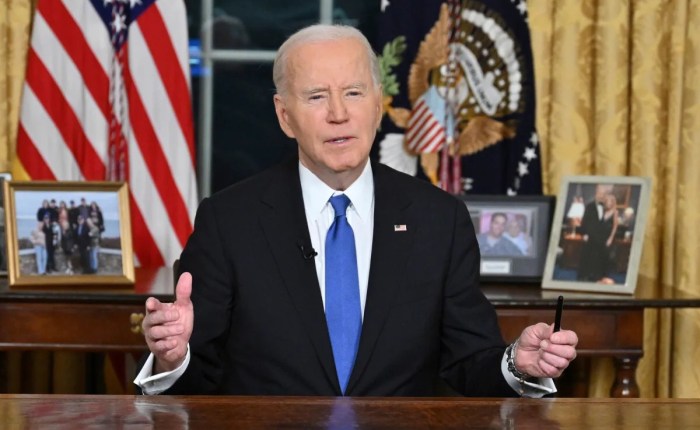
Whichever way you look at the Biden presidency, Donald Trump seems to hover over it at every turn. The return to “normalcy” or the goal of “restoring the soul of the nation” has either fallen flat or been dismissed as liberal hogwash. Trump has, in a sense, been legitimised this time around; by virtue of winning the popular vote and the Democrats’ own flawed power dynamics leading to their own downfall. And despite a relatively decent farewell address, one can’t help but roll their eyes when Biden warns against the abuse of power, weeks after pardoning his own son (who apparently was above the law). The problem remains that the top Democratic Party members appear too elitist, slow, and out of touch with the people. And for much of Biden’s term, that image was capitalised on, with every stutter and pause exemplified to the Republicans’ benefit. As it stands, the Democrats are weakened and down on their luck. Of course, they’ve been handed major defeats in the past and come back before but it’ll take a proper chance to mobilise their base next time; a new generation with some authenticity. If one thing can be learned from these last few years, whether with the election or Biden’s cognitive decline, it is that you can’t pull the wool over the people’s eyes forever.

Jimmy Carter: A Tribute

Jimmy Carter: A Tribute

The passing of the 39th president comes with a sense forlornness for the times and values now lost to us. In the summer of 1979, as inflation and the energy crisis dampened the American spirit, Carter came to address the nation, not with a false message of hope and optimism, but with a sincere and honest warning. “Human identity is no longer defined by what one does” he said, “but by what one owns.” Well, nearly half a century on, this concern resonates like something of a prophecy.

Carter was an unusual case in the presidency; an outsider with values that didn’t gel with the elite of Washington. Namely, honesty. This of course led to a lot of difficulties when it came to pushing through tough bills addressing inflation and the energy crisis. He also clashed with key figures in his own party and even faced an internal challenge for the candidacy in 1980 with Ted Kennedy. Ultimately then, he would be rejected at the polls when faced with the patriotic message of Ronald Reagan. Throughout however, he appealed to the good will of the people, setting an example to follow (by reducing the heating in the White House and donning a sweater and installing solar panels with respects energy; getting out of the limo to walk on Inauguration Day to demonstrate change; and devoting himself day and night in his final months in office to freeing the hostages). His legacy, as a result, rests more on the nature of his character and intrigues of what could’ve been, than the actualities that occurred.

To be fair, even his most ardent fans (which I consider myself one of) can’t argue this was a wholly successful presidency however. Had he co-operated a bit more with the Democratic Party and compromised for political capital, things might have gone differently in 1980. As it was, Carter did what he could at the time, chipping away his political lustre by eliminating what he deemed wasteful projects and pushing for the return of the Panama Canal, among other things. The American people, it seemed, just weren’t willing to accept hard times and pivoted to Reagan and the era of “greed is good” as a result. For awhile then they felt good as the economy improved and the Cold War came to a close with the US emerging victorious. In these important years however, the groundworks for unfettered capitalist (trickle-down) economics and sketchy politics were normalised, rotting away at the core of America. In light of how things have gone, one can’t help but wonder where the US would be today had they taken a second chance on Carter.

Would the US be less reliant on foreign energy? Would the world be in a better place to tackle climate change, given the emphasis placed on solar power? Would further peace talks have taken place in the Middle East, buoyed by the success of the Camp David agreement between Israel and Egypt? Would there be less of a gulf between rich and poor, assuming Reagan’s economic policies failed to come to pass? Would national health insurance have become a thing much earlier? (Carter came close until Ted Kennedy withdrew from negotiations, aiming to bolster his chances at the presidency.) It’s difficult to say, since the presidency is only one cog in the machine but Carter’s second term is one of the most intriguing “what ifs” for me, because he was genuinely different from any other president; far less beholden to the two-party system or short-term political gains. Not a Republic but not exactly a Democrat either (at least for the times) Alas, perhaps it is what we most admire about Carter that made him susceptible to the pit-falls of Washington. The post-presidency of course became a whole other story, affirming what Carter’s supporters always knew about him (with regards his commitment to human rights and service), while forcing his detractors the addendum that he was at least a “great man”.

The Re-Framing of Donald Trump

Something has shifted in the perception of Donald J. Trump. Even before the assassination attempt last weekend, there seemed to be a quelling of the crime and dystopian associations being levied his way in the media and online. It is perplexing in a sense, given his loss in the Stormy Daniels’ court case and the the amping up of rhetoric by the Biden campaign (vis a vis Project ’25 and January 6th), but it seems those matters just aren’t registering the way many would hope. Instead what’s emerging is the picture of a strong leader ready to get business done. Is this a genuine re-evaluation? Collective amnesia? Or simply, the more interesting narrative to be pushed forward?

Well, it’s always going to be a mix of the three isn’t it? With regards this re-evaluation, I’d argue some are falsely equating the stronger economy of the late 2010s with his successes, even though these changes take years to manifest. Since everything’s so polarised nowadays however, one can see why confusion would abound when Biden points to the deficit Trump established as an excuse for the poor state of things now. Inflation’s been covered suitably in the last several articles so I won’t delve into it here but basically “perception becomes reality”. So even though it’s unfair, Biden will undoubtedly be associated with the high inflation rates of 2022 where Trump will be with pre-Covid.

Then with the collective amnesia, there’s a tendency to forget the details of the past and look to the present and future with any president. Despite George HW Bush’s success with the Gulf War for example (leading to a 90% approval rating), it didn’t much matter a couple of year later when (again), the economy took priority. So many of the controversies of the Trump presidency have faded into the background; with his handling of Covid almost wilfully dismissed as a “strange anomalous time for everybody,… who knows what was going on then”. January 6th is more surprising. The democrats have relentlessly pursued that in making a case against Trump but to seemingly less effect each year. Maybe it just wasn’t consequential enough for the average voter to care: shocking to be seen but nothing to be concerned about on a day-to-day basis. I would argue this remains a concerning moment, in building on (rather than diminishing) the cult of Trump but alas, it seems things will have to escalate for that to become clear. It’s always a matter of urgency with these things.

Tied into January 6th now is of course the assassination attempt. The shooter’s motives remain ambiguous (registered Republican, otherwise liberal?) but Trump’s supporters will nevertheless have a point of contention when arguing for extremism on both sides; e.g. Biden calling for a “cooldown of rhetoric is rich given the existential threat he keeps pushing with Trump”. And given Trump survived and emerged for that photo op, it’s very difficult for anyone to portray him as anything but a fighter. It fits a narrative so well that it feels like the race is essentially over. His proclamation that “God was on his side” (despite someone dying at the same rally) should ring alarm bells but instead it seems to have struck a chord at the Republican National Convention this week, where a party stands unified. 

Naturally, we can’t talk about the narrative of Trump’s survival then without touching on the decline of Joe Biden. That’s where the media has pivoted most, even with those who traditionally backed him. Until that debate, I still believed Biden had a chance at re-election, had he given a strong performance and exposed Trump for his lies. But… well, let’s just say that last article on the debate has already aged like milk. Biden’s cognitive decline has been spotlighted everywhere from CNN to The Daily Show and he’s highly unlikely to recover. As it stands, he looks to be heading down the Ruth Bader Ginsburg road of leaving the stage well after he should’ve, securing a goal for the other side. With that said… to offer a glimpse of hope for a Democratic victory; the election is not over. And just as things have so dramatically shifted in the last month or so, there’s time for them to make a comeback. But it won’t be with Joe Biden and likely, not Kamala Harris either. Rather, with an open convention next month, they could introduce a new (younger) candidate to stand up and take the cameras away from Trump and offer something fresh and exciting. It would be the “twist” the media would devour; a necessary move in my opinion, for if nothing else, Trump knows how to play the media.

Trump v. Biden: The First Debate (2024 ed.)

Trump v. Biden: The First Debate (2024 ed.)

Back in September 2020, myself and a couple of friends discussed whether or not it was worthwhile for Joe Biden to debate Donald Trump. While the former president and clown prince of crime’s theatrics would surely play off the televised medium more fancifully, we felt it was important for Biden to take a stance in establishing normality again. Now, four year later, things have changed. The once-challenger, now incumbent has added much clout to his nickname “Sleepy Joe”, thanks to a number of recent bewildering public appearances, whilst his opponent has racked up an array of criminal charges, already convicted of one. Neither prospect is exactly gleaming in the eyes of the public, with a recent CBS poll showing Trump leading by just 1%. Will Thursday’s debate change much? Given how polarised the country has gotten, probably not. Nevertheless, I thought it worth exploring anyways for the heck of it.

Firstly, we should acknowledge how two rules, crucially, seem to suit Biden more: that there will be no audience and mics will be muted when the other person is speaking. Lame. On the other hand, there will be no pre-written notes either, which is fine for Trump since many of his best zingers seem to have come out of the moment, particularly in 2016. So if he can produce a couple of new greatest hits (in line with “weak-sauce Jeb” and “I should’ve won [the Emmy]”, then Biden may be in trouble. His material simply isn’t as entertaining. Having said that, we didn’t see as much of that as in 2020, when Trump’s maverick status had started to veer from hilarious if dumb to deranged if occasionally hilarious.

Supposing “the issues” come up in this debate, the candidates will likely spar on inflation, immigration, Roe v. Wade, and funding for Ukraine, among other matters. (Undoubtedly, the culture wars will seep into the mix too, since both sides see each other as an existential treat to the country vis a vis the fight for democracy, lawlessness, the far left, and so on.) Biden will make the case for an economic success story, which he can back up with GDP and unemployment figures. Trump will argue inflation has been a disaster for the country and that people’s wages travelled a lot further four years ago (from the book of Reagan). In tandem with this, he may throw his lot in with the Republicans questioning how much money should be put into defending Ukraine. Then, he may move onto the border. It depends how much time is wasted and what questions are asked (maybe that doesn’t even matter).

Biden will be on the defensive against a range of broad accusations and probable lies. Since perception becomes reality and the visual spectacle matters as much (if not more) than the content of what they’re saying, combatting them one by one may not prove the most effective strategy. Debates have swung one way or another for a variety of reasons, from JFK wearing makeup in 1960 to George HW Bush checking his watch during a question in 1992. Given the narrative that the president’s not “all there”, he needs to be as sharp as possible and to the point without any stammering or lost gazes.

Should Biden choose to hammer on the point of Trump’s multiple legal troubles, he will of course have to answer for his son, Hunter. Many people will of course come to the lazy false equivalency that both candidates are mixed up in corruption and so “it’s a wash”, but to Biden’s credit, he never tried to intervene or stir the legal course of action with regards Hunter’s mishaps. Perhaps that can be used to his advantage. Perhaps he can point to the kind of accountability he and his family take, which Trump has tried to elude and undermine. Perhaps that will work…. Though perhaps not.

One of the main issues Biden has returned to in his case against Trump is the January 6th Capitol Insurrection. This will likely be a talking point which he can exploit by asking Trump if he will concede the election should he lose again. I’m not sure what Trump’s strategy will be here, other than to deflect to other matters and emphasise the bias of the mainstream media against him. He will have to try wiggle out of it somehow and Biden, in turn, will have to keep the spotlight on this. But again, since everything’s so politicised and since three and a half years have passed since, this also may not matter much.

If I were to advise, without any moral culpability, I’d tell Trump to needle the president on the devastating effects of inflation on the average person and crime in America. For Biden, I would advise trying to keep up his 2020 performance, while pushing Trump on January 6th and how disastrous his first term was, thus resulting in him “losing” (emphasise that word) the last time. At this point, I predict a Biden victory in November (if a lesser one than before). While Trump’s percentage lead is not to be dismissed, he has come down in the last couple of months and come election time, he’ll have been raked through the fire a lot more than he has been the last couple of years, in which he’s been uncharacteristically absent from the spotlight. (Relatively speaking.)

The Economy Is Strong But Nobody’s Buying It

The Economy Is Strong But Nobody’s Buying It

In a recent CBS/YouGov poll, 59% of people questioned described the current economy as “bad”, with nearly 2/3 believing it was stronger during the Trump administration. This stands in sharp contrast to what the experts are saying and what the numbers show: GDP growth was 3.3% last quarter, unemployment down to a record-low of 3.4% (from 6.9% when Biden took office), consumer spending is up, inflation is down, etc. The fact of the matter is, despite these impressive indicators, the “average Joe” just isn’t feeling the good times or benefits. This can likely be attributed to years of price increases prior to recent change, the uncertainty of the Covid years, and staggering interest rates. In tandem with the general politicised air of today, people feel vulnerable to what’s been described as the “vibecession”, an addendum to the “perception becomes reality” thesis.

Needless to say, this is a major problem for the Biden camp as the election approaches. As with our last piece on Biden’s presentation of his age, it’s not necessarily effective to just state that everything is fine or “the economy is strong”. The lapse in credibility comes from the day-to-day reality of gas and grocery prices; the latter of which have remained high despite the slow-down of inflation in the past year. Indeed, the gravest mistake the Biden camp has made in this respect has been to emphasise this improvement, while blatantly ignoring how desperate the rate of inflation was in 2022 (8%). Either side of that (4.7% in 2021 and 4.1% in 2023) aren’t exactly great either, when you compare with the 2010s’ figures (e.g. 1.8% in 2019). So while the economy is on the right path, people are still feeling that 11% increase in grocery prices (2021-22), which normally would have been a 2% annual increase. 

As elections are largely media driven, we must remind ourselves that fear is unfortunately a big selling point too. Therein, the anxiety surrounding what may come seems to be more pressing than ever. As the invasion of Ukraine sent energy prices skyrocketing (albeit far more in Europe), people have become wary of international affairs having knock-on effects. The beginning of last year was marked by reports of massive layoffs in the tech industry. AI meanwhile, hovers as a merciless shadow over the proceedings of so many more. The housing market, of course, remains a mess as people resist selling, lest they lose optimal interest rates. And some economists have speculated that recent consumer spending (or splurging) could create vulnerability in the market going forward. It may be a glass-half-empty approach to looking at things, but the notion of a “vibecession” (while cringeworthy as a term) is not a merit-less one.

Again, it takes time for economic improvement to translate into reality. Back in 1992, George HW Bush’s electoral hopes were partially dashed by an 8-month recession (which ended in March 1991). The sluggish recovery cast doubts on his ability to govern domestically, leading to the popular slogan employed by the Clinton camp: “it’s the economy, stupid”. A compromise on his 1988 “no new taxes” pledge had actually helped set the stage for the growth of the 1990s but alas, despite recovery by the election, Bush’s image never faired as successfully.

Will Biden’s? There has been a longer stretch of economic prosperity than in 1992 (unfortunately mired by high inflation rates) but should things keel out and continue as they are, I think there’s cause for optimism in his camp. There’s still eight months to go and the creation of new jobs and businesses are likely to bolster his image. But it’ll take some strategic selling and frankness. As with the matter of age, perhaps Biden needs to acknowledge the perception out there; how devastating inflation’s been, while promising in turn to challenge unjust profits on the parts of certain corporations. He took a step in this direction during a Super-Bowl break, by addressing the scandal that is “shrinkflation” (where product sizes shrink but prices remain high; this is whole other article though so I won’t delve deeper for now.) He needs to continue fighting for an economy that works for low- and middle-income families, via cost of living prices, as well as the bigger picture trends of GDP and employment. Again, it’s the perception that becomes reality.

One Year Out… Does Biden Still Look Good?

One Year Out… Does Biden Still Look Good?

To answer quite literally; yes, I think Joe Biden looks dashing for a man pushing 81… But the ellipsis begs the further question of how he will look when he’s 82- which he would be upon commencing his 2nd term in January 2025. Well…

Running the country is different from running for the presidency. If we were to chalk this up to the record, Biden would look quite good (at least with Democrats). He’s gotten the US out of Afghanistan, lowered drug costs, made a start on cancelling student debt, and passed an inflation-reduction act, to name a few things. But… those measures simply aren’t painting the larger picture, which is that of an old man struggling to load up a restaurant’s QR-code menu on his phone (I know, frustrating for all). He’s old news. Past it. Out to pasture. Bamboozled by the times. Pork chops for dinner. Why, he’s even older than the president who was elected 31 years ago. The man’s ancient. Now, wisdom is acquired and in theory, having an older leader is no bad thing. But at some point, perception trumps (sorry) reality and if the latest polls are anything to go by (39% approval; Trump supposedly leading in 5/6 swing states), Biden’s not looking like a promising prospect anymore.

Biden’s detractors and supporters both fear he will struggle in the debates. While he held his own reasonably well against Trump last time, he may struggle in 10 months. Trump’s only several years younger but he just doesn’t wear his age the same way. It’s like his ego has sustained him with an unnatural propensity for spewing entertaining nonsense. Sure, Biden can fact-check him but I’m inclined to agree with Dave Chapelle’s analysis that Trump comes across as an “honest liar”. He may not know what he’s talking about but he’s not playing to the weary cringe-inducing politic-speak Biden or Hillary indulge in. Plus, last time Trump was running, the pandemic was hampering his support. This time around, virtually nobody will care about that and Biden will have four years of political baggage to account for. Basically, he’ll be playing defence this time around. 

And the defence will likely be centred around his son; Hunter Biden. That’s a whole other kettle of fish but again, since perception trumps reality, and the Republicans have been beating this drum for years now, it’ll be tough for Biden to avoid this. Perhaps too, it stings his supporters to admit that this was newsworthy, even if slight against the plethora of lawsuits dogging Trump. To the vaguely uninformed, the messaged received is: there’s some dodgy stuff with Biden, some dodgy stuff with Trump, it’s a wash; we’re all in the swamp. And thanks to the preposterous level of subjectivity in news media today, it’s hard to put things back in perspective.

Outside of all this conjecture however, two issues may affect Biden’s rating in the next 12 months; foreign policy and inflation. Typically, the former doesn’t have as much of an impact on the average voter but foreign aid and support directed towards Ukraine and Israel may weigh something. Republicans have opposed Biden’s allocation of “too much in funds” for Ukraine while support amongst Democrats for Israel has decreased somewhat. Since these are contentious matters (also worthy of a lot more exploration), I won’t dig in deeper (or cast judgement), other than to say there is a tangible level of resentment directed at the government for taking this capital from home. This leads us to inflation.

Inflation actually peaked in June of last year at 9% and is now 3.7%, but in day-to-day life, prices are still rising on the likes of personal care products, groceries, restaurants, rent, and more. It’s also speculated that it won’t keel out until 2025, which will prove a major factor in the election. Even though it’s not totally in Biden’s control, the “buck ends” at the Oval Office (as foolishly accounted for by Harry Truman). While statistically wages are up and unemployment is down, inflation will make the largest impression on Biden. It takes time for the appropriate measures to lead to results; for example, the economy was on the mend in 1992 but hadn’t yet shown, affecting Bush Sr’s campaign. As with the “controversy everywhere” analysis aforementioned, it’s hard for people to know where to direct their anger but the Republicans will beat this drum as the Democrats play defence.

So, as Biden languishes in the polls, with the possibility of the Dark Lord’s return, many have suggested it might be time for someone else to step in and run in his place. This seems unlikely at this point but not without precedence. In March 1968, Lyndon Johnson announced he would not seek re-election, mostly owing to his lack of favourability with the Vietnam War. His VP, Hubert Humphries, went on to lose to Nixon later that year, though one of history’s great “what ifs” remains in if Robert Kennedy hadn’t been assassinated that summer. And you know what, we have Robert Kennedy’s son running as an independent this year, so a Trump v. RFK Jr v. Kamala Harris ticket could materialise. Maybe another Republican could clinch the nomination, especially if one of those lawsuits leads to something with Trump. Maybe Kamala somehow gets popular? Well, there’s a long stretch ahead still but as it stands, it looks to be a rematch in November 2024 and that’s… terrifying.