Once More Unto The Breach – Trump Vs. Clinton – Round Two

Once More Unto The Breach – Trump Vs. Clinton – Round Two

Tonight, while you’re fast asleep in your bed with subconscious rumblings of the dreaded Monday morning work alarm, Hillary Clinton and Donald Trump dual once again, this time at Washington University in St. Louis, Missouri. The general consensus among most lucid pundits in the wake of the first debate was that Clinton managed to sink her teeth into a drowning Trump and came out on top – there is billionaire blood in the water.

Their first war of words coaxed a record audience of 84 million, which surpassed the 81 million that had watched Reagan battle Carter in 1980. While two weeks ago, the candidates faced each other in a traditional format, tonight’s platform offers up something wholly more tantalising and engaging, a town hall styled debate. For those of you not familiar with the Town Hall format, candidates must field questions from not only the moderators but also the audience in what is usually a partisan setting. Que drama, consternation, chaos, and plenty of uncomfortable dry sniffing…
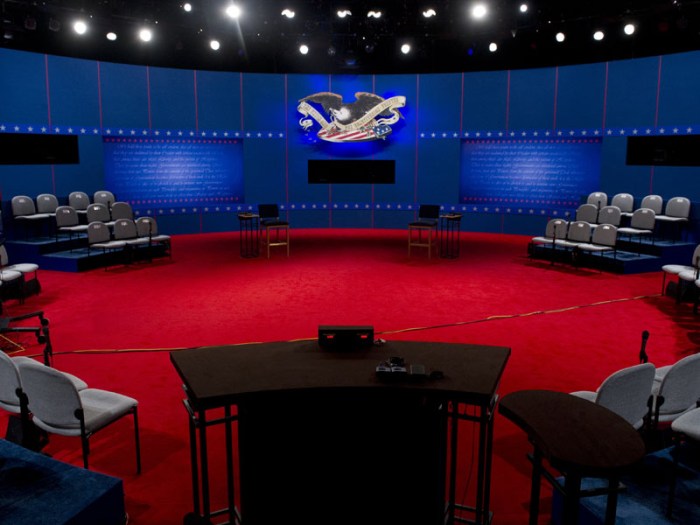
Image: US-VOTE-2012-DEBATE
This was the Town Hall set up when Mitt Romney faced off against Barack Obama in 2012 at Hofstra University – the venue of the first debate between Clinton and Trump

This year, however, with thanks to a civic group named the Open Debate Coalition, questions submitted via an online portal have been permitted. These questions have been whittled down to the thirty most popular and will feature in tonight’s debate marking the first time this variation has been used in the history of the Presidential debate. The task of meriting a question’s popularity falls to co-anchors CNN and ABC so expect a very slight left of field filter.

If we look at both candidates’ strengths in terms of how they react and respond to the environments they occupy, it becomes glaringly obvious that Clinton prefers smaller, more intimate settings – much like her husband (not in that way). Trump, on the other hand, thrives on addressing his dirigible, ire bloated, cadre in prodigious arenas and gargantuan sporting centres – reflecting his bumptious gestalt.

Trump’s gauche behaviour cannot now be un-coupled from his publicly enshrined lewd internal monologues that reaffirm his capricious, deleterious true nature. One can only guess how much practice that he has put into his latest debate strategy – if you can call it that. In light of recent events, the GOP are attempting to collectively pressure Trump. Many Republicans who had previously endorsed Trump have pulled their support. In Utah, for example, Governor Gary Herbert, and Rep. Jason Chaffetz have stated that they can no longer support their nominee, while others such as Sen. Mike Lee and Rep. Chris Stewart have called for Trump to drop out of the race altogether.
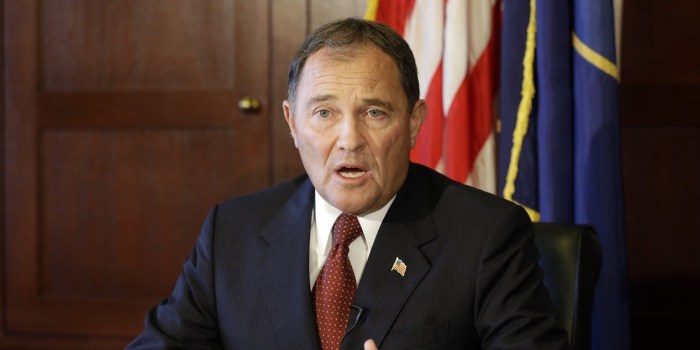
Gary Herbert
Utah Gov. Gary Herbert has pulled his support of Donald Trump this week amidst mounting GOP pressure following the nominee’s perverse audio leak from 2005

The derision within the GOP is absolutely anticipated. How many more times can Speaker of the House, Paul Ryan, appear before the cameras with the same hollowed out response to the party’s miscreant nominee? It’s a worn out scenario and clearly one that has left many Republicans notably frustrated.

Trump has responded by lambasting the party through his bully-pulpit, Twitter, and at the same time he has been praising his devout supporters who appear to be sticking by him no matter what.

The toxic rhetoric that has propagated the 2016 election thus far will once again come to a head this evening. While the debate may not be as substantive as many would like, one thing will be both incredibly interesting and entertaining: just how will Donald Trump engage with the average American citizen. If we return to the 1992 Presidential debate that featured incumbent George H. W. Bush, Bill Clinton, and Ross Perot, viewers witnessed a masterclass in how to relate to common concerns while appearing professional, intelligible, attentive, and dare I say it, presidential. Bush seemed uninterested and irritable at times, and Perot, well lets face it, he just seemed happy to be there. Check out Bill’s cool performance below.

While Hillary Clinton can appear robotic and cold, she has one quality that Trump doesn’t possess in his political arsenal, empathy (feigned or not, he is a terrible actor). Shane Ross, the current Minister of Transport once referred to Taoiseach Enda Kenny as a political corpse – if Trump doesn’t have a strong showing this evening, he is likely to be atrophied by the Republican Party.

Matthew O’Brien


Presidential Debate Tips For Trump & Clinton

Presidential Debate Tips For Trump & Clinton

On Monday, the 26th September, Clinton and Trump will engage in the first of three national televised presidential debates. Anyone who caught the back-and-forth between Trump and Jeb or Trump and Cruz or Trump and Rubio during the Republican primaries will understand just how pivotal these forums can be. Simple gaffes can destroy a candidate’s legitimacy. Poor phrasing can undermine a crucial point they want to convey. Even the wrong body language can result in severe repercussions. So what should Clinton and Trump take note of? We here at the Walrus thought it would be worth taking a trip down memory lane.

Kennedy vs. Nixon (1960)

This race heralded the first national televised debate, as the young and charismatic John F. Kennedy squared off against the raging jowls of Richard M. Nixon. Whilst many Americans, listening to the debate on their radios, felt that the Vice-President succeeded in offering a better vision for America, the television viewers felt differently. A wearisome, sick Nixon simply came off as less confident and able on the black-and-white screen. Kennedy, on the other hand, understood this medium in the way FDR understood how the radio could be used to communicate. He spoke clearly and held himself firmly- a man who was comfortable with nothing to hide.

Trump, of course, is no stranger to the televised medium and despite his outlandish hairdo, comes across as quite a unique and exciting figure to beheld. Hillary however, whilst experienced, often appears stiff and calculated, like she’s reading from a prompter.

Ford vs. Carter (1976)

Jerry Ford was one of the most affable presidents America ever had. He didn’t boast the sharpest of wits however, as evident in one of his and Carter’s national televised debates, when he stated that “there is no Soviet domination of Eastern Europe.” Carter wryly smiled whilst the stunned moderator, Max Frankel, responded, “I’m sorry. What?…” This performance only served to reflect and reaffirm the credibility of Chevy Chase’s SNL Ford; a bumbling, awkward man barely getting on by in the job. It may have been a just a little slip, but it cost Ford dearly in the media and public’s perception of him. Trump, in particular, should take note here. He may have gotten away with his random gesticulations in the primaries but Clinton, unlike most the GOP, is hawkish and ready to pounce on any little mis-step.

Carter vs. Reagan/ Mondale vs. Reagan (1980 and 1984)

Ronald Reagan was hardly the smartest of US presidents either but he was a great communicator. He had a way of brushing off criticism and making his opponents feel a bit overbearing. Against Carter, we saw this when he said “there you go again,” in response to a criticism the President made about Reagan’s stance on a past healthcare bill. Against Mondale, we saw this when he quipped “I will not make age an  an issue of this campaign. I am not going to exploit, for political purposes, my opponent’s youth and inexperience.” In that brilliant soundbite, he not only pushed aside any genuine concerns about his age, but also posed a good counterpoint and reinforced his likability as a humorous man. So if Hillary could crack a few more lines like “you heard none of this at the Republican convention and Trump went on for 70-odd minutes- and they were odd,” that would be just dandy. This kind of reflex is perfect for the Youtube generation.

Bush I vs. Clinton vs. Perot (1992)

Don’t look at your watch! The Commander-in-Chief George HW Bush made this fatal error in a three-way debate against Slick Willy and a more credulous billionaire than Trump. While Bush may have had pressing matters on his hands, this quick, likely subconscious act, reflected the media’s perception of him as a man both out-of-touch with/ not interested in the common man. Bill, in contrast, not only didn’t get distracted, he stood up and walked out from the center of the stage to make eye contact with the people asking questions. He is of course, in a league of his own, but it’s worth noting nonetheless that you must always respect the time given for these debates, even if they are repetitive and pointless.

Gore vs. Bush II (2000)

To borrow a term from W’s lexicon, Al Gore misunderestimated his opponent. Whilst the second Bush was clearly nowhere near as clever as the Vice-President, he did manage to come across to a great many people as a likable and relatable individual. Gore tried to pounce on his basic understanding of the issues with a multitude of condescending mannerisms. At one point, he walked over to Bush as if to confront him man-to-man on a question he felt he gave the better answer to. At another point, he loudly sighed. It’s not exactly fair but the public do like an underdog and in this case, they gave Bush II enough wriggle room for the contentious count-up that followed. In this year’s case, it may be tempting for Hillary to act this exact same way, but there is a line between humouring your base and offending the other. Reagan understood this; Gore didn’t.


And so Clinton and Trump should now be well prepared for September 26th if they have read this. Naturally we have only scratched the surface but it is clear from these cases that a winning personality and sharp wit does the job best. Hillary has the latter and to some- let’s call them progressively challenged people- Trump boasts the former. We may be given stiff, unintelligible, and ambiguous answers next week but one thing’s for sure, the entertainment factor will be huuuuuge. 


Why Bernie Didn’t Sell Out

Why Bernie Didn’t Sell Out

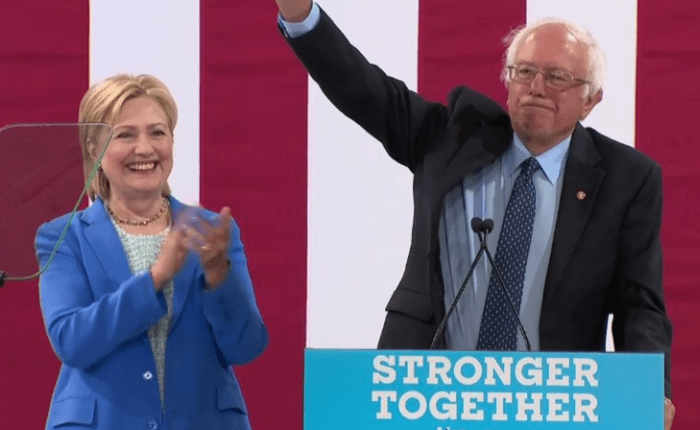
Last week marked the unofficial end of the rivalry between Hillary Rodham Clinton and that ever cantankerous Senator Sanders. In a speech delivered before the people of New Hampshire, who voted in his favour, he addressed the question of his movement’s future and where his loyalty lay. I watched this as it streamed live on Facebook, torn between the body language of the two figures at the podium and the incoming flood of knee-jerk reactions from half-wits and the odd informed. Many complimented this change in tone; it had after all been a long and arduous primary season. Others lamented however Bernie’s decision to stand by the Devil and surrender everything he had ever stood for. And that’s where we stop because (and I’ll put this plainly), Bernie didn’t sell out. Here’s why:

  1. He won on the issues- if you listened to Clinton’s speech, which directly followed Sanders’ endorsement, you will have noticed how clever SNL were with their skit on Clinton becoming more and more Sanders’ like (to the point where Kate McKinnon ended up with a bald cap). At first, I gave her the benefit of the doubt on the assumption that she just isn’t as conservative as the uber-liberals have suggested. When it came to Wall Street however and her bargaining plea to overturn Citizen’s United, it became clear that she was taking note of the issues that prevailed in the debates, brought about because of Sanders’ longstanding rhetoric. She delved into college fees and global warming too, which made for a nice combination, leading me to believe that she has moved far more to the left than even the most hawkish of critics could have guessed.
  2. It’s not just about the Presidency- Sanders’ movement and the rise of the Left cannot solely rely on an office tampered with more than ever. It needs to endure beyond one or two terms into a progressive model by which the future of the Democratic Party can be shaped. Yes, Hillary has, in many senses, won the battle but the future could be Sanders, so long as the issues on which he based his candidacy, continue to resonate. As mentioned above, I think they already have to the point that Hillary can’t afford to ignore them. As well as that however, he can also serve as a highly influential figure outside of the White House. Who, for example, had more of an effect on American culture in the 1960s than Martin Luther King? Has Jimmy Carter not accomplished some of his best work out of office? The presidency is a convenient altar, through which many channels, from foreign aid to educational reform, can be distributed but as Bill Clinton himself has noted, it’s also prey to circumstances beyond a president’s control (e.g. 9/11).
  3. Trump must be defeated- I’ll admit that this is not my favourite argument as I do not believe elections should be contested on the basis of fighting against, rather than for something. It is an important one though and whether it depresses you or not, voting for the lesser of two so-called evils is still worthwhile. Bernie’s candidacy, has gone as far it needs to, in my opinion. With the Democratic National Convention coming up, it has become clear that his issues and supporters will not simply be sidelined but incorporated into the party’s agenda for the coming years. For now, he needs to ensure, if his own visions are to be realised though, that this party does as well as it can come November. Otherwise, the country will head in the exact opposite direction with Trump.
  4. Listen to the speech again- Sanders didn’t have to necessarily endorse Clinton but it was the responsible thing to do; what purpose would their rivalry have served after all? Not enough to sway you? Listen to the speech again then and tell me where exactly he abandons the principles on which he built his campaign? Still not enough? Take a trip through his YouTube interviews and go back to a year ago when he expressed his admiration for Hillary Clinton whilst acknowledging their differences of opinions. Granted, the race heated up and nostrils flared during the primary season but the gulf in rhetoric that existed between their camps, was never as deep as many of Sanders’ less reasonable supporters suggested. He fought a good battle and we can only admire him for what he did but that battle is over now and at some point, you have to concede and look to the positives.

It’s undoubtedly sad to see Bernie leave the race; he shook things up and set the country’s vision towards a better tomorrow, in a manner we just couldn’t have expected over a year ago with the “inevitable” Clinton candidacy. His role however in this race will at least go down in the history books and his role to come will remain that of an inspiring spokesman for a disenfranchised generation.

The Age Of Protest Votes

The Age Of Protest Votes

The United States has something important to learn in the wake of Brexit; protest votes are not only petty, they’re extremely dangerous and stupid too. In this election year, we have been bombarded with multiple pieces on public frustration with establishment politics. As much as we are seeing an intelligent dialogue developing in this context however, we are also witnessing with a great many others, the collapse of a logical framework for debate. Too many people are now voting with knee jerk reactions; against rather than for something. The political game can’t be played like customer service though. Protest votes yield actual results.

imrs_wdp

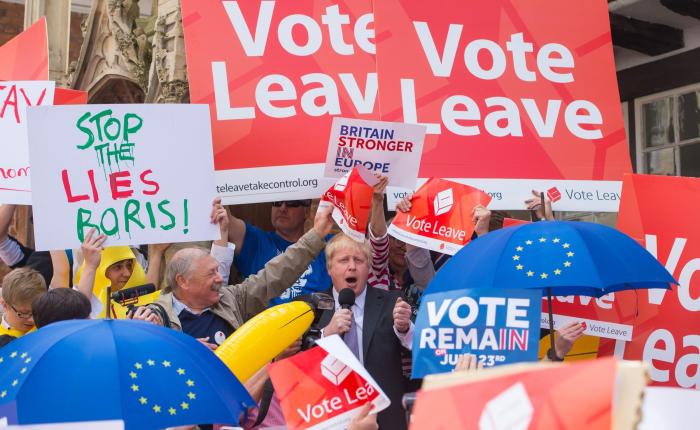
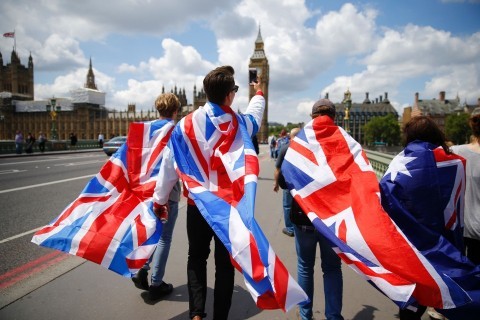
On June 23, the British people voted narrowly to leave the EU. Across social media and the web, the reaction was one of shock, even amongst many who voted in this favour. And then came “Bregret”- the pun on a word already being played with, as up to 7% Leave voters began to profess their vote was only cast in the belief that Britain would inevitably remain, or as some form of quasi-protest against some half-formed ideal they didn’t even understand. This became evident immediately in the wake of the votes, as top Google searches ranged from questions concerning what Britain’s role in the EU is to what indeed this “European Union” is. And we thought America was hogging all the stupidity this year…

The campaigns in Britain were of course controversial and already we are beginning to see how weak the structures on which Nigel Farage and Boris Johnson built their case were. Interestingly, national identity and immigration were key issues, especially amongst older voters who by large voted to leave the institution that had been irking them since 1973. The question has loomed for many years as to whether Great Britain is losing its Britishness. In America too, this question has come to the forefront with Trump’s campaign. Many of his voters, the so-called “silent majority,” white middle-class feel that they are not being catered for in the way they used to be. After all, look at how much hip hop music is on the radio these days. It’s threatening, quite frankly.

pho-english-bulldog-11-e1310185714112_zps6938df48
Holding onto their Britishness no matter what…


Political correctness is another factor, in tandem with this, which boils the blood of many. Where actual issues arise with immigration, many liberals disavow the very notion of discussion on this area with labels of bigotry being thrown around at the clinking of a tea-cup. Trump, for all his bullishness and disregard, comes across as genuine and honest, in contrast to the political suits of past times. When he speaks about Mexicans, he’s speaking from the heart. Granted, that’s not a heart I’m sure exists, but he’s speaking from whatever’s there nonetheless. People appreciate this. They want a politician who speaks like your drunken grandfather on a night out. So when people complain about how they’re losing their political identity, it’s not a far stretch to attribute it to many of the left-leaning commentators who put a binding on the language book many years ago.

trump-face-american-flag.png

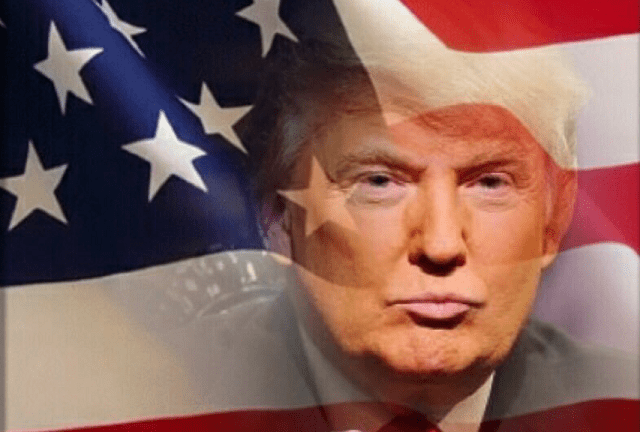
Whilst I am clearly not a fan of political correctness, I do appreciate where people are coming from. There are problems with the EU and America. There are problems with immigration. National identity and culture should be appreciated. With all these cases however, common sense must then prevail however. For example, you may not have agreed with David Cameron on many domestic or foreign issues, but his Remain stance, was no just cause for joining the anti-establishment. You may feel America is being pushed around with immigration, but does this justify the extremist measures of a man whose policy is based on a Wikipedia entry? Establishment politics can prove frustrating but overhaul and revolutions are only required where all other means are exhausted. Trump may appear to many the underdog saviour who will restore American prestige at rallies, but sit down again and read the transcript of what he says, then think. If the Google searches come November concern the costs of a border wall, then standardised testing should be needed to secure the right to vote.

Andrew Carolan

A Divided Left?

A Divided Left?

As Philadelphia prepares to host throngs of Democratic Party delegates for the upcoming Democratic National Convention next month, authorities are gearing up for the inevitable ‘Bernie or Bust’ protestors. This wildly loyal cadre of Sanders’ supporters, most of whom are Independents young and old, are eager to voice their displeasure with the internal processes of the Democratic Party, and their vehement dissatisfaction with the manner in which this primary season has been managed.

Yet, there is always a hope and purpose that through the carnival-esque mechanisms of the convention process, the nominee will emerge and successfully unite the party behind their banner. This incredibly tough challenge falls not only to the presumptive nominee, Hilary Clinton, but also to the yolk of the Democratic Party and those pious super delegates. However, the outcome of disunity and a growing chasm of indifference is often the result. Will it be the same this time?

635803756227070512EPAUSAELECTIONSDEMOCRATICDEBATE
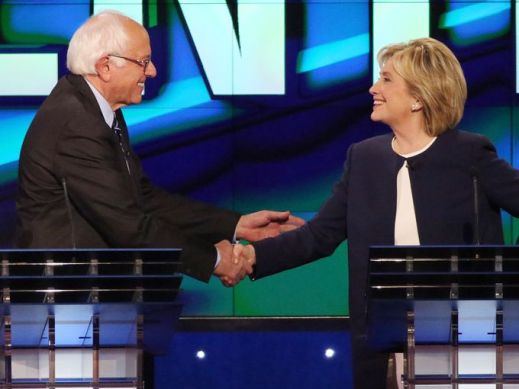
Sanders said that he will vote for Clinton in November to stop Trump

In short, no! Yesterday, Bernie Sanders stated that he will vote for Hilary Clinton in November in order to stop the meretricious master of tautology, Trump. Though Sanders’ concession to Clinton is long overdue, one cannot help but get the feeling that the political revolution at the foundation of his incredibly successful campaign will endure in some form.

For Sanders and his millions of dedicated supporters who continue to feel the ‘Bern,’ a revision (and in some cases overhaul) of Democratic electoral processes and procedures is desideratum. Following a meeting of the two Democratic primary candidates this week in Washington DC, the task fell to Hilary Clinton to placate the Sanders’ campaign in the interest of uniting the party and securing a larger voter base this coming Autumn. Both campaigns issued similar statements in the wake of the meeting saying that the candidates and their aids spoke constructively about beating their opponent and ‘progressive ideas.’

 It is no surprise that the Vermont senator has called for the ousting of leadership from the convention committee all the way to the upper echelons of the party. He has been especially critical of DNC Chair, Debbie Wasserman Schultz. The Floridian Representative, Schultz, was this week replaced by Brandon Davies – a Clinton surrogate. This move likely came as a conciliatory tactic by camp Clinton following comments made by Sanders’ campaign manager, Jeff Weaver, on MSNBC. These overtures were clearly an attempt to placate Sanders’ stoic efforts. Caveat Emptor!

Supporters hold signs and cheer as U.S. Democratic presidential candidate Sanders speaks during a campaign rally at Cornell College in Mount Vernon, Iowa
Hordes of Sanders’ supporters hungry for political revolution and reform

In a Washington Post article that Sanders composed this past Thursday, the obstinate senator laid out his 95 theses that, should we be living in the 1500s, he would nail to the doors of both the Wells Fargo Center and the Pennsylvania Convention Center. Sanders consistently and emotively repeats the question, ‘what do we want?’ at the beginning of each new point – appealing to the union and solidarity of his support base. Scansion aside, there is nothing new from Bernie here, yet he makes some incredibly salient points about the flawed criminal justice system and climate change.

If Bernie Sanders can auspiciously carry his brand of revolutionary politics to the convention floor and begin a comprehensive dialogue in a public forum the mollification process may continue. Among the alterations that the senator is lobbying for is the abolition of closed primaries, automatic voter registration, and the monitoring of voting machine software.

Sanders needs to show the Democratic Party that he still holds some of the chips, but will have to temper his approach if he is to garner any substantive gains. On the flip side, Clinton and the Democratic establishment know that the Sanders’ promissory note is a valuable asset and have slowly come around to his $15 an hour minimum wage, ban on fracking, and Wall Street reform. Though, according to a Bloomberg poll published on Wednesday, only 55 percent of Sanders’ supporters said that they would vote for Clinton – proving that the ball is now firmly in the establishment’s court.

Ixq79cw
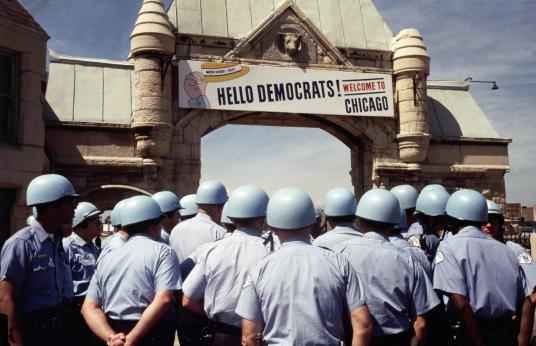
The National Guard were heavily utilised at the DNC in Chicago, 1968

For Democrats, the malaise of the 1968 DNC held in Chicago haunts the party to this very day, as it became a lacerating event that distilled a year of heartbreak, assassinations, riots and a breakdown in law and order. For many American’s, it symbolised the fragility and chaos of the nation. The present environment is equally as delicate and anarchic loaded with pernicious potential. While the issue of unity within the Democratic camp is tenuous, it’s not nearly as tensile as the threads holding the Republican Party together.

Matthew O’Brien

Who Will Be The Donald’s VP?

Who Will Be The Donald’s VP?

Since he announced his candidacy one year ago, Donald Trump has been drawing consistent headlines for his outlandish remarks, wildfire debate performances, and of course, the odd lapse in logic. It seems by this point that there is no way he can truly surprise us but just like Game of Thrones, he manages to reel you in every week to see if that threat beyond the wall is indeed serious or just a way to waste some time. And guess what? We are only a month and a half off from the Republican National Convention in Cleveland, Ohio where he’ll presumably hold his hand up with another’s and bark sentiments of making America great again. So who’s hand will it be? Will it be a hook?

First, let’s consider the factors that go into choosing a running mate. In 1960, JFK chose LBJ to compensate for his lack of support in the South. Obama got Biden on board so that he could add experience to his cabinet’s credentials. Similar concerns will no doubt be dogging the otherwise muddled minds of Trump’s camp. As it is, he’s doing well across the country with many speculative polls tying him with Clinton but women and Hispanics aren’t flocking to his side. Having some insiders would also be a good measure as his business acumen will not compensate for political naivety. So without further ado, let’s take a look at a cluster of depressing possibilities.

Chris Christie

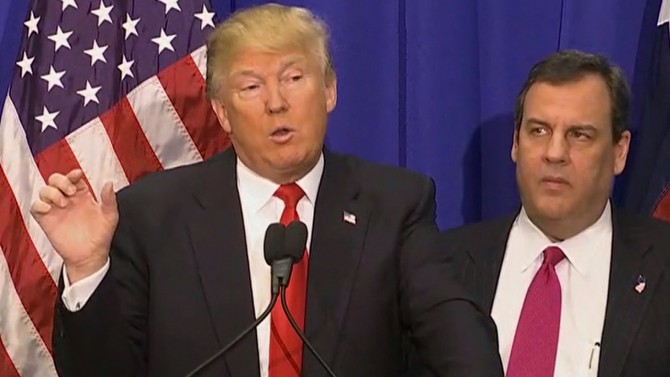
The New Jersey governor was one of the first Republican candidates to sell his soul to the Devil. We all remember that moment in March when he stood behind the Donald at a rally, conveying all the confidence of a Cosby apologist. Despite this, his loyalty has been noted by the Republican candidate in several interviews.

14940

Newt Gingrich

You may remember him as the crazed Speaker of the House from the mid 1990s but did you know Newt attempted a Presidential bid in 2012? He has ambitions still. As a stalwart of the GOP, Gingrich could help Trump solidify the party’s base, although that may not prove an issue considering how easy it’s been for him already in building that momentum.

Ben Carson

The former neurosurgeon and bat-shit crazy candidate was at one point last year, the gravest threat to Donald’s victory. He’s another person Trump has said he “respects” and his help could sway those easily fooled by the race card. And in terms of image too, he projects a level of calmness lacking from the frothing jowls of Trump.

Sarah Palin

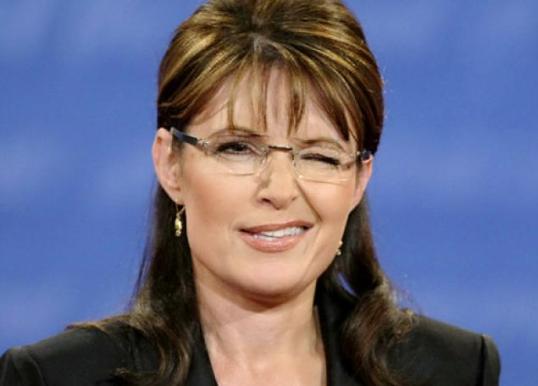
It was the death nail for McCain eight years ago but it says a lot about America that the wacky Sarah Palin still has a part to play in the party that pretty much disowned her a couple years ago. Some folk have speculated that Trump has just given up courting the female vote but if he has a woman as his running mate, he can’t be sexist, right? Sneaky stuff, Don but this would definitely be the worst bet.

palin-wink

Joni Ernst

Another female Republican but one who has been critical of Trump’s sexist comments, many feel Ernst could be the perfect counterweight to Trump. She’s an able communicator and can help Trump with the Midwestern vote. She’s a bit less colourful of course than the others though which may not go down well with the man who paints himself orange.

Ted Cruz

Cruz’ exit surprised me somewhat considering the fact that he himself had chosen a running mate in Carly Fiorina just before. Trump has repeatedly called Cruz a slime-ball and launched personal attacks, even against his wife. The senator’s exit may have been a calculated move for a greater cause however. This would seem a hypocritical move but many pundits are nonetheless intrigued as Cruz has a large following. After all, they don’t have to like each other (JFK and LBJ certainly didn’t).

A Member of his Family

This seems like a ridiculous prospect but not an unpopular one. Ivanka, in particular, seems to be drawing a lot of attention. They’ve had gainful employment in his business ventures so clearly he has no qualms with nepotism.

A Mountain Bear?

Why not? It’s not as if making sense is high on Trump’s agenda. The mountain bear, or any bear in fact, would sure up the support of those who enjoyed either this year’s The Revenant or The Jungle Book. They also convey a level of toughness that even Putin would flinch at.

il_340x270_918133908_l2qy

Nothing is of course yet finalised though we expect to hear an announcement in the coming weeks as Donald continues to rail assaults against Hillary and that wild husband of hers. Whoever he picks, it can be assured that there will be a lot of “winning.”


A Contested Republican National Convention in 2016?

A Contested Republican National Convention in 2016?

It is often said that history repeats itself, and like so many platitudes, this is true most of the time. Yet, while fundamental historical tenets and axioms that govern the discipline rarely change, the context and players certainly do. Let’s apply this to the present situation that is currently facing the Republican Party in the United States and the distinct possibility of a contested Republican National Convention this summer.

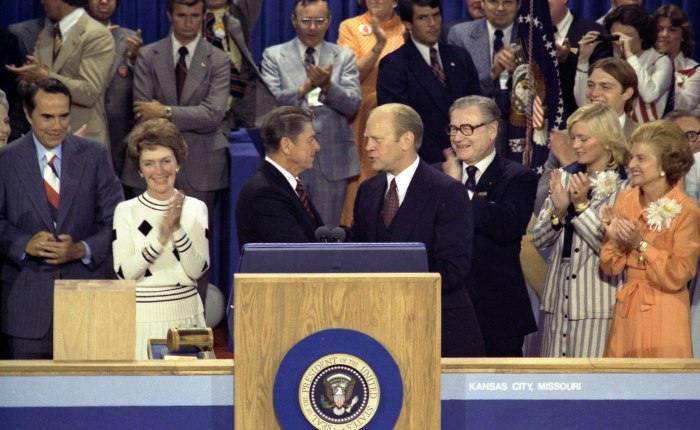
The last contested convention took place in August of 1976 and pitted B-star Hollywood actor Ronald Reagan against the establishment curry favourer and incumbent, Gerald Ford. This was the first contested convention since the brokered Democratic National Convention of 1952 in which there were 6 hopefuls vying for the nominations. The 1976 card however had just two Republican runners.

As the convention got under way at Kemper Arena in Kansas City, Missouri, Ford had amassed a greater number of primary delegates than Reagan, coupled with a plurality in popular vote. This was not enough however to get him to the magic number of pledged delegates needed to secure the nomination. As the convention kicked off in the Show-Me State, Ford and Reagan went on the charm offensive.

The President was able to use his executive prerogative to lure straggling delegates to his side by offering luxuries such as: exclusive flights aboard Air Force One, gourmet dinners in the White House (that were accompanied by wanton firework displays), or executive “favours,” the cornerstone of political leverage, longevity, and legacy.

Among the many bulwarks that Reagan’s managers tried to construct in an attempt to stymie Ford’s lead, was the pursuit of Rule 16-C, which stipulated that convention rules would be changed to require any presidential candidate to name his vice-presidential choice prior to mass ballot. This backfired though when Reagan shocked the nation with liberal Senator, Richard Schweiker of Pennsylvania.

Schweiker was rated 89 percent by the liberal Americans for Democratic Action, and 47 percent by the American Conservative Union, making him an unattractive choice. The risk taken by Reagan’s staff was injurious to his ambition and the vote on Rule 16-C wasn’t passed. President Ford managed to garner the necessary momentum to rubber-stamp his name on the ballot securing 1187 votes to Reagan’s 1070.

Interestingly, Reagan was viewed as an outsider to the Republican establishment, and was disparaged by many within the party elite – akin to Trump, though lacking the profound animus that Trump garners. Reagan left an indelible mark on the 1976 convention with his humble, extemporaneous closing stump speech that was a clarion call for unity within the party in preparation for the general election. It was at this moment when the charged Republican congregation witnessed the content of the former Californian Governor’s character – there was no equivocation, he would return.

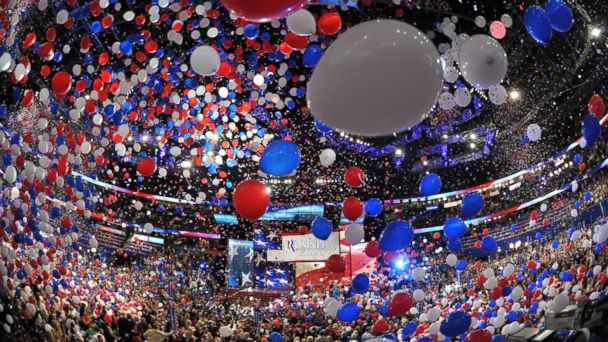
GTY_rnc_2012_jtm_140402_16x9_608
The Republican National Convention showcasing it’s pageantry in 2012

Many commentators have, in recent weeks, teased out the potential for a contested Republican convention this summer. In fact, it has become a highly popularised suggestion as a method of stopping the rogue Trump machine that seems to be getting more vitriolic and abhorrent by the day.

The last two weeks have been telling with Trump’s loyal troops marching on, propagating his language of hate and raw xenophobia. It is the results over the next few weeks which will contribute towards a degree of certitude on whether the convention will be a formality, or a tilt-a-whirl of political jockeying. This process can be obfuscating and frustrating to unravel and navigate. The confusion that perforates the aura of the process is muddied further by the semantics of the RNC Rulebook. Indeed, some of the rules referenced through the document are contradictory.

To parse the current situation: Trump has 741 delegates, Cruz has 461, and Kasich trails with 145. If Trump can sustain the momentum throughout the duration of the primaries, he may very well hit the desired 1237 delegate count. Traditionally, if this were the case, Trump would secure the Republican presidential nomination following the first count at this year’s RNC much to the party’s chagrin. Though, it is still unclear whether he can do this. The 2016 election cycle has been unprecedented for many reasons, and it seems set to continue in a carnival style of discourse.

While Donald Trump says that he is confident of securing the nomination after the first count, he has suggested that if this doesn’t happen and a contested convention takes place, there will be rioting in Cleveland – an ominous, but predictable portend from the demagogue. It appears that the establishment wing of the Republican Party, through a series of machinations, are doing all they can to downplay the electability of the billionaire bigot.

Curly Haugland, a member of the RNC Rules Committee, stated this past week in an interview with CNBC that the power is in the hands of the delegates, not the voters. He added, “The political parties choose their nominees, not the general public, contrary to popular belief.” Is this a clumsy warning shot of animosity across Trump’s golden bow? It looks that way. This bumbling anti-democratic statement is corroborated by the RNC rulebook, which whimsically states that:

“BE IT FURTHER RESOLVED, That the following be and hereby are adopted as The Rules of the Republican Party, composed of the rules for the election and government of the Republican National Committee until the next national convention…”

As these rules were adopted before the 2016 election cycle, technically like-minded Republican’s could possibly interpret the phrase, “until the next convention,” to suit their agenda by altering the rules to block Trump’s path to the nomination.

Looking at this from the other candidates’ perspectives, Ted Cruz remains confident that he will showcase a strong performance in the remaining primaries reiterating on Monday to CNN’s Wolf Blitzer that his was the only campaign to have bested Trump on a number of occasions. Meanwhile, John Kasich remains steadfast in the face of adversity. He reinforced this stance on CNN’s State of Union exclaiming that he is confident in his electability and that he expects the delegates to act seriously and select the right man for the job when the time comes.

Reince Priebus
Reince Priebus could be facing a very divided RNC this coming summer

Chairman of the RNC, Reince Priebus, commented that the Republicans are “preparing for the possibility” of a convention in Cleveland. Meanwhile Paul Ryan, Speaker of the House of Representatives, has downplayed the possibility of a 2016 run for the White House if a contested convention is called. That being said, he has not openly denied this media speculated, Twitter trending, notion. Ryan’s predecessor, John Boehner endorsed the current speaker for GOP nominee this past week, though he added further that his comments were off the cuff – good save!

One thing is for sure, the phantasmagoria that is this 2016 Republican primary race is set to get even more nebulous as the convention approaches. It has become apparent that the protectorate of the GOP kernel has realised that Ted Cruz, a man who is not entirely representative of their values, is the lesser of two evils when stacked against Trump. Frankly, the marshaling of ‘establishment’ politicians, Mitt Romney, and now Jeb Bush, may have come too late.

Just like Ford in 1976, the importance of a united front is desiderata in order to mount a successful campaign against either Hilary Clinton or Bernie Sanders in the autumn. Should Trump be denied the glory in Cleveland, expect rapture. The Republican loyalists have only themselves to blame.

Matthew O’Brien