A Bridge Collapsed: The Biden Presidency

A Bridge Collapsed: The Biden Presidency

Had President Biden made the decision to withdraw from the 2024 race earlier, we might’ve been writing a much different story. Alas, his refusal to do so (in conjunction with his initial proposal that his presidency would mark a “bridge”- like transition to a new generation) will likely be the first thing people recount when asked about his legacy. As it stands, this legacy looks on the grim side of things; at least, according to a Gallup poll which showed 54% of Americans viewed him as a “below average” or “poor” leader. But… history has a way of changing perspectives and so in complete folly, we’re going to (already) try and take the longview in assessing this administration.

Well, it’s a bridge of some kind, albeit between two terms of Donald Trump. So assuming the historians hold true on their negative assessment of Trump’s tenure, they’re not going to be too pleased with Biden for enabling his comeback. Granted, a lot of that blame can be placed at the feet of top Democrat party heads too but the story of a fractured party, torn by generational and cultural values, doesn’t exactly help Biden’s case. Had a more effective coalition been built, there might’ve been proper competition for the MAGA crowd. Instead, this party floundered and yielded way for the return of a stronger Trump backing. 

Granted, some of this was beyond Biden or Trump’s control. The chaos of the pandemic, for instance, was always going to have severe economic repercussions and this came in the shape of a massive 9% inflation rate in 2022. Like Jimmy Carter or any other unfortunate president before him, Biden simply had to take the hand he was dealt. To his credit, he passed sweeping legislation such as the Inflation Reduction Act to tackle this but since prices never went down, the average person was unable to see the benefits of such actions. In actuality, the economy has improved, with record-low employment and a record amount of applications for new businesses. In the next couple of years, Trump will undoubtedly take credit for the changes in fortune as they manifest more clearly. Unfortunately, sound economic policies just can’t be waved as a flag until everyone has else got theirs.

For that matter, the major achievements of the Biden presidency, such as the CHIPS act, his supports of unions, and infrastructure bill seem to pale against the half-glass empty analyses, i.e. the revelation that there are still some ways to go. This will always be true with regards any measures taken by a sitting president (who can only face tough decisions). For example, while the “Plan B” proposals of his student-loan forgiveness scheme were withdrawn, he still managed to achieve $180 billion in loan forgiveness. 

And then there is foreign policy, where there are domestic differences to contend with. Given another era, there probably would’ve been a consensus in the US against Russia. In the 2020s however, there’s even a faction of Republicans who favour their former adversaries over the Democrats, complicating the funds appropriated for Ukraine’s defence. Biden has been steadfast in his support of NATO and a strong ally of Zelensky, but as Trump prepares to take office again, a question mark lingers over how this will resolve. With the Palestine-Israel war then, we have seen divided opinions in the US on an ethnic and generational level. This has marked a shift away from the broad support Israel was once guaranteed there, with critics of Biden’s (and continued US foreign policy) arguing he’s helped facilitate war crimes in the Gaza Strip, failing to ever hold Prime Minister Netanyahu’s government to account. Should the very recent ceasefire hold, Biden might be looked on with some deference eventually, though it’ll be eternally countered with questions of why he couldn’t have pushed for peace sooner. This will also likely go down as the most contentious foreign policy decision of any president since George W Bush. We’re also going to have to contend with speculation on whether the incoming Trump administration was a greater factor in allowing this to pass.

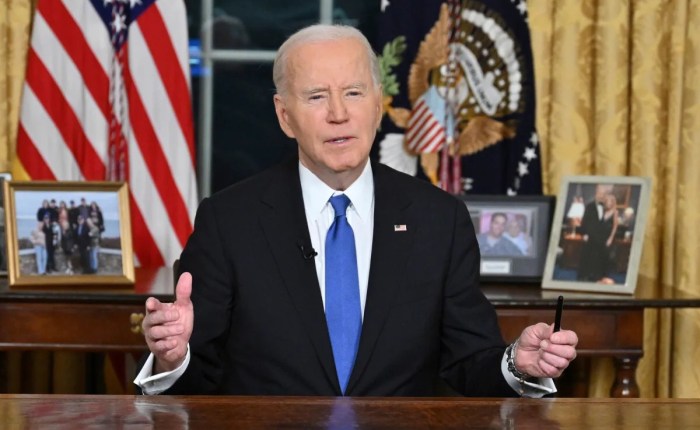
Whichever way you look at the Biden presidency, Donald Trump seems to hover over it at every turn. The return to “normalcy” or the goal of “restoring the soul of the nation” has either fallen flat or been dismissed as liberal hogwash. Trump has, in a sense, been legitimised this time around; by virtue of winning the popular vote and the Democrats’ own flawed power dynamics leading to their own downfall. And despite a relatively decent farewell address, one can’t help but roll their eyes when Biden warns against the abuse of power, weeks after pardoning his own son (who apparently was above the law). The problem remains that the top Democratic Party members appear too elitist, slow, and out of touch with the people. And for much of Biden’s term, that image was capitalised on, with every stutter and pause exemplified to the Republicans’ benefit. As it stands, the Democrats are weakened and down on their luck. Of course, they’ve been handed major defeats in the past and come back before but it’ll take a proper chance to mobilise their base next time; a new generation with some authenticity. If one thing can be learned from these last few years, whether with the election or Biden’s cognitive decline, it is that you can’t pull the wool over the people’s eyes forever.
One Year Out… Does Biden Still Look Good?

One Year Out… Does Biden Still Look Good?

To answer quite literally; yes, I think Joe Biden looks dashing for a man pushing 81… But the ellipsis begs the further question of how he will look when he’s 82- which he would be upon commencing his 2nd term in January 2025. Well…

Running the country is different from running for the presidency. If we were to chalk this up to the record, Biden would look quite good (at least with Democrats). He’s gotten the US out of Afghanistan, lowered drug costs, made a start on cancelling student debt, and passed an inflation-reduction act, to name a few things. But… those measures simply aren’t painting the larger picture, which is that of an old man struggling to load up a restaurant’s QR-code menu on his phone (I know, frustrating for all). He’s old news. Past it. Out to pasture. Bamboozled by the times. Pork chops for dinner. Why, he’s even older than the president who was elected 31 years ago. The man’s ancient. Now, wisdom is acquired and in theory, having an older leader is no bad thing. But at some point, perception trumps (sorry) reality and if the latest polls are anything to go by (39% approval; Trump supposedly leading in 5/6 swing states), Biden’s not looking like a promising prospect anymore.

Biden’s detractors and supporters both fear he will struggle in the debates. While he held his own reasonably well against Trump last time, he may struggle in 10 months. Trump’s only several years younger but he just doesn’t wear his age the same way. It’s like his ego has sustained him with an unnatural propensity for spewing entertaining nonsense. Sure, Biden can fact-check him but I’m inclined to agree with Dave Chapelle’s analysis that Trump comes across as an “honest liar”. He may not know what he’s talking about but he’s not playing to the weary cringe-inducing politic-speak Biden or Hillary indulge in. Plus, last time Trump was running, the pandemic was hampering his support. This time around, virtually nobody will care about that and Biden will have four years of political baggage to account for. Basically, he’ll be playing defence this time around. 

And the defence will likely be centred around his son; Hunter Biden. That’s a whole other kettle of fish but again, since perception trumps reality, and the Republicans have been beating this drum for years now, it’ll be tough for Biden to avoid this. Perhaps too, it stings his supporters to admit that this was newsworthy, even if slight against the plethora of lawsuits dogging Trump. To the vaguely uninformed, the messaged received is: there’s some dodgy stuff with Biden, some dodgy stuff with Trump, it’s a wash; we’re all in the swamp. And thanks to the preposterous level of subjectivity in news media today, it’s hard to put things back in perspective.

Outside of all this conjecture however, two issues may affect Biden’s rating in the next 12 months; foreign policy and inflation. Typically, the former doesn’t have as much of an impact on the average voter but foreign aid and support directed towards Ukraine and Israel may weigh something. Republicans have opposed Biden’s allocation of “too much in funds” for Ukraine while support amongst Democrats for Israel has decreased somewhat. Since these are contentious matters (also worthy of a lot more exploration), I won’t dig in deeper (or cast judgement), other than to say there is a tangible level of resentment directed at the government for taking this capital from home. This leads us to inflation.

Inflation actually peaked in June of last year at 9% and is now 3.7%, but in day-to-day life, prices are still rising on the likes of personal care products, groceries, restaurants, rent, and more. It’s also speculated that it won’t keel out until 2025, which will prove a major factor in the election. Even though it’s not totally in Biden’s control, the “buck ends” at the Oval Office (as foolishly accounted for by Harry Truman). While statistically wages are up and unemployment is down, inflation will make the largest impression on Biden. It takes time for the appropriate measures to lead to results; for example, the economy was on the mend in 1992 but hadn’t yet shown, affecting Bush Sr’s campaign. As with the “controversy everywhere” analysis aforementioned, it’s hard for people to know where to direct their anger but the Republicans will beat this drum as the Democrats play defence.

So, as Biden languishes in the polls, with the possibility of the Dark Lord’s return, many have suggested it might be time for someone else to step in and run in his place. This seems unlikely at this point but not without precedence. In March 1968, Lyndon Johnson announced he would not seek re-election, mostly owing to his lack of favourability with the Vietnam War. His VP, Hubert Humphries, went on to lose to Nixon later that year, though one of history’s great “what ifs” remains in if Robert Kennedy hadn’t been assassinated that summer. And you know what, we have Robert Kennedy’s son running as an independent this year, so a Trump v. RFK Jr v. Kamala Harris ticket could materialise. Maybe another Republican could clinch the nomination, especially if one of those lawsuits leads to something with Trump. Maybe Kamala somehow gets popular? Well, there’s a long stretch ahead still but as it stands, it looks to be a rematch in November 2024 and that’s… terrifying.

Do The People Want An Interventionist America?

Do The People Want An Interventionist America?

President Joe Biden has issued some major economic sanctions against Russia in the midst of the ongoing invasion of Ukraine. These measures have largely been supported by the public, both in America and across the world, as strong displays of condemnation, without taking the next dire step. The question arises everyday then: will such a step be taken? If we consider the trajectory of America’s recent interventionist past, I would say it’s unlikely. (Of course, such postulation may be emboldening Putin so there’s a caveat to consider there.)

Anyways, to take the first view, let’s look back at Syria in 2013. Obama was concerned that if the US didn’t intervene, it would undercut the severity of chemical weapons’ usage there. Rather than go in all-guns blazing like his predecessor had with Iraq though, he instead went to the Capitol to seek approval. It was determined America wouldn’t intervene. Years later, a divide remains over whether they should have with a Guardian piece in 2018 entitled “The Epic Failure Of Our Age: How The West Let Down Syria”. I mention this, not to weigh in on any specific view, but to show that it’s not always clear-cut when, where, and why America should intervene.

Had Syria’s crisis come ten or twenty years before, America may very well have sought a different approach. As it happened, George W. Bush had led the nation into two costly wars in 2002-3 with Afghanistan and Iraq. We know all about how those went but it’s interesting to consider that at the beginning, support for the Afghanistan War was close to unanimous (90% according to Gallup). Iraq wasn’t ever quite as popular but it got a whole lot less so in the following years. But what if it hadn’t gone so wrong? Yes, I understand and completely agree that the invasion of Iraq was wrong from the get-go but in the eyes of the American public, what if there had been less casualties and more success associated with it? Like with the Gulf War a decade before?

George H.W. Bush sent the military in to liberate Kuwait from an Iraqi invasion. It was a quick, bold, and decisive victory that skyrocketed his approval ratings to 90%. The mission was complete but a lot of his supporters felt he should have gone further (into Iraq) and removed the problem of Saddam Hussein there and then. He declined, though years later (under the auspices of the War on Terror), his son determined America could not hold its head high while Saddam continued to violate international laws (and maybe have nuclear weapons???) Perhaps, an invasion in the early 90s would have gone just as poorly, even with the senior Bush proving a formidable foreign policy strategist. Indeed, his interventions in Panama and Somalia (while contested and dubious to many) were well planned out and successful. Well…

With regards Somalia (which began just after Bush had lost election), the people were initially thankful for his swift intervention. His record would then turn out positively when Bill Clinton took over and Somalia descended into chaos (with Black Hawk Down and more). Bush didn’t have to deal with the eventualities such interventions can bring, where Clinton was faced with an uphill battle he hadn’t even sought. The rest of his presidency would be tested on the question of when American intervention should and shouldn’t occur with critics (and himself, later on) citing a late entry to Rwanda and Bosnia as unfortunate, if not shameful, chapters in history.

In 1996, Eric Carson wrote a piece for the Rand Organisation entitled “Public Support For US Military Operations” exploring the factors that restrained presidents, in this sphere. Having come out of the Cold War just a few years ago, America had entered a “more confusing world” where the objective wasn’t always clear as had been with something like World War 2 (where people acknowledged the gravity of the situation). Further to that, political divisions or disagreements were having a knock-on effect on public perception. To bring this back to the present, we can see the potential of this political divide crinkling American support for a “next step” as many Republicans weren’t long ago flaunting a “rather be Russian than Democrat” motto.

Public support is essential when a president has a paper-thin political majority or faces contentions. This is another reason why I feel a strong intervention from the US is less likely today than it was years ago. After 9/11, George W. Bush had the nation’s support, even if he would quickly squander it. Back in World War 2, Franklin D. Roosevelt was a president in his third term. Even though Truman’s reputation would for years be bashed by the Korean War, there was still general support for a policy of Communist Containment.

Vietnam, the follow-up to Korea, truly took on its perception as an abject failure when the public started seeing what was going on through the medium of television. With public marches and demonstrations, bolstered by the counter-cultural movement, a new picture of American interventionism and soldiers themselves (quite harshly) was ingrained in the public’s psyche. What if Vietnam had happened ten years before, however? Well, as already mentioned, Korea was a contentious affair, though the South remained free of Russian influence but it is reasonable to assert it wouldn’t have been as unpopular or ended in quite the fashion it had, heavily influencing an election cycle.

Is it bleak to conclude that Americans will support American intervention then only if success is assured? It seems to be the case though such luxuries are never realistically afforded them. Popular support, as a result of today’s media, rancour in politics, and recent dubious interventions, has become nigh-on impossible. The best a president can do, in this age, is justify the chances of success should an intervention occur, answer how the nation is a threat to US interest, exert all means of diplomacy, and run the usual course of air strikes. Though as much as history has taught us how any conflict resolves in the public’s imagination, it is also worth remembering how easily people forget history. In a 2019, YouGov poll, the people were vary much split on whether the Gulf War was justified, for example. So as an addendum, one must note that we can’t even assume a clear or factual basis for public perception when such crises arise.